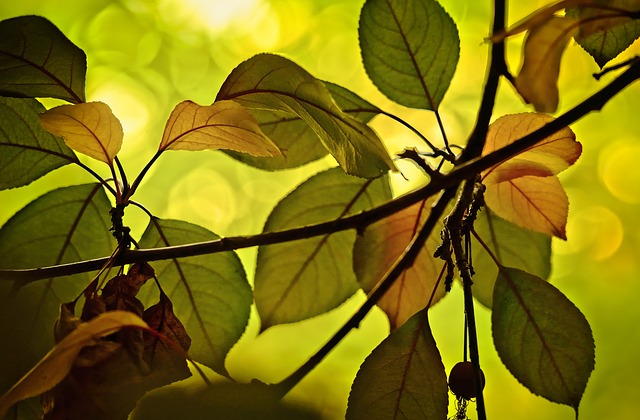
Last year, I managed to get 1.5 kilogrammes of fruit from our John Downie crabapple tree, and made one jar of crabapple jelly from it. It looked like molten rubies and tasted sharp and sweet together. I said then that I would make sure of gathering the fruit from that tree earlier next year, of making a proper batch of crabapple jelly and having some to give to friends.
Roll around, September, and there’s me tottering at the top of a stepladder to collect the crabapples before they fall and rot. I picked all the fruit from the lowest branches, shook the tree, shook individual branches with a boathook and leaned ladders everywhere I could get them to lean. Today I have washed the fruit, cut it in half and dropped it into a jam pan. And a stock pot. Because this year I have nearly 15 kilogrammes of crabapples. I have one muslin bag of boiled fruit hanging up right now, dripping juice into a pan ready for the next stage tomorrow. Plus all the fruit that I couldn’t fit into the large pan, sitting in the next size pan down ready to be boiled up and bagged up.
It’s a long process, and it’s probably cheaper to buy a jar of crabapple jelly from Sainsbury’s – maybe even from Waitrose – than spending my time and electricity boiling the fruit, boiling the juice, sterilising the jars. But what you cannot buy is the impact of handing a jar of your own jam or jelly to friends (sometimes, a jar still warm from the cooking) as a gift. Especially if the fruit is from your own trees and can’t be bought anywhere. Our quince trees are sulking this year, but the John Downie is taking up the slack.
Any jelly needs you to be patient, and to not squeeze the bag to get the last fluid ounce of juice – if you do, you’ll have maybe an extra spoonful of jelly and a murky haze to the end product, Better to let it drip to its own pace and have a jar of jelly that lets the light shine through it like light through a pane of a stained glass window. Dark red for blackcurrant or blackberry and apple; rose red for crabapple; bonfire orange for quince. Hold them up to the light as you pass them to friends for extra effect. No money on earth can buy that.
Tonight I will be boiling the last few kilos of crabapples and leaving them to drip overnight. Tomorrow I will be measuring how much juice I have – maybe two pints, much less than I thought – and boiling it up with sugar to make the jelly. Pouring it into sterilised jars. Screwing on the tops (hot tops, hot jars, even thick gloves doesn’t keep it from burning your palms). Then waiting to hear the Pop. The jar lids have those inbuilt buttons you find on commercial jam jar lids, and if you’ve ever wondered how they make them suck down so that they pop up if they haven’t been interfered with? The lids screwed down on a volume of very hot air over the surface of very hot jelly are screwed to airtight – then the jelly and the air above it cools and contracts, and the flexible section in the centre of the lid is sucked down by the vacuum. It pops back up when the lid is taken off for the first time. My mother-in-law was impressed that we’d managed to trick the jar lids, and didn’t listen to the explanation.
Tonight, I’m trying to mend a not-so-brilliant story for the Globe Soup competition. They give a theme and a genre and a word limit, and you have seven days to send it in. I got chick lit. That’s like asking Barbara Cartland to write cyber-punk. I admit I’m struggling, but it’s a great exercise. Makes me think about what a typical reader of the genre would expect to read, and how to make a good story for that reader. It’s good practice for writing for my own chosen genres, making a story that keeps the reader going. If you can write a story that keeps a reader going long past the time when they know they should stop to start dinner, to go to sleep, to set off for work – that’s when you can call yourself a writer. I’m not there yet, but I’m still trying.
 Julia Chalkley