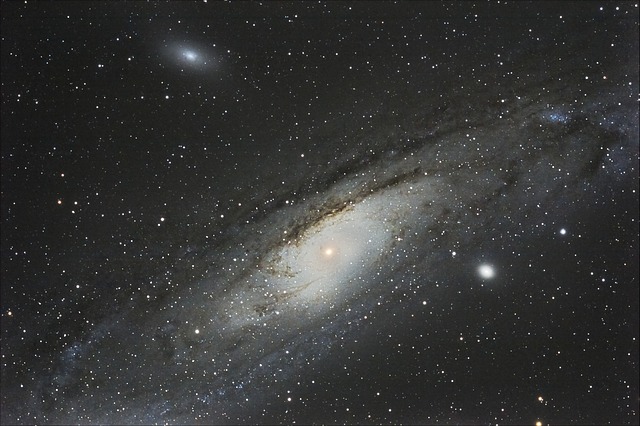
I should start by admitting that the photo above is not taken by me, but is from one of the contributors to Pixabay – which is where I get so many appropriate images while I hunt down the camera download equipment to download and display my own photos. But it is almost identical to the shot taken by a fellow astronomer on Sunday with what he described as ‘the cheapest bottom of the range DSLR I could get from Argos’.
We’ve been enjoying two nights of stargazing in Northumberland National Park, Britain’s first International Dark Sky Park. We’re staying at Battlesteads, which is – depending on who you talk to – a luxury hotel with an observatory in the grounds, or a dark-sky observatory with an award-winning hotel attached. I’d go with the latter. We booked the observatory first and took pot-luck on getting into the hotel. Though if you want a luxury stay in Northumberland, I would recommend Battlesteads Hotel. We will be back.
Saturday night was settling in, finding the observatory – a wooden hut about the size of a long double garage, two hundred metres from the hotel entrance, its purpose unmistakeable from the group of people on the deck being shown around the night sky. The hotel has red lights in its parking areas to the rear, to preserve night vision, and the path to the observatory is lit by a line of red lights.
We had booked places on the astrophotography course on Sunday. The course description said to bring your own equipment or just turn up and use theirs – we lugged the telescope and tripod up there, and our standard digital camera (we weren’t thinking of buying a specialist camera until we’d heard what the experts had to say). Of the six people on the course, one described himself as an expert photographer and expert amateur astronomer (he took the photos of the Andromeda Galaxy that built up to make an image just as detailed as the one at the top of the post, so I wouldn’t challenge that description) and the rest of us were keen photographers and enthusiastic stargazers.
Chris Duffy and his volunteer assistant Harry took us through how to find the best places to take good photos of the night sky, and how to get a better photo in areas suffering light pollution. He described the kinds of camera we could use, from DSLRs with detachable lenses to tiny CCD units whose only purpose in life was to be the intermediary between the telescope and the laptop. After all the inital theory was done, we went outside to try our luck.
We treated the course as a ‘watch, listen and learn’ course, though we did fetch our telescope up to the observing area to set up and do some viewing. Chris and Harry helped us to get the telescope set up, giving us some good pointers on how to star-align accurately. ‘Star alignment’ is getting the telescope’s ‘go-to’ unit to confirm where it is – once it has been told that Vega is in exactly this direction at this height, and Algol is in that direction at that height, it can point to any star, planet or object you ask with accuracy.
We tested it by asking for Jupiter, and got a clear vision of Jupiter, with its bands faintly visible and three of its closest moons shining pin-bright. Harry suggested I took a photo by putting my camera to the eyepiece, and I laughed, then tried it. The photo won’t win any awards, but it is going to be one of my favourites from this holiday. It’s a clear image of tiny Jupiter and three moons.
Another revelation was Tony, a quiet man who set up his tripod and camera next to ours. Our EQ-5 tripod is heavy and awkward but very stable – his astrophotography tripod was light enough to be carried in one hand, with the minature telescope/camera unit in the other hand. He takes his photos up mountains, so going back down for the counterweight and the telescope and the battery is not an option. And yes, he got brilliant photos too.
At the end of the night, Chris gave us a summary of good cameras, where to go for the software, what to be wary of in processing the photos and we left with a sense that we could do this, and without paying astronomical sums.
Yesterday’s session was a tour of the night sky. Ladies and gentlemen… cloud over here, cloud over there… and the lights of Newcastle illuminating the low clouds way over there. But Martin (assisted again by Harry, who gets home around midnight and gets up for his day job at 8am…) gave us a thorough theory session on stars and nebulae and meteor showers and where to see them before taking us out to the deck for a hopeful peek at the sky.
If you love astronomy, you have got to go to Battlesteads. The telescope is a Schmidt-Cassegrain with a refractor piggybacked onto it, a pair of dumpy cylinders that bring the universe down to the viewfinder in detail. It’s housed on a wooden deck outside the teaching room that is covered by a wooden roof. At a press of a button, the roof slides back over the teaching room roof and lets the telescope see the stars. I want one of those.
The clouds were breaking up enough that Martin was able to set the telescope to a few beauties and let everyone take a turn in seeing them – the Pleiades, Albireo, the Andromeda Galaxy 2.5 million light years away, and the Ring Nebula. In between, he was spotting stars and constellations breaking out of the clouds and taking his chance to point them out and tell us their age, distance and the tales behind them. The session came to an end around eleven pm, although Martin was willing to answer questions until we ran out of them. We walked back to the hotel with the Milky Way clearly visible, Cygnus dropping tail-first into the western horizon and the Pleiades blazing high in the east.
 Julia Chalkley