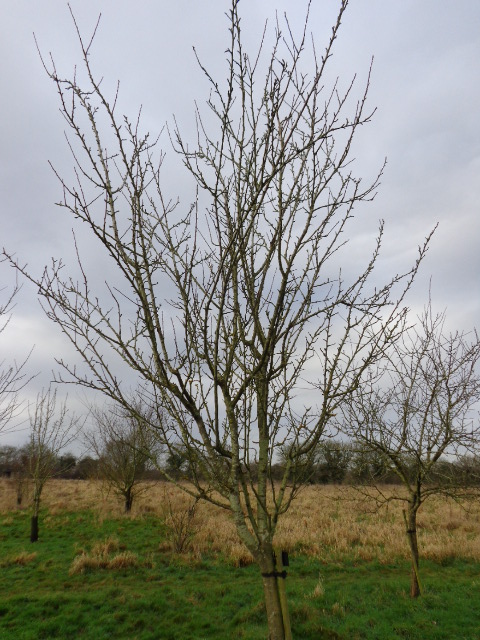
I got persuaded to take part in a tree pruning course in the community wood last Sunday. It was chilly and threatening to rain, so I could have happily stayed home, but out I went. I’m glad I did. The course tutor, Dr Anna Baldwin, had a great teaching manner; enthusiastic, knowledgeable, took questions as a priority. She rated our little orchard as a seven out of ten – considering it’s been sporadically looked after by volunteers, that’s not a bad score.
The orchard was the result of people asking the wood’s donor what he wanted for his 90th birthday. He told people not to buy a present for him, but to buy a fruit tree for the wood. He died five years later, but his presence lives on in the wood and the trees, and in our memory of him. I still remember reading the interview with him when his house was flooded. “The river runs deeper when it rains,” he’d said. “I can’t stop that, so I tiled the ground floor of the house, because carpet just gets ruined. I put the furniture up on bricks, open the front door and the back door and let the river flow through the house until the river subsides.”
The trees he asked to be planted are going strong a decade later, though they need some serious work. Some of the quince trees are sprouting pear shoots from the base, the muntjac are eating the apple tree bark and all of the trees are in serious need of pruning. We formed three pairs, each pair taking on a tree. First, twenty minutes walk around to consider the shape and any problems we could see. Then cutting, standing back, reconsidering and cutting again. We were told to aim for taking off 20% of the branches each year, and to make a separate pile of cuttings for each tree to make it clear how much we’d cut. Good idea, as it soon adds up. And before anyone says the whole tree will be shaved to a stump within five years, the tree responds to a cut by growing even more shoots.
By the end of the day, we’d pruned eight trees and had an idea of how much we had yet to do. For a start, they have the same problem as us – most of the labels have either dropped off or are bleached blank. In winter, that means that we’re relying on bark and growth characteristics. Pity the pair who pruned a tree to perfection, only to find they’d pruned a plum tree. Hard-stone fruit like plum should be pruned between mid-summer and early autumn. Whoops.
Two of us went back to the orchard yesterday to finish the job of cutting all the tree ties off before they strangled the trees. We put as much protective mesh around the trunks as we had mesh for, to save them from the deer. By the end of the year, I hope we can map the orchard, identify the trees (even just as “apple”, “pear” and “plum” if not the cultivar) and get some idea of how much pruning we want to do. And whatever we intend to do in the community wood, I need to tackle our own trees just as much. The one small comfort I have is that Dr Baldwin tells me that cider apple trees do not need pruning. That’s a third of the orchard done, then.
It’s been fun to work with a team again, and this time I’m working with a team that’s turned up because each person’s keen on the task rather than paid by the hour. This is a task that won’t finish for as long as the wood remains in community trust; these trees will (I hope) outlive me by a century.
 Julia Chalkley