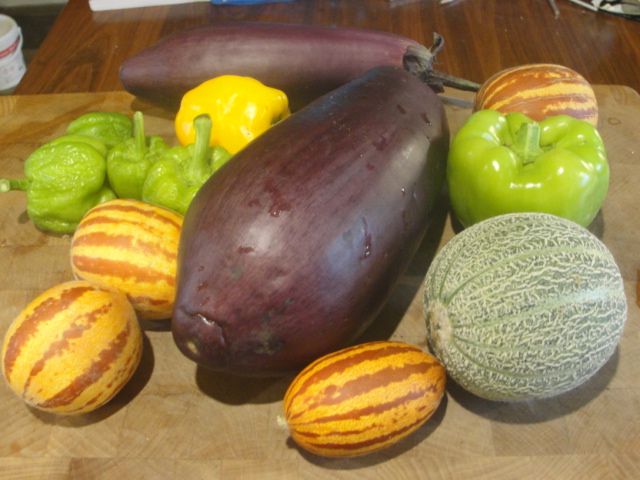
Last year we planted eight melon vines and were rewarded with two melons. So I planted the last of our melon seeds with more hope than expectation this year. I ended up with fifteen surviving melon plants and no-one else offering to take them in, so I planted the lot in the polytunnel. Laws of Sod, they all produced melons except for the Collective Farm Woman melon vine (on strike, I think) and every damn fruit turned ripe during our September holiday, and half were on the floor by the time we returned. We ate as many as we could. The cucumbers objected to the heat and produced cukes that were so bitter that I didn’t like to give the excess away. The aubergines went completely beserk, and the peppers (after a slow start) are providing a good crop. We grow a full salad here, with a glut of cucumbers in August, good crop of lettuce in September and a few tomatoes in October. We need a time machine to make the whole lot into a few decent, varied salads.
But the apples – the apples have made up for it all.

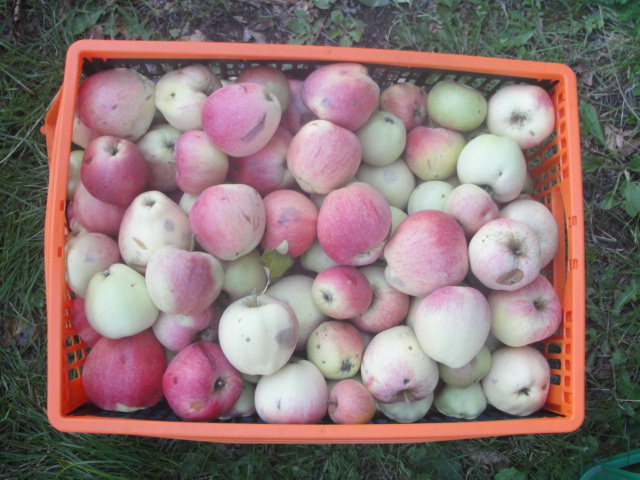
After four bad years, the apple trees have come out in force. Our neighbour told us that he was throwing his apples on the compost heap as no-one in his family were keen enough to keep up with its output. We volunteered and a day later we had five full crates of juicy eaters to deal with. When we’d finished with those, we stripped our own cider apple trees – planted in 2008, they have finally found their strength. The Yarlington Mill and Michelin was laden, and the Morgan’s Sweet offered four huge yellow apples. The Kingston Black, the Stoke Red and the Dabinett had a dozen each. Between them, they gave us four full crates. Next up was the Bramleys. You can make a good sharp cider from Bramley, as long as you don’t mix it with other varieties, and we stripped the tree. Five kilos for fruit for future apple crumbles, the rest went through the scratter.
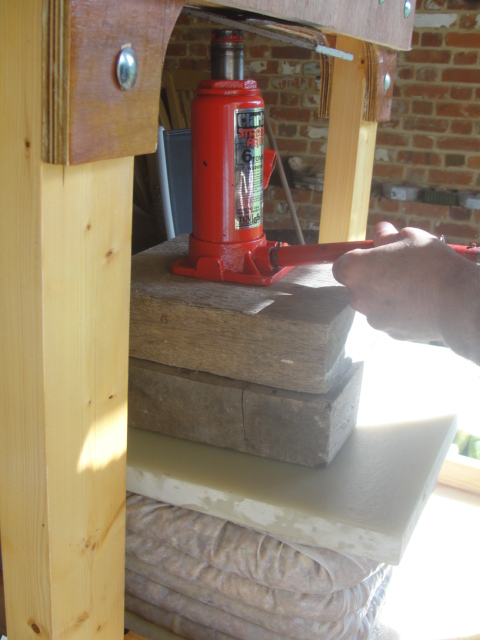
I admit we had an advantage this year. Our Gloucestershire friends are hoping to move house soon, and are clearing away some of the stuff they’ve acquired over their decades in their current house – including the cider press he built a decade or more ago. We took it home and have been testing its limits this week. It’s a serious piece of kit. It’s a wooden arch over a tray with a drain hole. The apple mash is formed into a pile of squares enclosed by fine mesh (‘cheeses’) in the tray and covered by a slab, or two or three… a car jack on top of the slab presses up against the arch and down against the slabs, pressing the juice from the mash. Efficient, quick and fun.
The neighbours’ eaters gave us six gallons in a barrel and four gallons in four demijohns – the juice gushed out, pouring two gallons into the barrel even before we put pressure on. The cider apples were dry and stubborn, giving just six gallons of thick, dark juice and staining our hands bright orange. It took 24 hours of determined scrubbing to get the Tango off. Yesterday we pressed the crates of Bramley and got almost eight gallons of juice – a full barrel, a gallon demijohn and a few litres to freeze for apple juice in the depths of winter.
If you leave freshly pressed apple juice, the yeast from the skins will begin to ferment within hours – slow at first, then desperately quick and vigorous. The only ways to stop this is to pasteurise it (heat it to at least 63 degrees F for at least 20 minutes), freeze it or put in a carefully calculated dose of sodium metabisulphate. This is why extra gallons in demijohns are so much fun. Early batches of cider were half OK and half vinegar – these days, we can all but guarantee a decent cider in the barrel from a calculated stop and re-start with a yeast culture, leaving the demijohns for experiments. Fizzy? Double strength alcohol? Mild and weak? Oak or vanilla flavoured? We can risk a gallon to try out ideas.
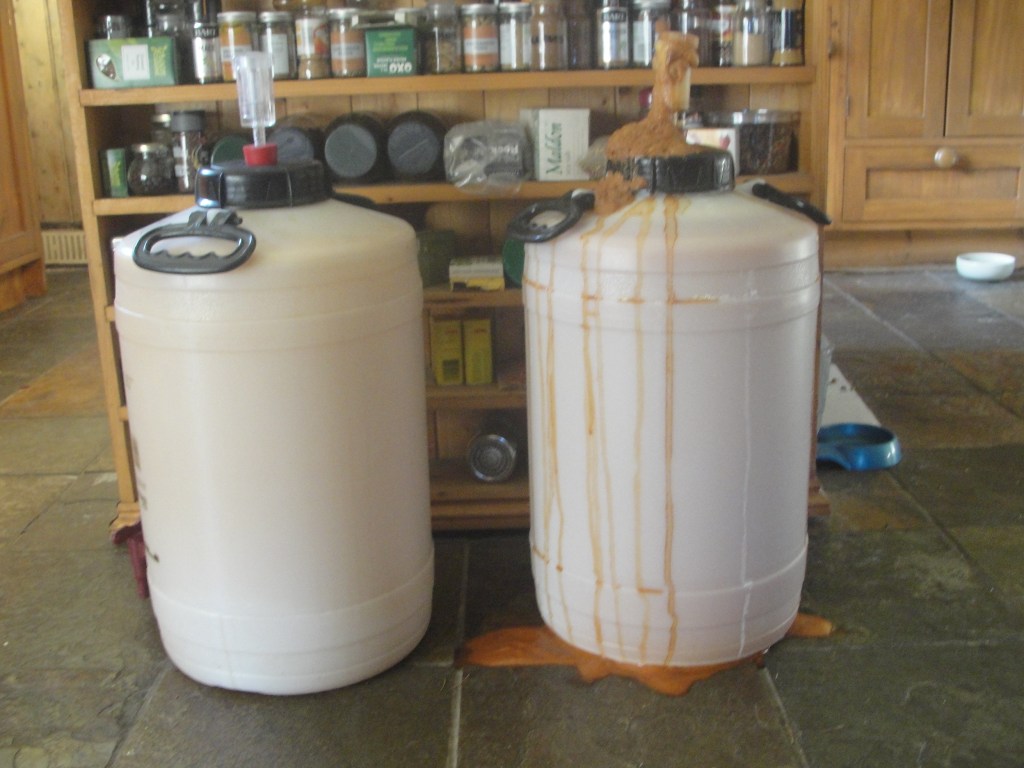
The pure cider apple barrel is a thug, belching dark orange syrup out through its airlock every hour. It’s been like cleaning up after a messy kitten, mopping the floor and scrubbing the barrel. Next door’s eaters have been blopping away quietly and steadily and we’ve just put the E1118 yeast culture into the Bramley barrel, so we wait to see how well mannered this one is. The demijohns are lurking in the shower room. We are back to the days of explaining to visitors that we don’t drink all this in one year… honestly… and it’s been a real blast to be back making cider.
 Julia Chalkley