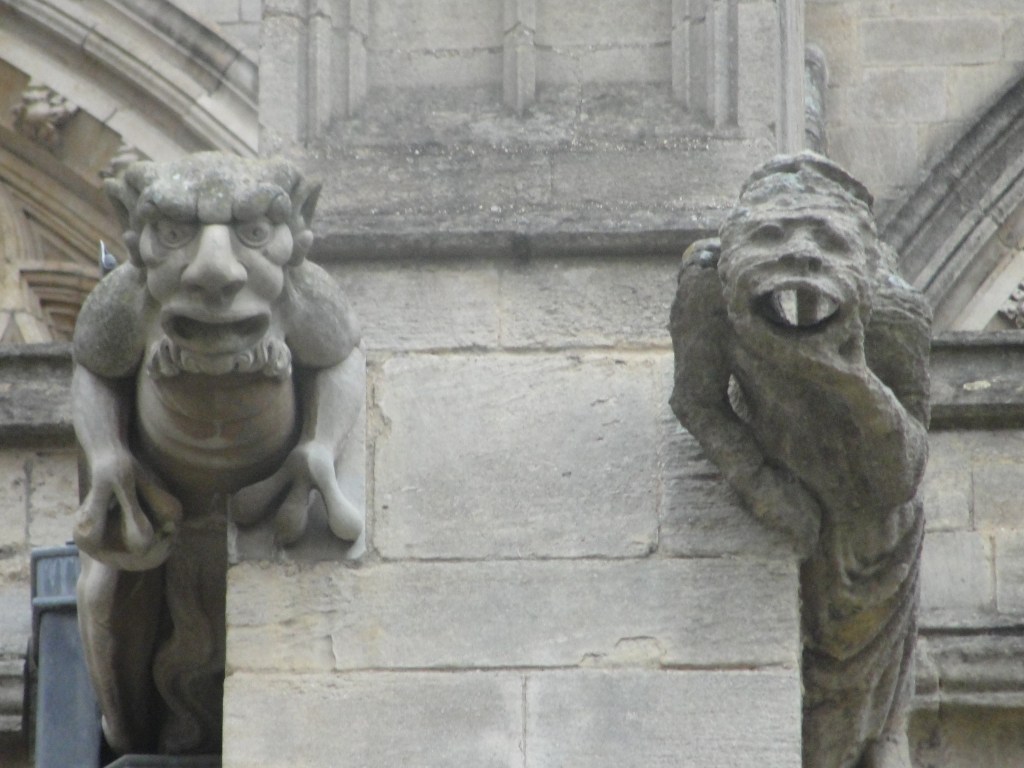
Our latest trip out was to Ely Cathedral. It’s the third time we’ve been there, and every time that first sight of the cathedral is a Wow moment. All those miles of flat land and then that enormous pale building on the skyline.
The first visit was for my graduation from the OU with a BSc in Earth Sciences – priority given to students from the East Anglian region, so I was able to book a ticket for my husband and father to watch as I went up on stage to collect a blank scroll of paper and shake the hand of the Vice-Chancellor. The second visit was to the 2018 Christmas Fair – stalls lined up along the aisles of the cathedral and the Lady Chapel. This time, we’d been drawn in to see the Table.

In 2012, a farmer in nearby Wissington found a tree trunk buried in a field he was ploughing. Whatever made him call the experts, I have no idea; what they found was a thirteen metre long section of black oak that had fallen in the Fens 5,000 years ago. When the experts tried to work out which end was the rootball and which was the canopy, they realised that it was barely tapered – that it was a section from a much larger tree. The height of the complete tree was estimated at 50 metres, almost twice as tall as the tallest oaks today.
The Canadians sent their largest mobile mill over to England to create planks from it, and the crew found that it was easier to set up the mill in the field than it was to move the tree trunk. They got ten planks from the trunk, and dried them out over the course of ten years in a purpose-built dehumidifying kiln. The planks lost nearly 1,800 litres of water – 1.8 metric tonnes – along with half of their thickness, a quarter of their width and 150 mm from their length. There was still enough left to make a table. The Jubilee Table.
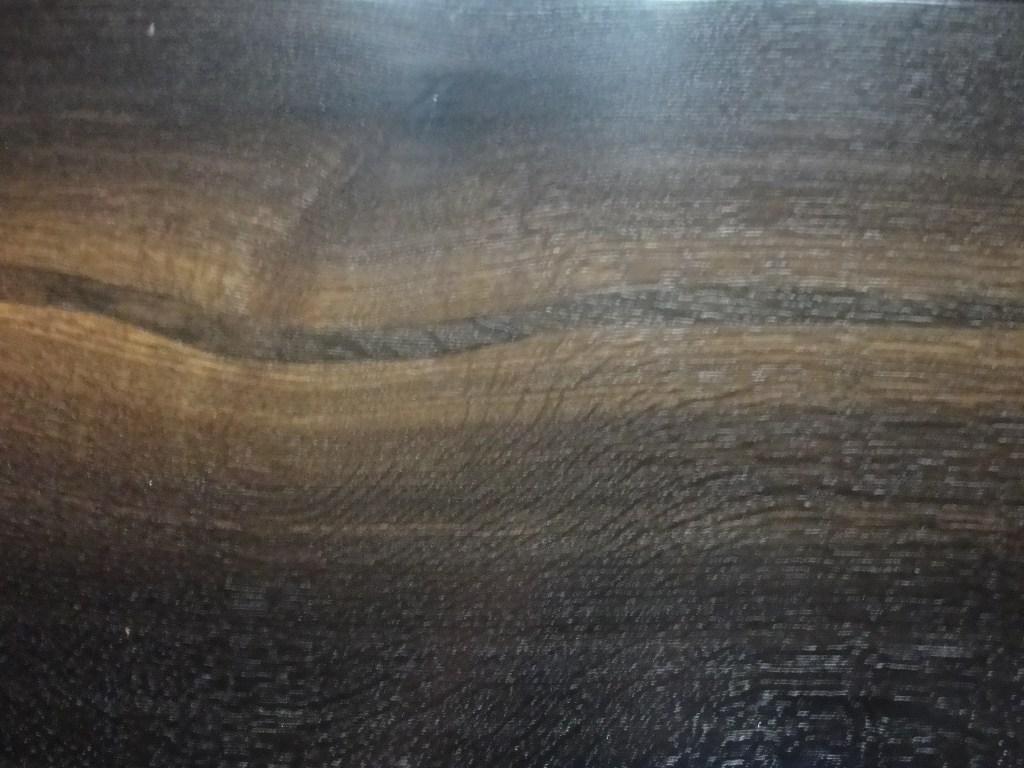
The grain and colour and shine of the wood is amazing. The sign on the table invites visitors to touch it, luckily, as the first thing I did on reaching it was to run my hands over the surface. It’s beautifully designed and put together, and they would have to put up some barrier to stop people from stroking it.
Having travelled all the way to Ely – and got up early enough to get a parking space – we were going to make the most of the trip. We’d booked tours of the Octagon Tower and the ground floor and entry to the Stained Glass Museum. The West Tower was closed, and frankly, I’m now pretty relieved that it is. The Octagon Tower was tall enough. I was lucky the guide realised that I was afraid of heights and took it easy on me. Thanks, Dave.
The journey up to the top of the tower is in stages, via three sets of spiral stairways – we came out onto the gallery overlooking the ground floor at first, then on to a walkway along one edge of the northern transept (with a very low stone wall between you and the lawn some thirty metres below) to the inside of the octagon. Impressive enough to see the huge struts of oak supporting the tower, and then to hear that it cost £2,000 in mediaeval times (they still have the invoice in the archives) and weighs 200 tons. Then he opened Door number 2.
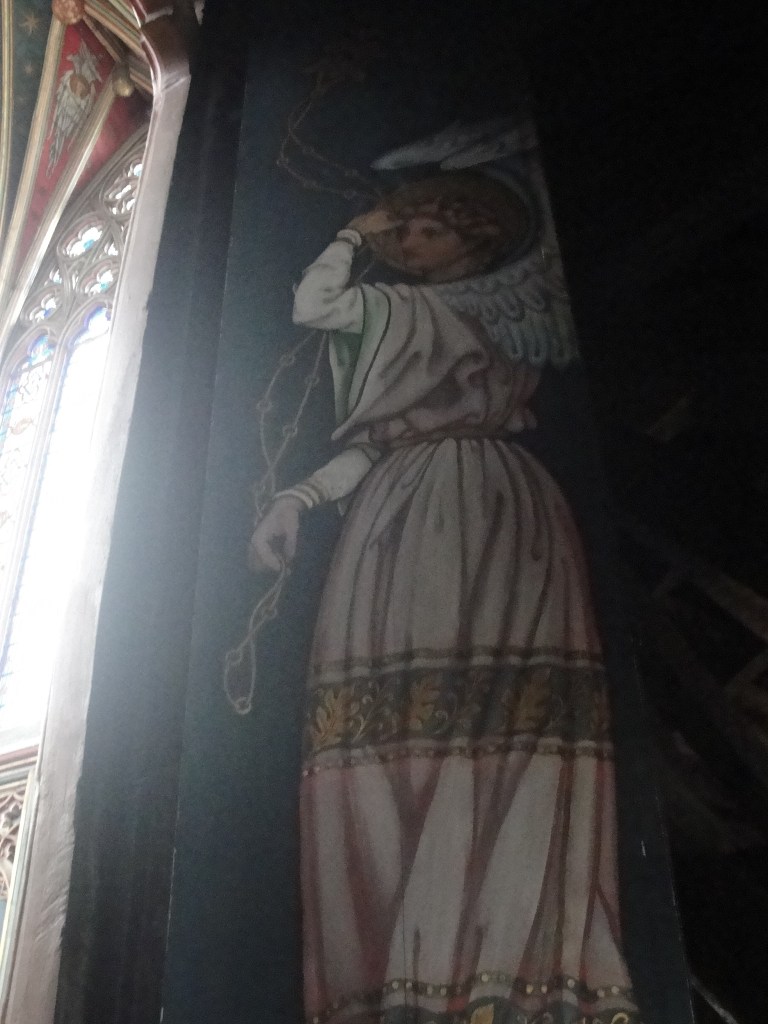
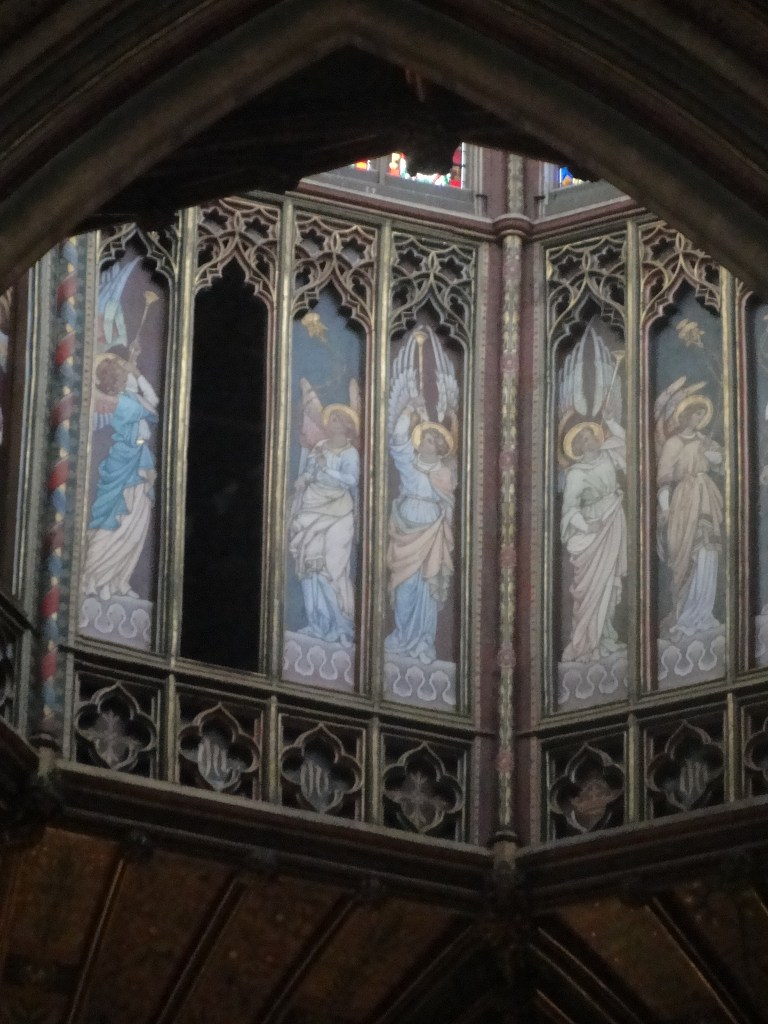
There are 32 angel panels around the Octagon, and each one is a doorway. Open it up and look straight down 142 feet to the floor of the cathedral. I managed that, just. Above each angel is a stained glass window, and our final stop was to get onto the walkway around the outside of those windows. Up one final set of stone spiralway with a rope for a handhold and out through a door designed for a ten year old. Onto the roof of the Octagon.
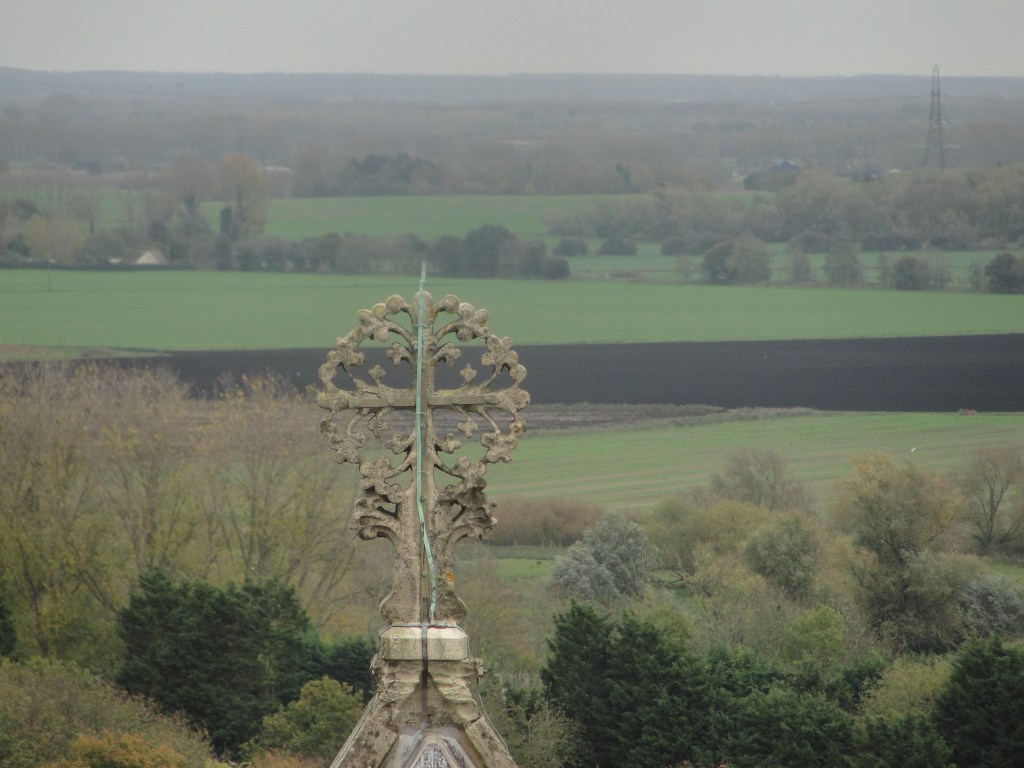
The view was spectacular. There’s a taller stone balustrade between you and the lawn below, but visitors walk around a steel platform set a metre back from the stonework, with its own scaffolding handrails. It was almost like not being a fatal height above the ground. I think this first view might be across the fields where Pink Floyd set up two giant heads for the cover of ‘Division Bell’. Take a close look at the distant background between the heads on that cover and you’ll see Ely Cathedral.
There’s another 200 tons of lead protecting the wooden structure below, so a total of 400 tons on the roof of the tower. We’d already been told that the original tower collapsed in 1322, and that the cathedral is built on very shallow foundations on soggy Fen land. Now Dave pointed out that the West Tower – the main tower at the front of the cathedral – is a few degrees tilted off true, one side sunk a little further than the other into the soft ground. The whole structure was built to be a huge impressive statement of victory at long last over the rebels who held the Isle of Ely against WIlliam I for longer than any other part of Britain, and I doubt anyone would have spoken up to the king about the sense of putting a tall, heavy structure on shallow foundations.
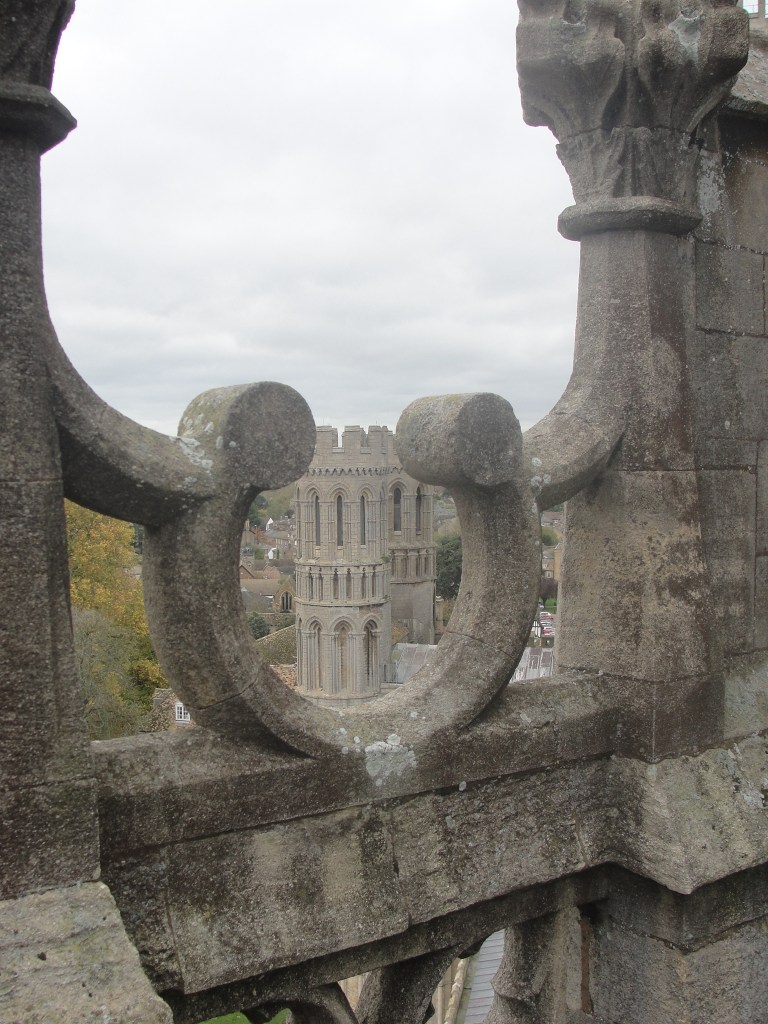
We walked the full circuit around the walkway and then back the way we came, down past the angel doorways and along the walkway to the next set of spiral stairs, down to the floor of the nave. I thanked Dave for putting up with my fear of heights – I like to test myself, and sometimes I fail. We went off with wobbly legs to wander around the Stained Glass Museum. It’s small but it packs a lot in. We were hoping to see the Seven Ages series again, but it was one of the exhibits that had been moved on and been replaced by something new.
And at last, the tour of the ground floor.
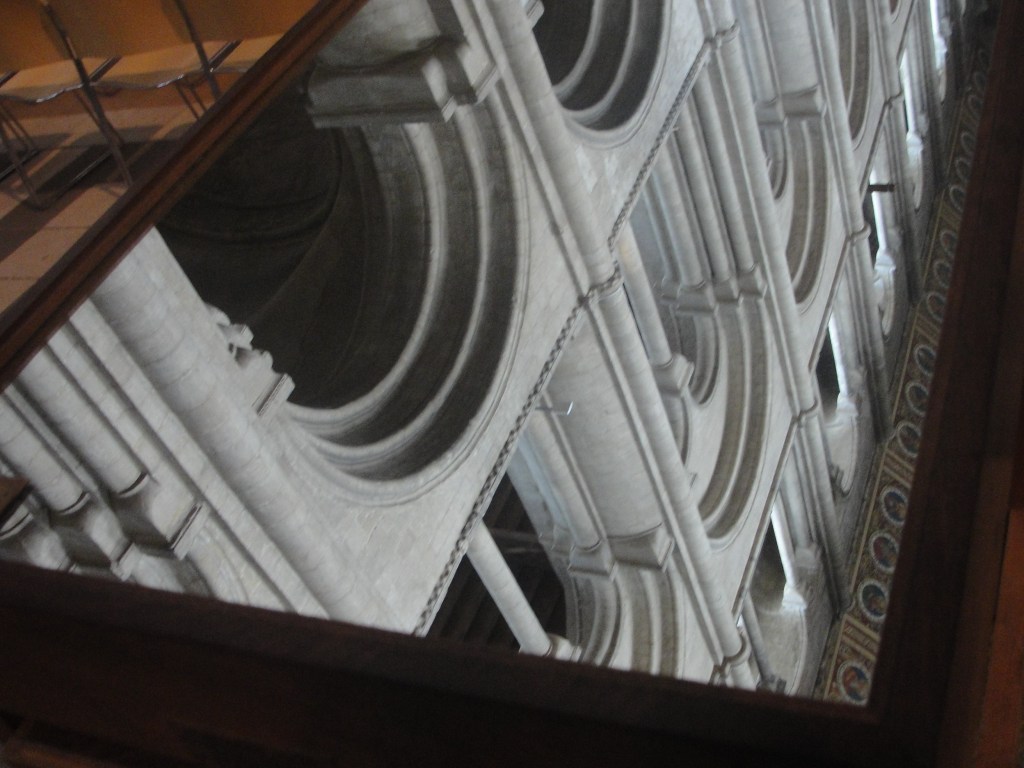
It’s the kind of place where you can’t help but look up, so these mirrors on the nave showing the details on the ceiling are valuable for visitors. Our guide pointed out the painted figures and faces along the ceiling, including one of the prophets who had been painted with the face of the dean of the time. While I was looking up, I noticed that the next tour of the Octagon Tower had the angel doorways open in the gloom – the same door with the pink angel that I photographed earlier.
We left the cathedral after the tour, having spent almost the whole day there. One last long sweep along the table, and we were out in the gloomy afternoon. We didn’t have time to visit Oliver Cromwell’s house, just a few hundred yards away, or the Thursday market or the local museum. We will have to come back one day. Soon.
 Julia Chalkley