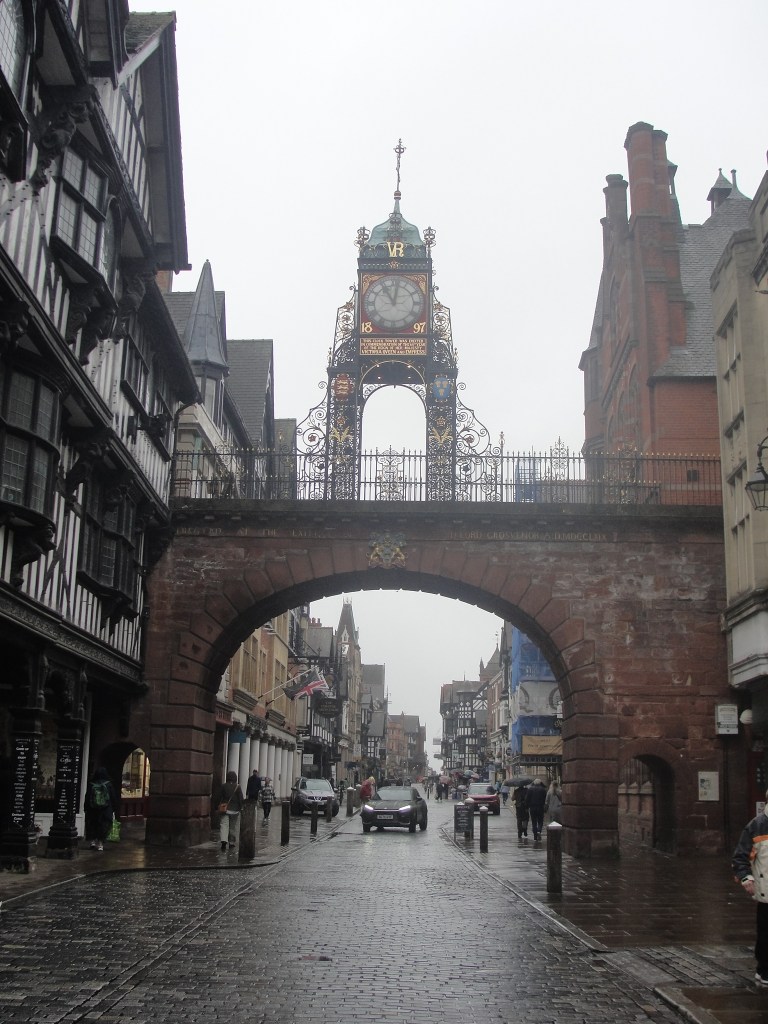
This was our first day in Chester. Not very impressive weather, but it matches our first view of the city itself. We were staying about five miles out, relying on the Park & Ride to get us in each day. No problem with the system, the bus or the drivers – £2.50 to ride around all day, free parking and helpful drivers. But having got onto the bus we had to do the whole route round the city to get back to the car, and the first sight of the city wasn’t impressive.
Fat Boys Pizza and Kebab. Rows of shops but virtually no customers. Metal shutters on a fabric shop? I dunno. Maybe you can exchange ten yards of that polyester curtain fabric you just robbed for a bottle of whiskey round here. The weather wasn’t helping much, and we spent most of that first trip wondering whether we’d made a mistake coming to Chester for a few days – maybe a long weekend in Qaanaaq would have been better?
What we came to realise was that there’s two parts to Chester – you’re either inside or outside the wall. Outside – on the route we took – it looks like any town these days. Vape shops, people shouting as if drunk or drugged, rundown houses. Not the kind of place we’d get off the bus to explore. The fourth bus stop is Foregate, the city centre – about two hundred yards from that famous Eastgate Clock.
First objective was to get up onto the wall and set ourselves to walk all the way around it. We had real trouble finding the wall and the way up onto it… Anyone who’s been to Chester will be laughing by now, but come on. It isn’t immediately obvious that the clock sits on the wall itself, as there were no tourists on that stretch of the wall on that rainy Tuesday morning.
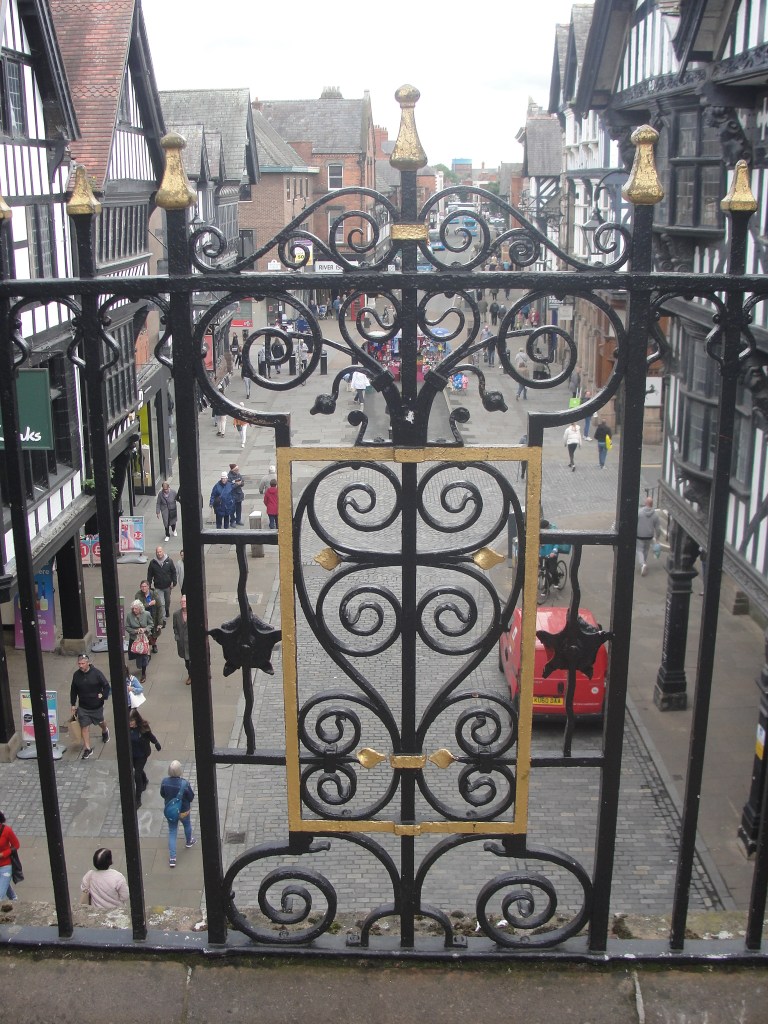
We walked down to the Roman ampitheatre that first day. Maybe because it was raining hard or maybe because we were tired from the drive over, but we were not impressed. We found a dead end up onto the wall from the Roman Gardens that was blocked off completely. We backtracked to a set of stairs up onto the wall (hidden at the end of an alley that ran between the back of a business and the side of a disused church) and set off.
We got about halfway around that day. We stopped at the Little Roodee Cafe – huge car park full of cars and about a dozen coaches, but inside the cafe we were outnumbered by the staff. Something to eat and a good coffee and we were off. Himself wanted to see the Agricola Tower. Which hides between the University of Chester and the complex of the courts, council offices and the Military Museum. And is also definitely not Roman.

The solid square shape should be a clue. William the… Conqueror, or what ever name you know him by, had it built as the gateway to a castle. Interesting, that when that tower was newly built, the king gave it a name from a thousand years before his own time to give it substance. That tower is still there almost a thousand years later.
Our second day in Chester was entirely different. Dry, sunny and warm. We turned up early and got straight up onto the wall, heading in the opposite direction. This was definitely the pretty side of the city. We walked behind the cathedral, found a collection of independent shops (including one that sold great coffee) and got as far as Chester Racecourse. The races were on and the crowds were arriving. The racecourse was built on the silted up bed of the River Dee, apparently. The things you learn along that wall.
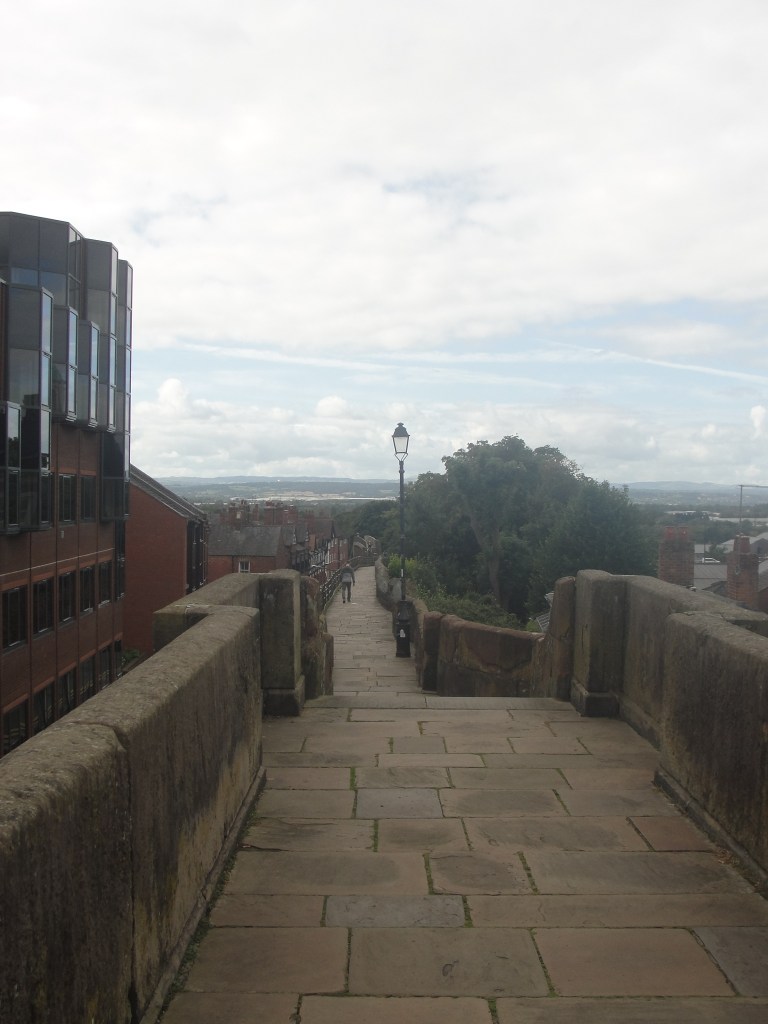
Just beyond the racecourse was the Little Roodee Cafe; the point where we had got off the wall last time. This time, we headed up to the Military Museum and spent an hour looking around. Then another half hour talking to the volunteers who run the museum, and that was just as much of an eye-opener as the exhibits themselves.
The final trip to Chester was to visit one of the Civil War events at Chester Castle. Although we’d been drawn to visit for the Roman ruins, Chester played a key role in the Civil War. It declared itself neutral but warned that it would be fortifying the city in case either side felt the need to nudge that neutrality. The walls were repaired and strengthened. Despite the ‘neutrality’, the area was strongly Royalist, and the Parliamentarian forces set up a siege of the city that lasted for sixteen months, with frequent attacks from both sides. There’s an information board in the Roman Gardens which explains that the city walls were destroyed in places, with a vertically-mounted picture on a sheet of glass showing the troops fighting around a V-shaped gap in the walls. If you crouch down and look at the wall through the glass, the V-shaped gap on the picture lines up with the repaired section of the wall beyond it.
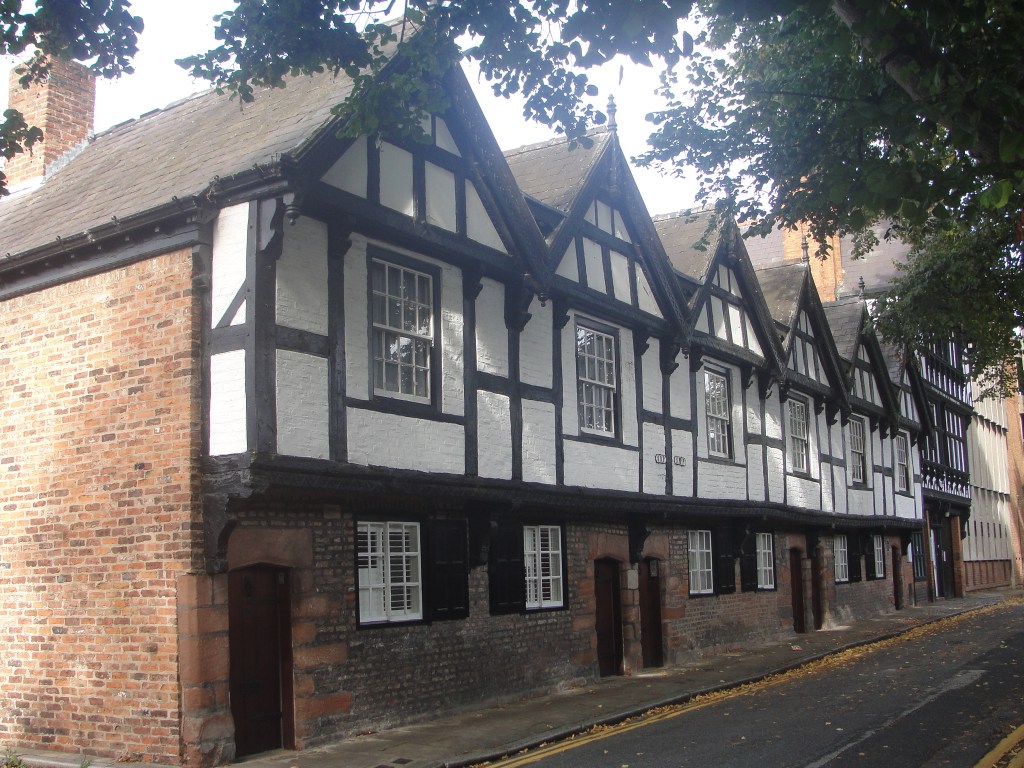
The Civil War exhibition went on for two days, with re-enactors firing muskets, explaining life during the siege and the timeline if the siege itself. The highlight was the visit to the top of the tower, where the guide explained the geography of the siege and we got a good look around.
On the way back down the tower, I dropped in to the chapel on the first floor. The re-enactor who had retired from fighting to become a mural painter had explained the paints to us – effectively, dyes that were painted onto fresh lime mortar. In the Old Chapel, Victorian murals on fresh plaster had flaked and faded and fallen off the walls in patches, and modern restorers had found the original murals underneath. Not just surviving, but reviving as the chapel was visited; the condensation from the breath of visitors is bringing the old images back, faces and angels and leaves appearing on the walls and ceiling.
That was the city half of our visit to Chester. Given that a lot of disputed cities must have had walls around them, it’s a shame that so few survive. Chester’s walls were built between 70 and 80 AD by the Romans, and by a quirk of luck have been strengthened, extended, maintained by levying a murrage (tax) on goods entering the city, repaired, adapted to accommodate Georgian walks and modern traffic. It’s good to walk around the walls. It gives a view down onto the city, a different perspective from the usual street-level city tours, and an insight into the different uses of this wall throughout almost two thousand years.
 Julia Chalkley