
Last month’s adventure was a trip to the Self Publishing Show in London. I went last year, drawn in by an author friend, but this year I was going back with intent. I had so many questions that I’d wear a big hole in any friendship with them all, so I would be asking those questions to the sponsors at the stalls.
Just like last year, I booked a room at the Mad Hatter Inn in Southwark. The building was once a hat factory owned by the Tress family, but it cheers up its industrial past by putting Alice in Wonderland references everywhere. My room had pictures of the White Rabbit anxiously checking the time and Alice reading the label on the bottle (“Drink me”), while the dining room was decorated with various characters from the Alice books. Including the Blue Caterpillar inhaling smoke from a bong, and I’m told this was one of the Tenniel illustrations to the first edition. Tenniel probably drew the author sitting cross-eyed at his own bong, from the general crazy whirl of the plots.
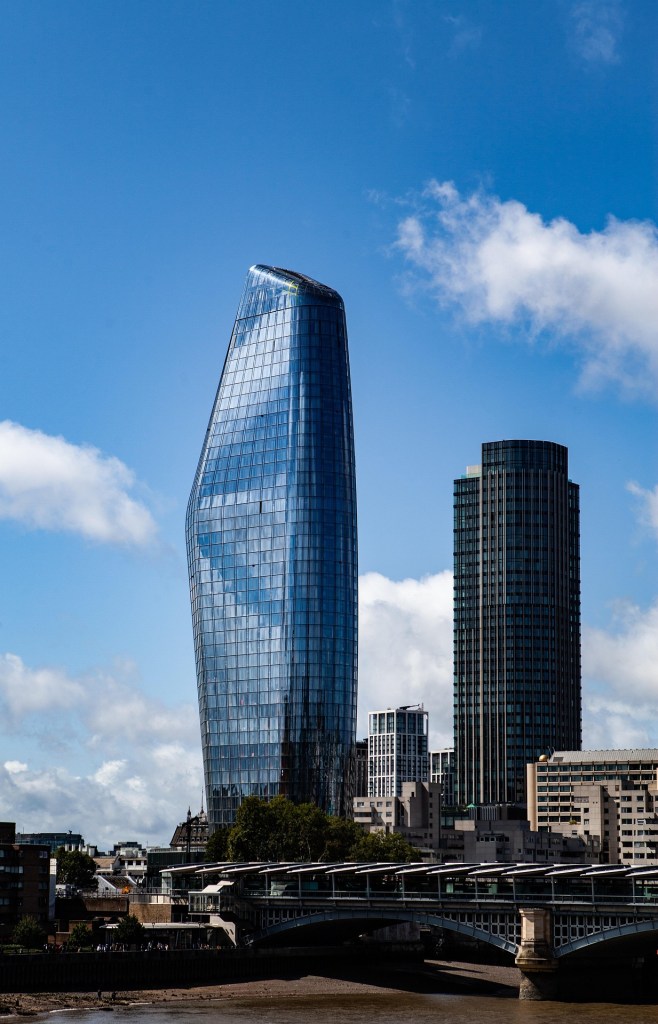
Last year I had a room on the first floor overlooking the waste ground behind the hotel. It gave me a view of what was behind a tall wooden fence – the rough ground and weeds and wildlife of a site ready to be built on. This year, I was given a room on the third floor, and on the side facing the Thames. Not that I got a view of the Thames. I was looking directly at One Blackfriars, the curvy glass tower that is on the same scale as the Gherkin and the Shard – after planning objections cut its height by a hundred metres or so. As with all residential developments, it came with a side-order of ‘affordable homes’ – in this case, in a separate concrete building on a nearby street, thereby dividing its inhabitants from the gorgeous views and smart facilities enjoyed by residents of One Blackfriars itself. I couldn’t see the topmost towers without putting my face to the glass of the window and really craning my head. It was spooky from evening onwards, and I couldn’t help but think of the Twin Towers every time I saw it. Lovely for its rich inhabitants, but a crap neighbour.
This year I knew that things could be different. I walked to the show each day and I knew the route included a few hundred metres along Stamford Street (traffic, June heatwave, noisy) before reaching a cut-through to the Thames through a pair of quiet, cool parks called the Bernie Spain Gardens. From the entrance of the southern garden you can see through the trees to the buildings on the north bank of the Thames. The first garden is a sunken lawn built on the basement hollow of a demolished building, with flower beds all around it and narrow paths diverting through stands of trees and tall shrubs. From the centre of those small paths, all you can see in any direction is tree or shrub. Lavender and honeysuckle kept the air scented everywhere.
Just beyond the wall enclosing the park are flats. Three stories tall, unintrusive and looking out onto the gardens – I would have loved to live there. Very different from the side-street block of the One Blackfriars affordable housing, where the view was of a non-descript building across a dark street.
At the northern end of this park is a road with speed humps to slow the traffic and just across that road is the wide lawn and bushes of the northern Bernie Spain garden. From here, the Thames is in view. It’s a straight amble to the Thames across the garden alongside Gabriel’s Wharf, a group of independent shops and street-food businesses. There’s a line of food trucks and shack-type restaurants all the way along the South Bank from here to the Festival Hall.
The signage at the entrance to the gardens answered my question about who Bernie Spain was. She was a psychologist living in Waterloo, in the Coin Street area, and seemed to be always a campaigner. She worked to have a community hospital built in Lambeth and spoke out on behalf of her patients. When she heard about plans to build a huge complex of office buildings between Coin Street and the river, she organised the residents to form an action group and begin fighting.
If the development company had won, one resident described their plans as a “Berlin Wall” that would have completely cut off access to the South Bank for the residents living just a few hundred metres from the river, meaning a long walk along busy London A-roads to the nearest bridges. Bernie wouldn’t give up. She set up signs saying; “London needs another office block like it needs another plague”, and fought the company all the way through the courts. The company gave up its plans on one site just before Bernie’s death in 1984 and gave up the second site months later. The Coin Street Action Group bought both sites and organised a community gardening scheme to have both sites planted and maintained.
I couldn’t help thinking that Bernadette Spain might have had other plans for the last seven years of her life, something that didn’t involve standing up against teams of corporate lawyers intent on making wealth for their clients. Seeing what she did achieve with those years made me very glad she didn’t just give in and move. The walk through those gardens was something I looked forward to in the months approaching the Self Publishing Show.
And yes, I got the answers I was looking for. But as is the way with all projects, more questions have cropped up since then. The first draft of ‘Shilling Cove’ is about to come under the eye of an editor who will definitely tell it like it is, and after that, I can release it into the wild and turn my attention to the next project. Just hoping this one will take less than five years to finish. Bernadette Spain, how did you find the energy?
 Julia Chalkley