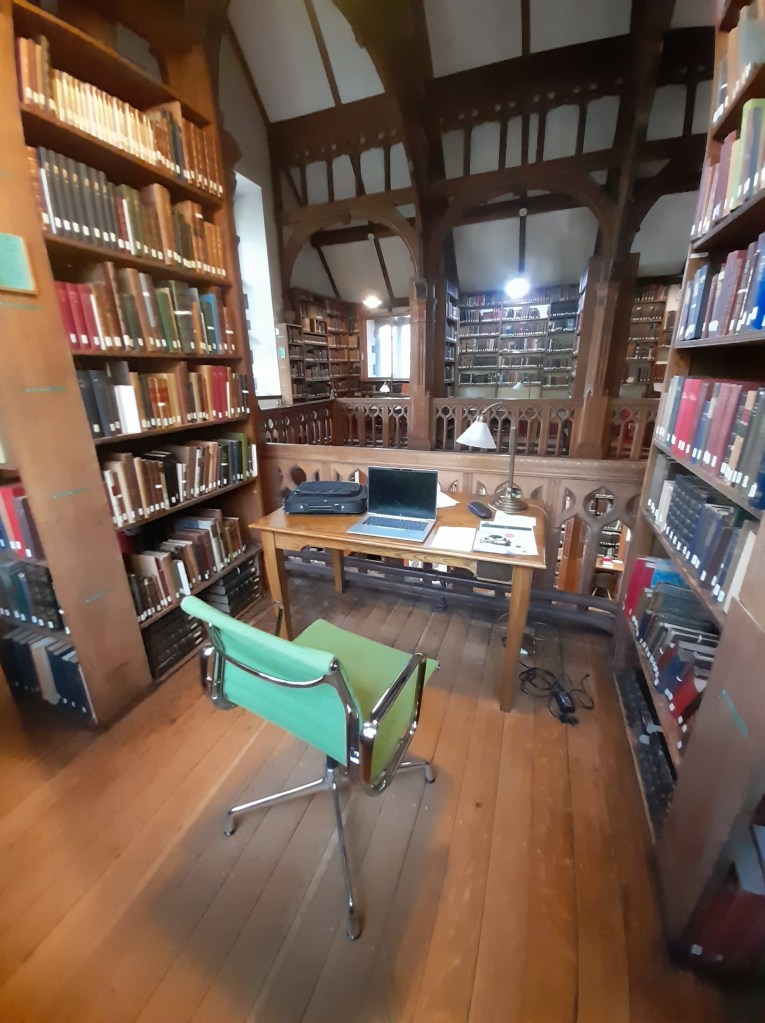
I have just returned from a writing holiday like no other. I’m trying to describe it, and there’s no sentence big enough. You’ll see the photo at the top of the page and understand it’s a library, but… this is Gladstone’s Library.
You can start with the fact that it is a library and move on to understand that it is the national monument to William Ewart Gladstone, politician for both major parties and Prime Minister for a large chunk of the 19th century. It’s a grand and sprawling building with acres of worked stone and dark wood which replaced Gladstone’s original structure of a ‘tin tabernacle’, put up to house his thousands of books towards the end of his life. It must be the only library in the country that insists on silence. I didn’t realise just how much I missed the traditional silent reading rooms until I walked in and heard nothing at all.

The Theology Room is about twice the size of the library in our nearest town, spread over two floors. Not just theology – though there are plenty of books on Christianity, Quaker faith and Judaism – it contains Celtic works, books about ley lines and witchcraft, ghosts and folklore. Next door is the History Room, and again, not just history. A small room just off the main History Room contains works concerning the Islamic faith. Many of the books on the ground floor are the original ones owned by Gladstone, rather than works donated by others or collected by the library. I don’t think the trustees mean to be funny when they ask readers to treat Gladstone’s own books with especial care – laying them on huge cushions to support their elderly spines, for example – to preserve these fragile items. The same books that Gladstone transported in wheelbarrows across the park and the street to the tin tabernacle.
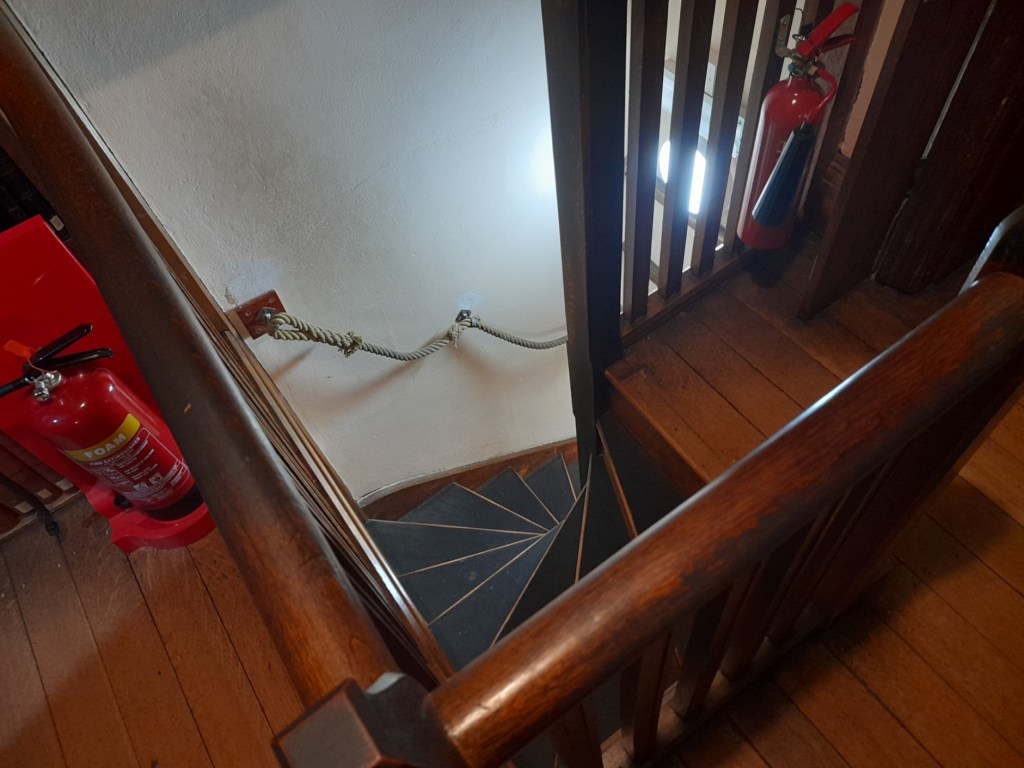
In the far corner of the History Room is a door that leads to the modern books. Stacked in those rolling cases designed to give the maximum amount of storage, each case is almost completely full. Literature. Poetry. Journals and magazines. History of Britain, Europe, all periods of time, particular histories such as the Suffragette movement. You’re welcome to take a book or more to your desk, or (for residents) back to your room for a night. Not off the premises and never to be propped open in the canteen while you eat your soup.
I took Pevsner’s ‘Buildings of Cambridgeshire’, the New Penguin Book of Welsh Short Stories and Christabel Pankhurst’s account of the suffragette movement. This was a history as far as the 1919 Act that gave a very strictly limited group of women the vote. It took until 1928 before British women were granted the right to vote on the same basis as men. If that sounds harsh, Switzerland didn’t grant equal voting rights to women until 1971. One interesting fact I found in Miss Pankhurst’s work was that the liberal-minded Gladstone – the politician who voted to end slavery in the British Empire and championed the right of all to have access to books and education – was apparently so set against extending the vote to women that he was seen as the main obstacle to full suffrage on every occasion it was put before his government.
Apart from the books, there are 33 comfortable bedrooms and a restaurant / cafe, a lounge for residents, rooms for groups to meet in and a chapel. Many of the rooms have names as well as numbers. Four or five are named after Gladstones – one is named for John of the Cross – and next time I visit, I want to stay in Room 25.

Anyone can turn up and ask for a card to give them access to the library for the day. Both library rooms are open from 9am till 5pm to anyone with a day card or a reader’s card. At 5pm, everyone is asked to leave the History Room and the Annexe and the doors are closed. The Theology Rooms remain open to residents until 10pm.
The Sisters in Crime loved it, and there were always a few of us in the library. Beth had returned from a day trip to Anglesey with a driving need to learn about the lives and beliefs of the Celts on the island, and her desk was decorated with piles of books on the subject.
It was chiefly a social gathering of the Sisters in Crime. The group gathered in the Anwyl and the Glynne rooms each day to discuss writing and to meet each other. We meet all the time on Zoom, but there is a different feel to meeting someone in person. A couple of people I have found interesting on Zoom and WhatsApp have now become friends, the kind I will make huge efforts to keep in touch. Though I admit the initial introduction session went on for so long my introvert fuse blew and I spent most of Saturday hiding in the library with my laptop and my latest writing project.
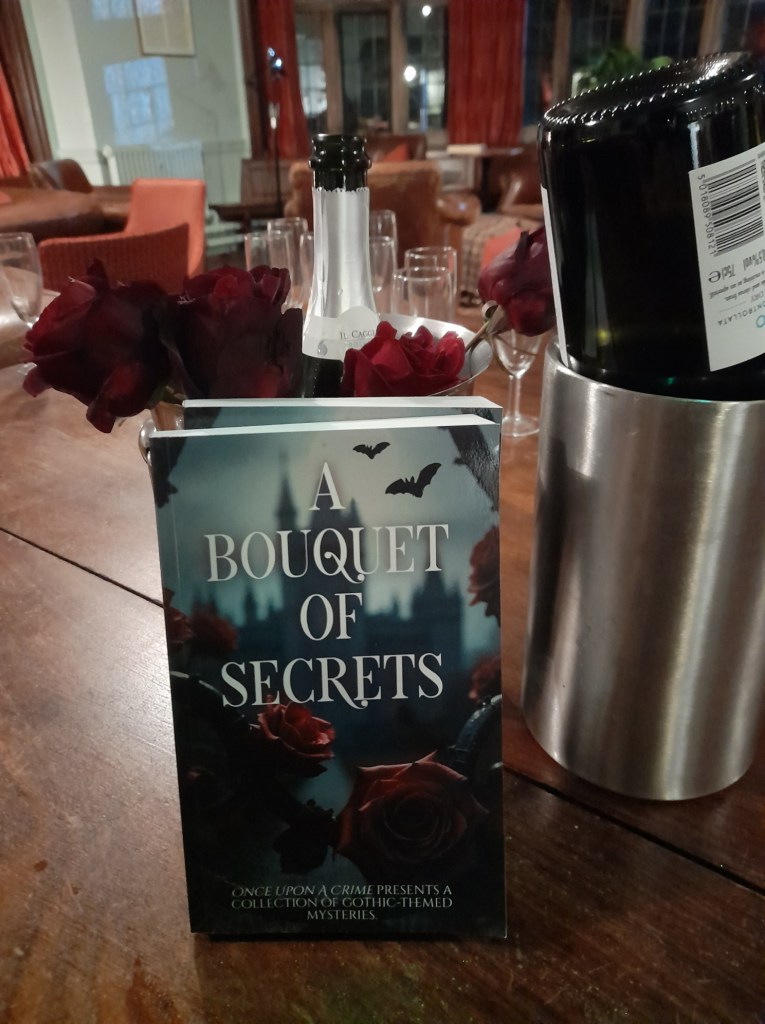
On the Friday night, we held a party to celebrate the launch of ‘A Bouquet of Secrets’ with Prosecco and Gothic fancy dress. No idea what the other guests at the library thought of it all, but we had fun. Everyone had a copy to pass around and eight of the group had contributed stories, so we swapped copies and signed.
The final day of the meeting was Remembrance Sunday. We all checked out of our rooms by 10am – I knew there’d be a queue, so I got up early and checked out at 9am. While I was loading my bag into the car, the local brass band was rehearsing by the war memorial. The road would be closed for their parade until 12.30, so I couldn’t have set off on my journey home until then.
We gathered in the Glynne Room for a goodbye session, then a final photo outside the library. Brilliant timing. Just as it started to rain. By the time I left the lunch and set off for home, it was traditional Welsh weather – raining with no sign of stopping. Just the right kind of weather to disappear into the library with a good book.
 Julia Chalkley