Every year I go to the Scottish Association of Writers’ Conference in March for the last time, and every year I find a reason to go back. By the time I left the conference last year several people had come up to greet me and I’d stopped others to say hi. The number of people I knew and who knew me was growing. It was turning into a social event.
This year we both went to conference (Himself is not a writer, but he enjoys a whole long weekend of enforced not-working with added reading time) and we extended it to cover a few extra days away. This year, back to the Gladstone Library for a day and on to Jodrell Bank for a visit.
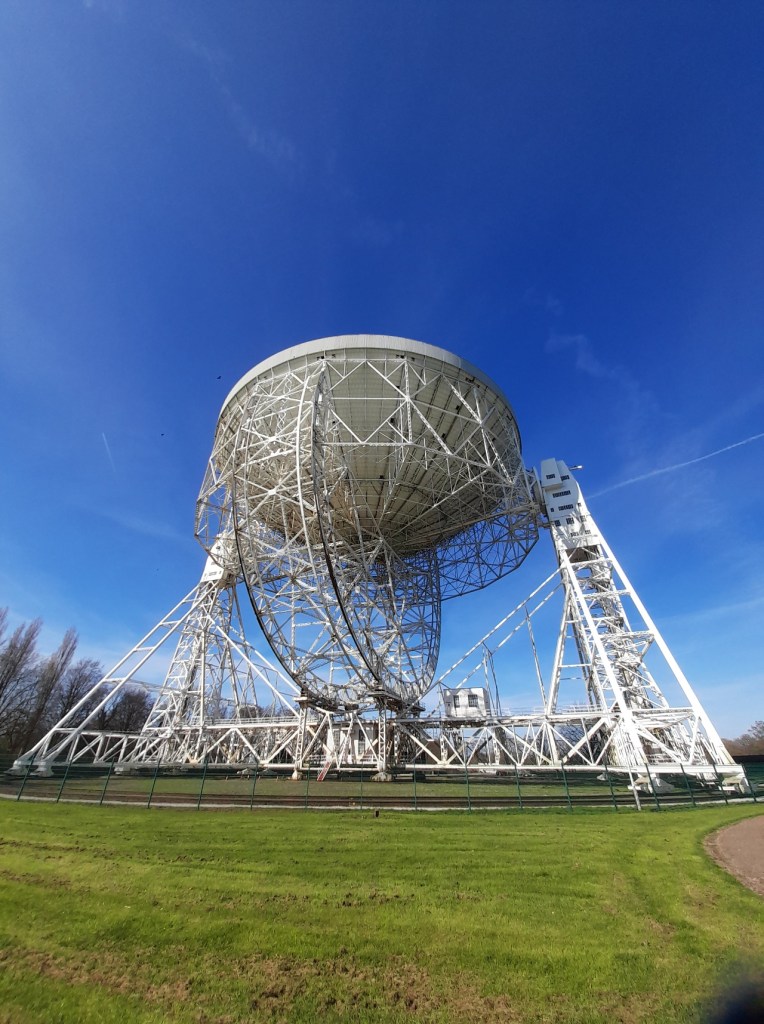
Jodrell Bank is amazing. Not just the dish itself, or the secondary dishes set up to monitor particular areas of research, but the history of it. I thought it went; the Government appointed Bernard Lovell to build the dish, he built it, lots of research and discovery. This is the true version…
Bernard Lovell worked on cosmic rays at Manchester University until 1939 before spending his war developing radar technology. At the end of the Second World War he bought a now-unwanted military radar unit to assist with his continued research into cosmic rays, but found that it picked up too much interference from the passing trams to be useful. He borrowed a remote area of land from the university’s botany department for two weeks, moved in his radar unit and never got around to giving the land back. It’s now the core of the Jodrell Bank site. Lovell used his results to persuade the university to let him build a more permanent radio telescope, but suffered from the usual problems of taking three times as long to build at ten times the original cost, even though he was using scrapped parts from retired battleships to build the steering mechanism.
There were increasing protests about the rising costs. Eventually Lovell was told that all support for the project was stopped and a committee was considering whether to prosecute him for misappropriating public funds on a crazy project. His children said years later that it was only then that they were told that their father was in serious trouble and might be sent to prison. Just before the decision was made, the Russians launched Sputnik and suddenly the British government wanted to throw money at the dish to get it built now, as in – NOW – so they could track that Russian rocket orbiting the Earth. The dish was finished in days and the debt was taken on by the Government.
It was so close, that line between a rusting half-built pile of junk in a Cheshire field and the first radio telescope in the world. All we could do was look up at it, all that white against a perfect blue sky, and wonder how many other brilliant ideas sank without being finished over the last century.
We spent a whole day there and it wasn’t enough. The First Light dome houses displays showing the whole project from empty field to the current set-up, plus the appearances the dish has made in music concerts, art installations and films over the decades. Parts of the original dish – removed during a recent refurbishment – are the bases for some of the displays. On our way back to the cafe for lunch, we passed through the room displaying information about our solar system, including a large orrery set into the ceiling. Turn a handle and the planets move around the Sun.
We agreed to stay on for the last lecture of the day, even though it meant we’d get caught in the rush hour traffic. I’m glad we did. The lecturer introduced himself as an explainer (he told us afterwards that he had no aptitude for scientific research as it existed today, but he certainly had a talent for getting complex ideas across in concise plain English).
And what ideas. Supernovae. Radio waves. The life cycle of stars (illustrated with an expandable ball). Gravity and the artificial version of it created by centrifugal force. For a finale, a practical demonstration of rocket power (not for the nervous, but I could see a classful of teenagers cheering him on. We piled out into the traffic just before Jodrell Bank boldly told everyone to go home and sat for 90 minutes in thick slow traffic. It was worth it.
 Julia Chalkley