I’ve been part of an OU graduates’ writing group since 2010, contributing to their anthologies of short stories and poetry in 2014 and 2015.
I didn’t take writing too seriously while I was in paid employment – holiday diaries, OU courses, small competitions. As other members of the group began to succeed in their writing careers, they suggested that I might join them in the blog race.
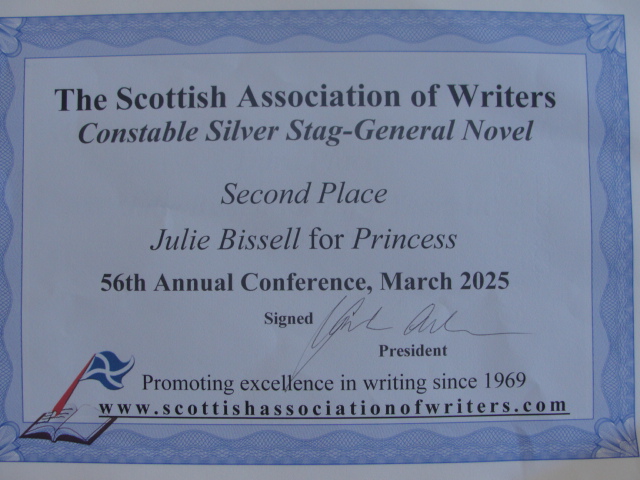
I have a few publishing credits – a dozen short stories in various anthologies, a couple of competition wins and shortlisted places. I’m hoping to publish my first novel early in 2026; the first two chapters took third place in the Scottish Association of Writers’ Constable Stag competition, and I have been working to improve the whole work ever since.
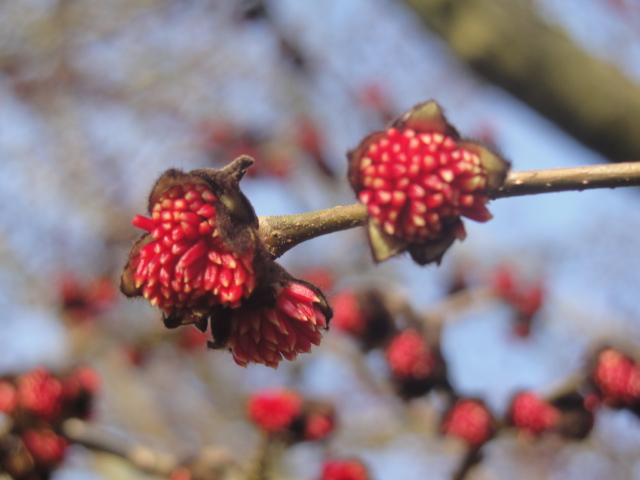
The photo above is my cack-handed attempt to capture the extraordinary sight I saw on February 18th last year. I was out in the garden on a sunny day and saw red dots on a beech tree. As I got closer, I could hear what sounded like hundreds of bees buzzing around, and actually yes, there were bees swarming over the tree, landing on one bright flower after another. I caught a few blurry shots of bees rushing away out of shot to get to the next blossom before I put the camera down and just enjoyed the sight and sound of an early spring.
What a difference a year makes. We’ve got off lightly here, but many areas of the country have had their entire average annual rainfall by now. The road past our house was closed for twelve hours while the authorities rescued cars and their occupants from a flooded stretch further down, and we gave up digging over the veg plot when the sleet started. Digging waterlogged clay soil is not so much digging as scraping the mud off your fork and spade every few minutes.
But the birds are hopeful. We have a blue-tit attacking his own reflection in our windows every few minutes for an hour every morning, a pair of ducks treating our pond as some kind of holiday retreat and the birds outside are singing that upbeat spring song, very different from the subdued chittering sound of winter.
The rain and cold has discouraged us from getting outside to get the garden prepared for this year’s growing season, but when it turns it will turn suddenly. I’ve been delaying planting those early seeds – peppers and tomatoes – as the last few years have been a case of plant in January, get seedlings that come up skinny and fall flat, plant again in March and get them coming up too late to crop. Sometime in the next week or two might be a better idea.
Right now, it’s blowing hard and cold and gusty outside (and inside, must check where it’s getting in) and I’m staying right here. The moment I get back out, I’ll be checking to see whether the beech has come out in those amazing red flowers again, or whether it is hiding from the weather like I am.
The sign is intended to mark the bay in the wood-shed where this year’s wood will be stored
Maybe a little late to wish a happy new year, but I will anyway. The year still has that hopeful feeling to it, a long time before we start to ask where the year went and what are we eating for Christmas dinner? Aubergine moussaka this year. Even the cat refused turkey scraps by the time Boxing Day dawned.
We cleared out the bay in the woodshed that housed wood from trees cut down during 2022 and swept it clear of leaves and bark and twigs. Tidiness that won’t last long. We’d already felled a dead elm along the hedge line during our Christmas garden work, and we still have a big pile of ash wood from the tree trimming a year ago. It will need to be cut to size before it can fit into the stove, but that’s a good job to do in the winter. As both sets of wood come from trees that have been dead for at least five years, they’ll need little drying in the woodshed before they can go onto the stove.
I paint the signs to mark the year the wood was cut, and this year for the first time, I needed to paint over a previous year. I’d painted the ‘2022’ sign as a pair of gold dragons with faces and red outlines; I overpainted the 202 and sanded off enough of the final ‘2’ to replace it with a ‘6’. This year’s choice is black and silver, but I’ve still given the figures dragon faces. It was easier than having to sand off half of the ‘2018’ on the other side of the block.
The Christmas task is a tradition we began while we were both at work. While he was able to take the whole of Christmas week as holiday, I had to negotiate with colleagues to get time off, and often they’d play their ‘Ah! But we have children’ card to get priority. Which I do understand when the child is still young enough to believe in Santa. When your child is nineteen and bringing his laundry home from university, pull the other one. My husband is my family, just as much as your adult kids are yours. Whatever time together we could spare, we got out into the garden (unless it was severely naff weather) and got on with one job. One year it was planting the final fifty trees in the hedge; another year, we finished building the compost bins. Our compost bays hold roughly five cubic metres of material each, so that was a serious job.
This year, we made a good start on our dead hedge. We saw a huge dead hedge at Sutton Hoo a few years ago and thought it was a good idea but too wide and sprawling for our garden; this year, we saw another at Beth Chatto’s garden and decided to follow their pattern. Progress so far – we’ve cleared the short stretch of fence where nothing grows except elm (briefly) and honeysuckle, repaired the neatly cut fence wire and hammered in the stakes we need to strengthen the fence posts that were installed over twenty years ago and to create the parallel line of posts to contain the cut branches. The wire fencing forms a retaining wall on the footpath side, while a series of very long cuttings from an overgrown section of beech hedging form a trellis to hold any shorter cuttings from spilling out onto the garden.
I’m on my way home from a week away with friends today and tomorrow (weather permitting) I hope to be back at work in the garden, filling in the rest of the dead hedge before the snowdrops are out in flower. I’m hoping this year will be happy and full of quiet achievements. It’s started well, at any rate.
Yeah, this one’s for all you scammers out there. I’ve had five or six posts over the last few years, but the pace is picking up; I’ve had four in the last two weeks and one of them was a prize winner.
Usually I get an email through the contact section of this page that tells me how much the person enjoyed reading my blog and then points out something that I have done wrong that could be improved in future. I took the first one at face value and went back to correct the spelling he’d pointed out. I looked for several minutes before realising that I had spelled that word correctly in the blog. The word was ‘inital’ according to the spammer. I wrote it off as a helpful person who couldn’t spell.
The next few had almost identical wording, all pointing out something ‘wrong’ in my blog that they could help me to correct. They can achieve stellar success in blog rankings and SEO scores, and I’m sure they charge reasonable prices for the service. But the easy way to get a 100% discount on a service is not to buy it.
This month’s crop of friendly ‘I can help you get more readers’ emails was followed by one that made me check the date. Not April 1st, not yet. The bot that wrote me the email really enjoyed my novel. You haven’t missed the publication date, by the way, I haven’t published a novel yet.
I mentioned this oddity to author friends (real, genuine, published author friends), only to find I was way down the rankings of targets. One author got a dozen of those emails a week. Block, delete, ignore is the standard response. That’s fine, even when a famous author contacts you to say how much they love your book. A little more spooky when a deceased author contacts you to say how your book has held them spellbound. Is it enough to block them, or do you need to call Ghostbusters?
As long as that’s all these bots do – offer to help – that’s fine. I may have seen the more sinister next step in this weird game and it’s a bit less amusing. A site that states that it will broadcast an author’s work for free (meaning no more book sales, no more royalties) unless said author pays the protection money to stop them.
Authors of the seventies, eighties and nineties – Jilly Cooper, Wilbur Smith, Dan Brown – wrote a book and earned money for it. These days? If you write a book, you’re an open target for people who do no work, can’t spell simple English words but are viciously determined to earn money on the back of your hard work.
If you don’t think writing is hard work, try it. Write a novel. Send it to friends and see how hard they laugh. Send your short story to a competition and see whether anyone hails you as the next big thing of literature or struggles for a polite response. It doesn’t work like that. My current novel is all but finished after years of drafting, re-writing, editing, editing again… and now? Almost afraid to put it out there, because I despise spammers and I value a quiet life. If I get novel spam before I publish, how much worse could it be?
Perhaps as bad as the two professional authors featured in an article in ‘The Bookseller’ magazine who reported that Goodreads published a one star review of their novel before anyone had read it. No author copies issued for review. In one case, the novel had just arrived back from the editor with a round of edits and was nowhere near being ready to publish. When the authors protested, Goodreads replied that the reviewer was entitled to post a review based on whether they imagined they’d enjoy the novel or not, and refused to take down the troll review. When The Bookseller contacted them for an interview, they changed their minds, but a new indie author is unlikely to have the chance of getting a big magazine to weigh in on their behalf.
Enter Amazon, who got their start as booksellers. Amazon, who are about to turn every Kindle publication into an e-pub and PDF version to sell alongside the Kindle-only format. That doesn’t sound drastic, till you think of a PDF as equivalent to a paperback. The paperback sold in a bookshop, that got passed to a friend, to a charity shop… one sale, one royalty payment, three readers. Multiply that. One paperback, one sale and an endless round of friends reading that one copy.
If that sounds okay, how chuffed would you have been if your employer paid you a tenth of the agreed salary? One read, one payment. If Jeff Bezos can’t afford that, I’m sure there’s food banks in America he can go to.
What can you do as a reader? Buy the damn book. Every author spent hours and months and sometimes years to get it readable. Paying them a pound to read it is fair. Borrow it from your library if you can; free to you, but the author gets an ALCS payment equivalent to a royalty. If you want something for nothing, ask yourself what you’d do for nothing. How many times did you work for free, wrote off overtime, told an employer to keep that final pay cheque to help them out? Commercial employers, never. Charities, maybe. Billionaires? Bugger off.
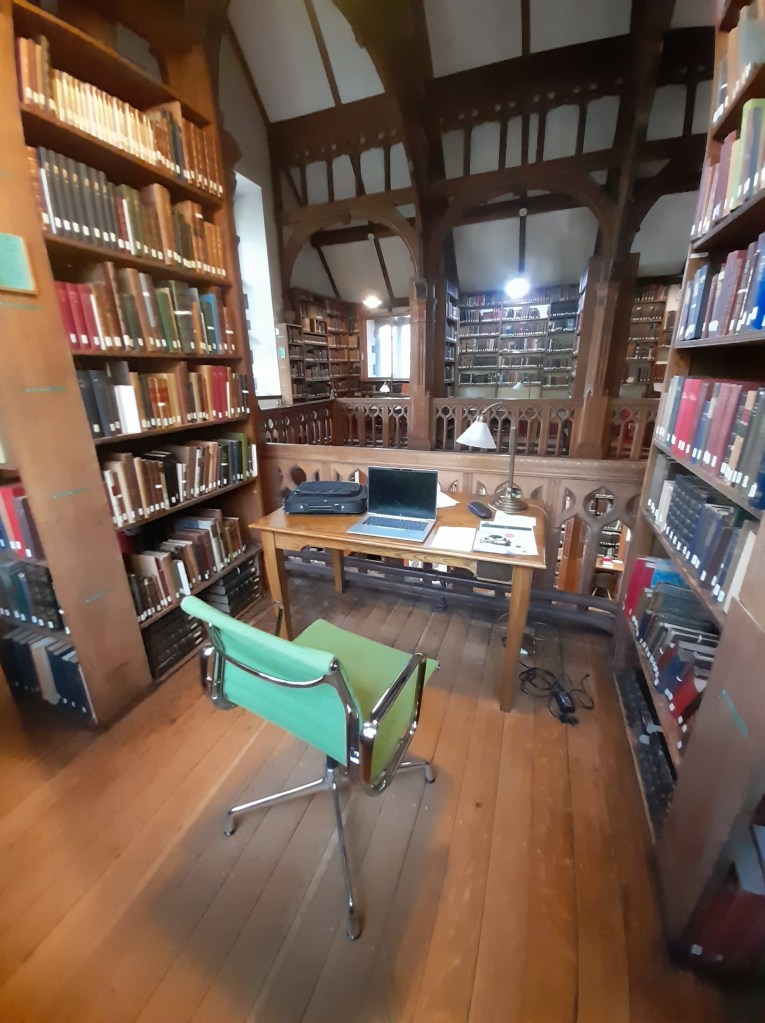
The desk in the History Room I chose for Saturday’s writing session
I have just returned from a writing holiday like no other. I’m trying to describe it, and there’s no sentence big enough. You’ll see the photo at the top of the page and understand it’s a library, but… this is Gladstone’s Library.
You can start with the fact that it is a library and move on to understand that it is the national monument to William Ewart Gladstone, politician for both major parties and Prime Minister for a large chunk of the 19th century. It’s a grand and sprawling building with acres of worked stone and dark wood which replaced Gladstone’s original structure of a ‘tin tabernacle’, put up to house his thousands of books towards the end of his life. It must be the only library in the country that insists on silence. I didn’t realise just how much I missed the traditional silent reading rooms until I walked in and heard nothing at all.
The Theology Room is about twice the size of the library in our nearest town, spread over two floors. Not just theology – though there are plenty of books on Christianity, Quaker faith and Judaism – it contains Celtic works, books about ley lines and witchcraft, ghosts and folklore. Next door is the History Room, and again, not just history. A small room just off the main History Room contains works concerning the Islamic faith. Many of the books on the ground floor are the original ones owned by Gladstone, rather than works donated by others or collected by the library. I don’t think the trustees mean to be funny when they ask readers to treat Gladstone’s own books with especial care – laying them on huge cushions to support their elderly spines, for example – to preserve these fragile items. The same books that Gladstone transported in wheelbarrows across the park and the street to the tin tabernacle.
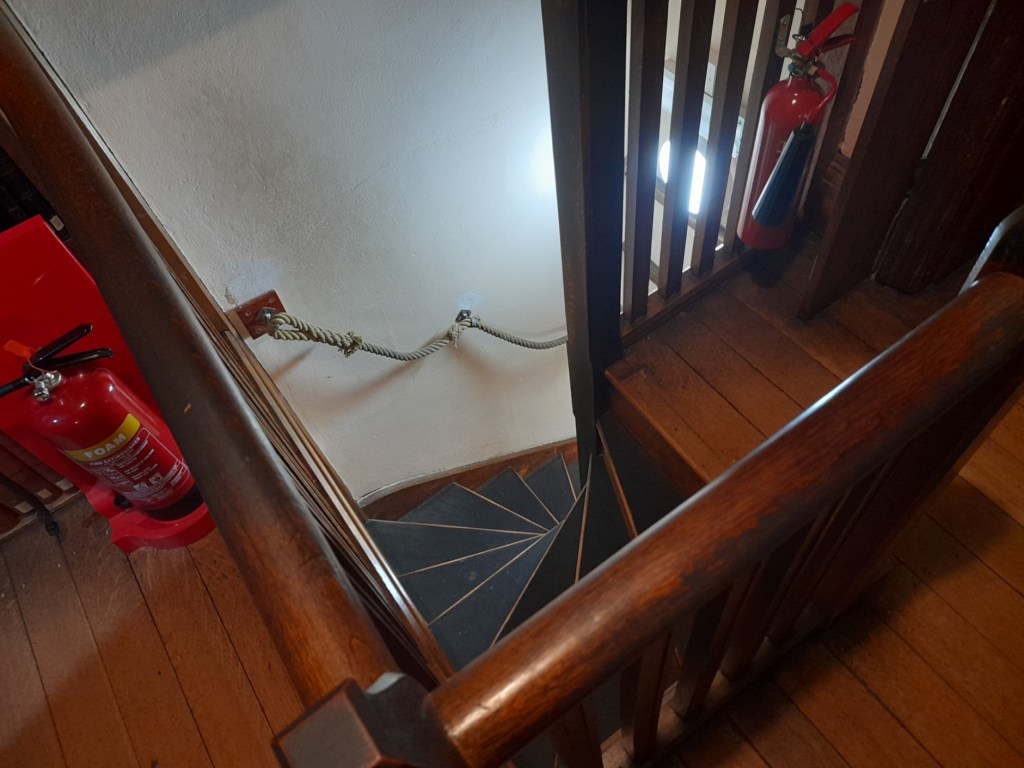
Tight spiral stairs between the ground floor and gallery
In the far corner of the History Room is a door that leads to the modern books. Stacked in those rolling cases designed to give the maximum amount of storage, each case is almost completely full. Literature. Poetry. Journals and magazines. History of Britain, Europe, all periods of time, particular histories such as the Suffragette movement. You’re welcome to take a book or more to your desk, or (for residents) back to your room for a night. Not off the premises and never to be propped open in the canteen while you eat your soup.
I took Pevsner’s ‘Buildings of Cambridgeshire’, the New Penguin Book of Welsh Short Stories and Christabel Pankhurst’s account of the suffragette movement. This was a history as far as the 1919 Act that gave a very strictly limited group of women the vote. It took until 1928 before British women were granted the right to vote on the same basis as men. If that sounds harsh, Switzerland didn’t grant equal voting rights to women until 1971. One interesting fact I found in Miss Pankhurst’s work was that the liberal-minded Gladstone – the politician who voted to end slavery in the British Empire and championed the right of all to have access to books and education – was apparently so set against extending the vote to women that he was seen as the main obstacle to full suffrage on every occasion it was put before his government.
Apart from the books, there are 33 comfortable bedrooms and a restaurant / cafe, a lounge for residents, rooms for groups to meet in and a chapel. Many of the rooms have names as well as numbers. Four or five are named after Gladstones – one is named for John of the Cross – and next time I visit, I want to stay in Room 25.
All they need to do now is rename the toilets after ‘Desperate Dan’
Anyone can turn up and ask for a card to give them access to the library for the day. Both library rooms are open from 9am till 5pm to anyone with a day card or a reader’s card. At 5pm, everyone is asked to leave the History Room and the Annexe and the doors are closed. The Theology Rooms remain open to residents until 10pm.
The Sisters in Crime loved it, and there were always a few of us in the library. Beth had returned from a day trip to Anglesey with a driving need to learn about the lives and beliefs of the Celts on the island, and her desk was decorated with piles of books on the subject.
It was chiefly a social gathering of the Sisters in Crime. The group gathered in the Anwyl and the Glynne rooms each day to discuss writing and to meet each other. We meet all the time on Zoom, but there is a different feel to meeting someone in person. A couple of people I have found interesting on Zoom and WhatsApp have now become friends, the kind I will make huge efforts to keep in touch. Though I admit the initial introduction session went on for so long my introvert fuse blew and I spent most of Saturday hiding in the library with my laptop and my latest writing project.
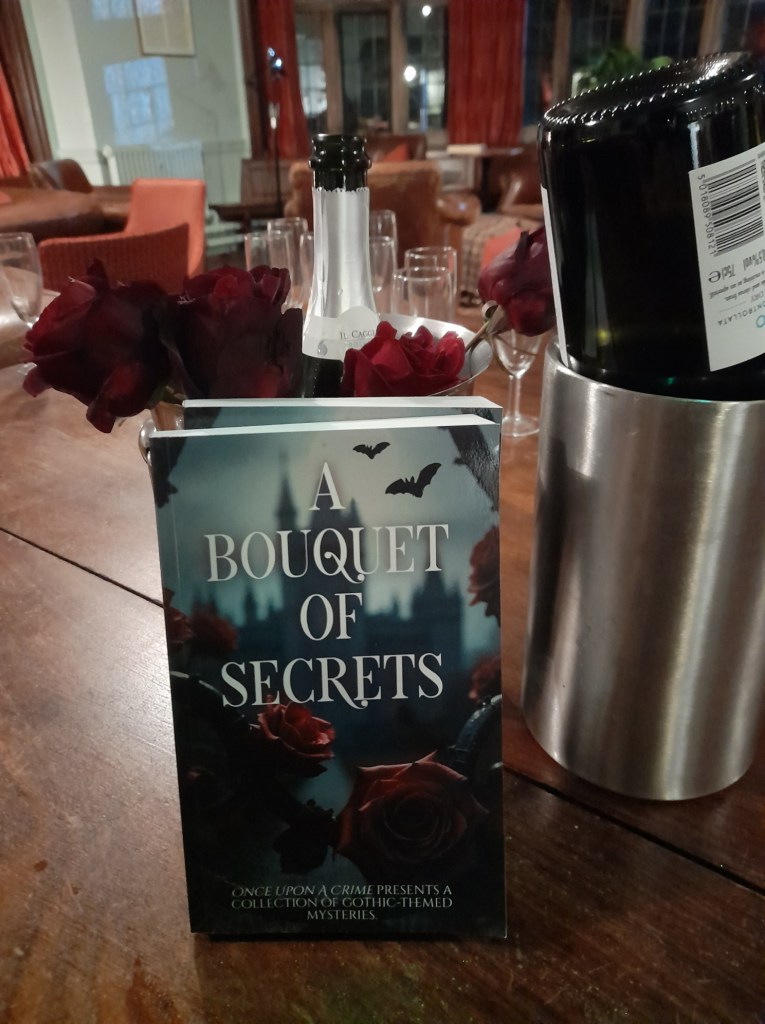
On the Friday night, we held a party to celebrate the launch of ‘A Bouquet of Secrets’ with Prosecco and Gothic fancy dress. No idea what the other guests at the library thought of it all, but we had fun. Everyone had a copy to pass around and eight of the group had contributed stories, so we swapped copies and signed.
The final day of the meeting was Remembrance Sunday. We all checked out of our rooms by 10am – I knew there’d be a queue, so I got up early and checked out at 9am. While I was loading my bag into the car, the local brass band was rehearsing by the war memorial. The road would be closed for their parade until 12.30, so I couldn’t have set off on my journey home until then.
We gathered in the Glynne Room for a goodbye session, then a final photo outside the library. Brilliant timing. Just as it started to rain. By the time I left the lunch and set off for home, it was traditional Welsh weather – raining with no sign of stopping. Just the right kind of weather to disappear into the library with a good book.
If you go down to the car park today, you’re in for a BIG surprise. Photo; Josh Withers, Unsplash
Coming up to Hallowe’en again, so I suppose I shouldn’t be surprised that the orange and black brigade have started up their annual whoo-hoo party. I had a manager who always got very upset by the fact that people marked Hallowe’en in any way at all; in his view they were inviting evil into their lives. I used to spend October listening to his grumpy lectures about stupid people disturbing things better left undisturbed.
I don’t disturb supernatural beings if I can help it, but I do run into some strange creatures all the same. I went to our local town last Friday with the intention of buying some tomato puree (for pizza, not ghastly blood-substitute decoration) and visiting the library. A woman got out of her car a few yards from ours and began fossicking in a bag. Within minutes, I was helping her get her arms into her giant orange T-Rex costume, and we were both giggling like kids.
She was a primary school teacher and her school thought they’d cheer up the students with a scary costume party on the last day of term. As she was explaining, she pressed a button somewhere and the suit inflated, leaving her waddling away as a rustling, giggling T-Rex over seven feet tall. I want one of those…
There’s all kinds of ways to approach Hallowe’en. My old manager would spend it lecturing the sinful and hammering the teachings of his own personal saviour into the ears of anyone who’d listen. I spend it as the old traditions of Samhain treat it – a day to remember those who have had a benevolent influence on your life and have now passed on. Whether you believe that their spirit has gone completely or has escaped into a different place, what these people have done to mould my character will live on for as long as I do and (if I can pass on that good to others) for much longer.
I’ll be thanking my aunt for being cheerful and patient while she taught me the basics of sewing. I’ll be thinking of the headmaster of my primary school, Kenneth Agar, who told my parents at their first parents’ evening that I showed a distinct spark of talent and they must encourage me to write as an adult. He was an author himself, but he encouraged every child in whatever they wanted to do, whether that was sport, music, art or academic studies. I’ll certainly be thinking of my parents and grandparents. Anyone who feels that Hallowe’en is only for scary tales and gory films should spend a minute thinking of their own dead and what they achieved in their lives.
That’s the thing. We’re all born, we all die, and it’s what we do between those two events that counts. Me, I hope I left a good legacy somehow. I hope that in years to come I’ll have people thinking of me at Samhain, smiling at something I said or did. I’ve got time yet to add to that number.
I will leave stories, including the Gothic crime flash in the ‘Bouquet of Secrets’ anthology. There’s been a hitch on Amazon, with its all-powerful AI deleting the anthology that was listed on its page because it felt there were too many author copies being ordered. Hello Amazon… 27 authors, some of them full-time crime writers with several novels and a busy schedule of author signings? If you did pre-order, go to Amazon and check they haven’t accidentally deleted it. Trust me, if you don’t enjoy the house that did the haunting you’ll love the black dog… or the spooky library… or many of the others.
Happy Samhain! May it be all good memories and no tricks.
In the final words of the Lord of the Rings trilogy; “Well, I’m back.”
We’ve just returned from a holiday that took us back to places we had been to before. Usually, I prefer to go to somewhere new. But the memories associated with this area is so good that I couldn’t stay away.
Let’s start with our base. Filey.
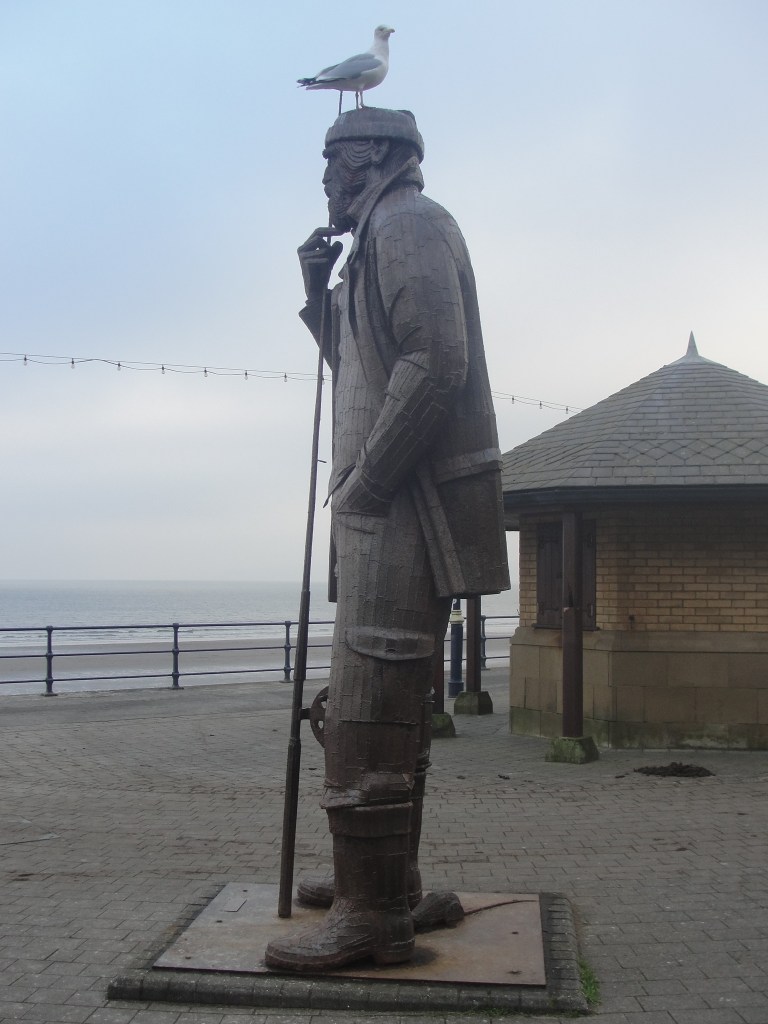
A High Tide in Short Wellies by Ray Lonsdale
I first saw this statue in 2015 and I love it. A giant fisherman staring out to sea, while a mouse creeps up on the fish wrapped in newspaper between his toes. The photo above was taken earlier this year. No, you don’t see a wrapped fish between his feet. Either the local vegans protested, or somebody hacked it off the base and stole it. Either way, shame on them.
The town is much as it was ten years ago, and that’s a large part of its charm. It can’t last forever, but right now it’s a great place. With the addition of a new gin distillery in the old smokehouse, for gin addicts.
Staithes
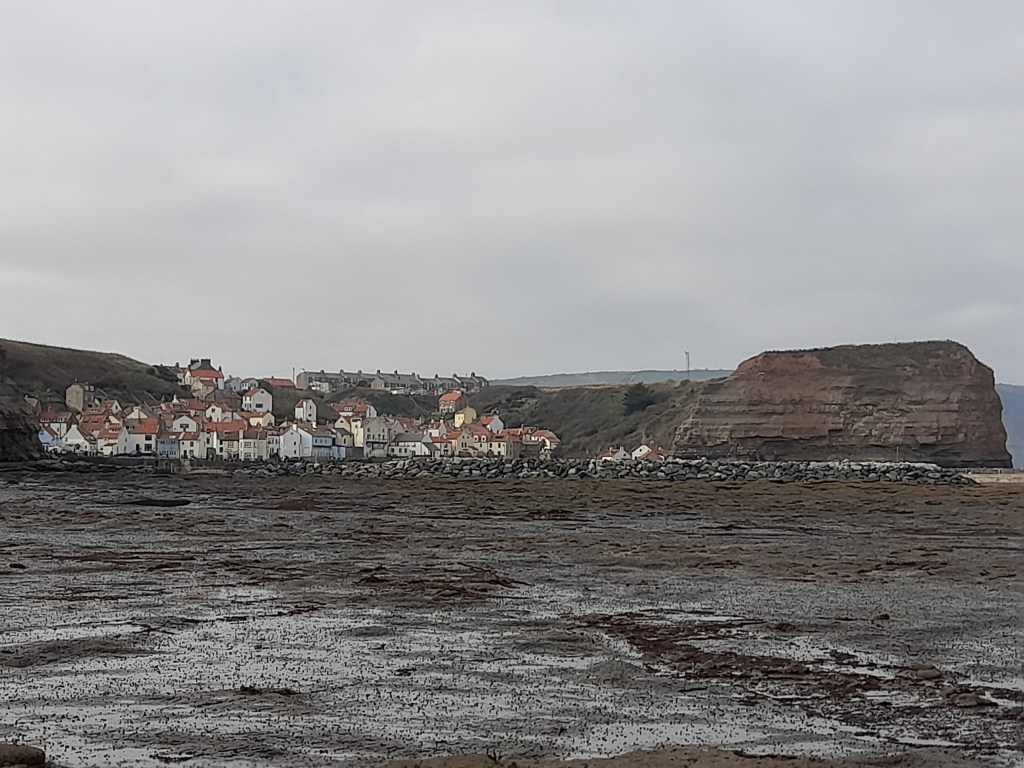
Staithes seen from Old Nab at low tide
I have been hoping to return to Staithes for decades. I was taken there on an Open University geology field trip in the early 2000’s and loved the place. Not so much the town, though it is pretty; more the foreshore below it. Staithes marks the northern end of Yorkshire’s Jurassic coast, where the oldest fossils can be found.
Anyone wanting to go fossil hunting at Staithes needs to be aware of the tide. The rocky beach barely slopes at all, meaning that the falling tide recedes very quickly and a rising tide gives virtually no warning before you’re ankle deep in water. The advice is to start your return journey to Staithes at or before the time of low tide.
We arrived at about halfway between high and low tide, and the sea was still covering all but a narrow ledge next to the cliff. That was the other piece of advice we were given; stay away from the cliffs. Minor rockfalls rattled down the cliff and exploded on the ledge while I was on my way out towards Old Nab. I’d been adopted by an amateur geologist who was leading me out to Old Nab and on towards the Port Mulgrave headland. He wore a hard hat, but even he stayed fifteen metres away from the cliffs.
We didn’t find any remnants of the Victorian train tracks running from the old ironstone mine at Mulgrave to Staithes, but we did find fossils. I brought back one stone full of tiny fossilised shells and one small ammonite, but I couldn’t find any of the sea-lilies I found on the OU trip. We parted company halfway to Port Mulgrave; he knew a way up the cliffs near the furthest headland and I went back to Staithes, finding a brick in a rockpool along the way.
I didn’t realise what it was until I visited the Staithes Museum on my way back to the car.
Next up… Whitby.
We spent Tuesday in Whitby. This was my fifth visit and the first time I’d gone as a free-range tourist while both the abbey and the Whitby Museum were open. The first visit was after sailing from Norway in 1995. The skipper brought us in to Whitby as he claimed it was a port of last resort – if you called them up, they had to let you in. The skipper knew a lot about the town, including the fact that the best chippy shut at 9pm so we’d have to average six knots for the next few hours if we wanted a proper fish supper. He and the first mate drove the boat hard and the last few hours were rough sailing, but we made it to the mouth of the river by eight o’clock. The waves were ringing the bell on the safe haven buoy like the Devil was coming to town and the Abbey’s ruined outline was lit up on the headland above. As we were tidying the ropes to get in, a rowing boat came out from the shelter of the harbour walls with the cox howling at the crew to Pull, Pull!
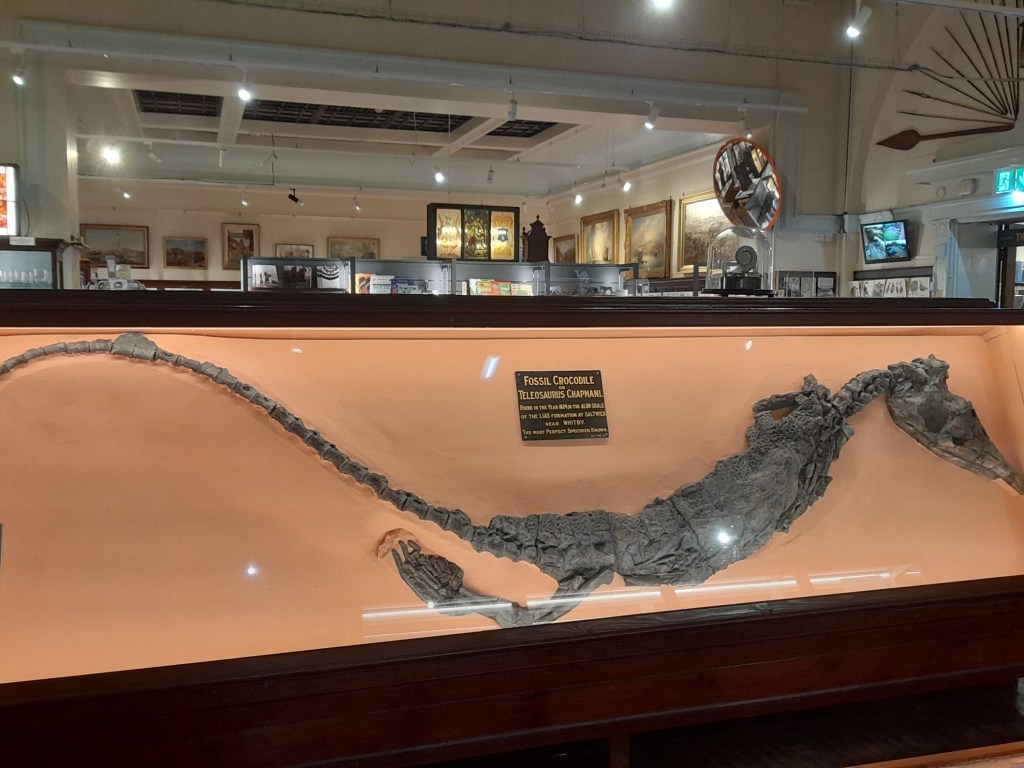
This visit was a lot less frantic. We spent six hours prowling around the Abbey, the shops of Whitby and the museum in Pannett Park. I had the chance to get close to the abbey walls, spent an hour in the geology section of the museum and now have another Lazy Lemon T-shirt warning anyone who cares to read the text on my chest that I really don’t like mornings (“I’m awake. That’s as good as you’re getting today”) And there are fossils on Whitby Beach, alongside the jet (and the dog poo). The legend has it that St Hilda turned all the snakes of the area to stone and threw them into the sea, which is a fair mediaeval explanation for the coiled forms of the ammonites you can find there. I didn’t have enough time to go hunting. I must go back, maybe during the next Goth Weekend.
Teleosaurus Chapmani in Whitby Museum
We were intending to travel to Scarborough by train but… trains once an hour, the next one cancelled and limited seats remaining on the rest, it didn’t sound too attractive. Park and Ride it was, then. A good choice, as the first stop was right outside the Rotunda Museum, the place I really wanted to see.
I’d been to the Rotunda in 2015 during a writers’ group meeting and always wanted to come back. Have to say that this year’s visit has cured me of that. There’s still some of the old Georgian charm in the place, but the recent refurbishment has stripped out many of the original wooden framed cases. It’s geared towards educating the kids now. Three very noisy groups of primary school children took over the place all morning, sprawled around on the floor and shrieking. We had to wait until they’d been herded off to their lunch before we could see the whole range of exhibits. It was great that the teachers led them through the basics of geology, but I miss the atmosphere of a serious Georgian museum.
An access ladder made in 1855 for £6 10 shillings and the spiral stair to the top floor
We spent the rest of our visit enjoying a superb lunch at Brewed next to the Rotunda, then wandered across the Spa Bridge to see what the park was like before getting back on the bus. We would have walked on the beach if the sea hadn’t been hogging it all, or walked into the centre of Scarborough to look at the independent shops in the Market Hall and then on to the marina. But our feet were aching and we just wanted to get back to Filey for the chance to loll on the sofa with a mug of tea.
Scarborough Marina is where our sailing holiday finished in 1995. We sailed from Whitby to Scarborough in light winds and helped the skipper tie his yacht to the marina wall (the marina dries at low tide and he wanted the yacht to lean quay-wards rather than topple into the mud). We went home on the train. Easier to do in those days as we lived in London, within walking distance of a station.
Flamborough Head from Reighton Gap
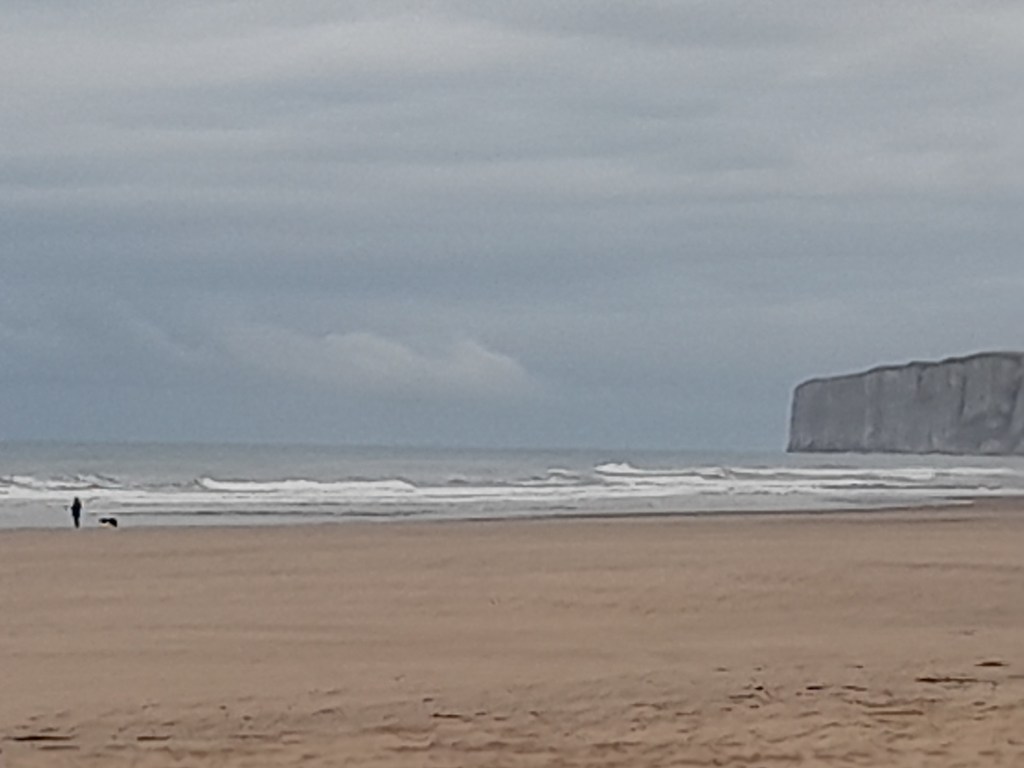
The last free morning of our holiday was spent at the far end of Filey Bay. We parked at Hunmanby Gap and walked along to Reighton. The tide was coming in the whole time so we had just an hour to enjoy the walk – enough time to get to Speeton, if we hadn’t been dawdling and fossil hunting. I found a couple of Gryphaea fossils from the clay cliffs to show Himself why they’re called Devil’s Toenails.
The following day we packed up and set off for home. The weather had turned to grey October with rain threatened for next week. The trees along the route were still flying yellow and red leaves but some of the branches had been blown bare. It won’t be long before the only green in the trees will be holly and ivy leaves.
It all started when Sara Paretsky grew tired of being the only female author at the crime writers’ conventions she attended. She started a group for female crime authors called ‘Sisters in Crime’, hoping to encourage other women to get those crime thrillers published.
There was obviously a need. The group grew and spread into other parts of the world, and I am now a member of the EU/UK chapter, even though my few attempts at crime stories have never made it into print. I don’t have a criminal mind, apparently, but I have been welcomed into this community of writers who can conjure up anything from knife in the back thrillers to amateur sleuth capers.
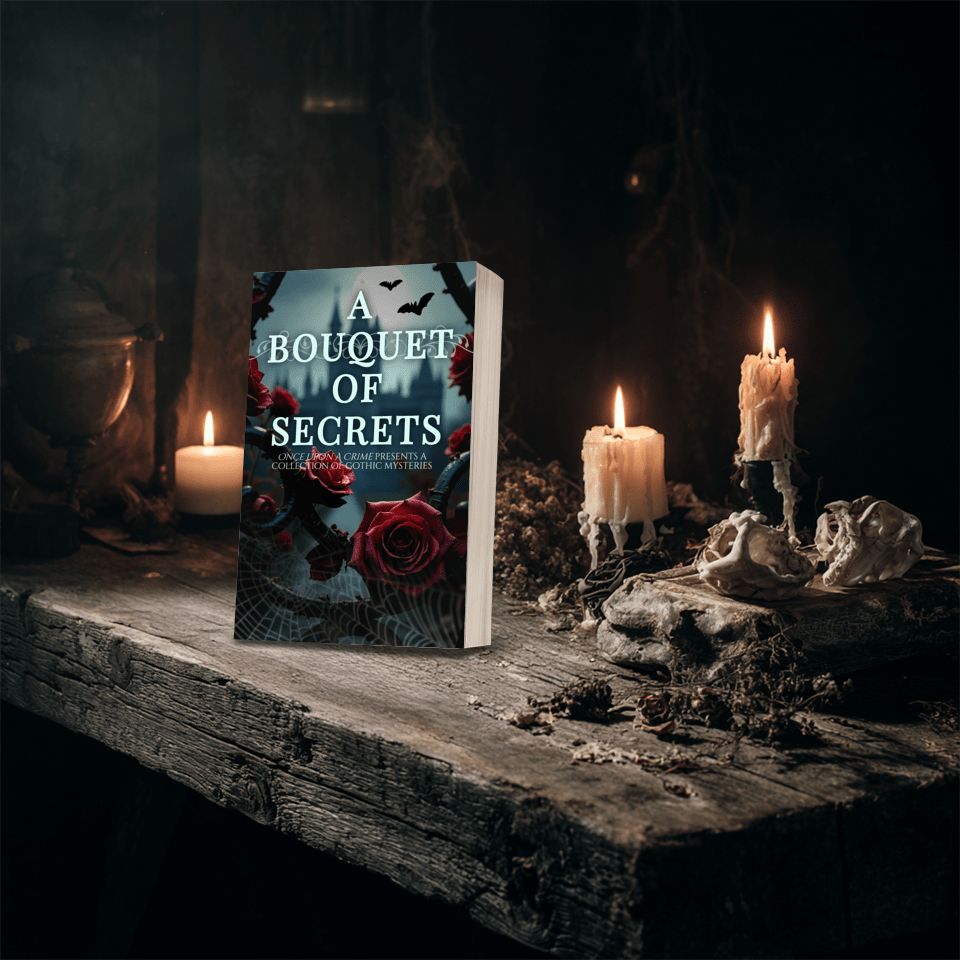
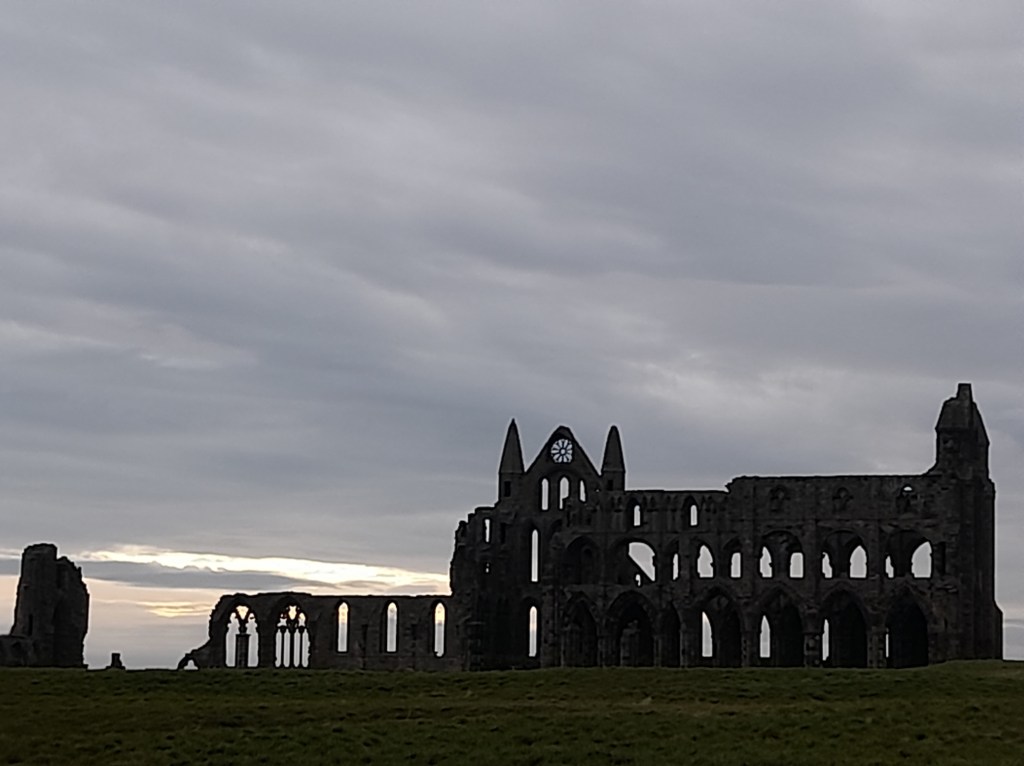
Last month, one of the Sisters announced that she was willing to edit an anthology of short stories and did anyone have the time to write a crime story with a Gothic setting? I didn’t have the time, but that word Gothic drew me in. Later this month I’m going for my fourth visit to Whitby Abbey, the setting for part of Bram Stoker’s ‘Dracula’, and that kind of imposing ruin has always impressed me.
Whitby Abbey on a winter evening, with the Moon shining through the window.
The nineteenth century was the golden age of all things Gothic in England, drawing inspiration from the ruins found during the Grand Tours around Europe and its Asian border countries. Half-destroyed castles. Neglected stately homes with dark and cobwebby corridors. Ruined abbeys. The Sisters had no objection to moving things along into the new century, so I took my character into an abandoned warehouse and locked him in the cellar. Darkness, cobwebs, mysterious noises… I live in an old house and that’s every night around here. I am so glad I have a pet cat (‘Sasha, go to sleep!’).
Anyone with time to read and a yen for creepy crime could do worse than buy the anthology. ‘A Bouquet of Secrets’ is available for pre-order on Amazon now, and is due for release on October 31st (of course!). There are some talented crime novelists in there, and I’m looking forward to reading their interpretation of Gothic. They’re all probably creepier than an idiot hero who thinks it’s a laff to go exploring an abandoned warehouse…
Bats must be so tired of being used as a horror motif. They’re just me with wings… all they want to do is sleep all day.
Most of the litter was soft drink cans. Guys, this doesn’t biodegrade…
I was out with a group of people on a youth club trip in 1975, and we stopped partway to our destination for a break to stretch our legs in a local wood. I went out to explore while the tea was brewing and came back with an empty plastic compost bag that had been dumped in the stream. I stuffed the bag into the litter bin nearby, and the rest of the group just watched me like I’d grown green fur and horns. I tried to explain about the Conservation Corps and their drive to improve the environment, and they said “Riiight…. So is it okay if we leave some of our urine behind this bush, or will you want to scrape it up?”
Fifty years on and I’m still that person, though I admit I can’t bend down to pick up litter as easily as I could back then. So I was pleased to hear that our local library hired out litter-picking equipment. Long-handled picker, gloves, hi-vis vest and purple bags. I was in town last week to get the encrusted calcium chipped off my fangs (dental hygiene appointment) and took a few minutes to drop in and pick up a litter kit.
It took a few days to find the time, but Saturday was the day. Even so, there were several other jobs waiting for me and I had to say very firmly that I was going out for an hour to pick up litter.
An hour turned into two, and then some. Two purple bags filled with rubbish – mainly drinks cans (one of them unopened), though plastic sweet packets and bottles also featured heavily. Once I got my eye in, it was easy to spot; if it had straight edges or bright colours, it was likely to be litter. Special mention for the two unopened packs of some kind of medical tablets – not prescription, or I’d have dumped them in the garden of whoever it was assigned to. Four wheel trims, all from different makes of car, and a rusty iron bar. And of course, the traditional plastic Evian bottle containing either whiskey or the piddle of a severely dehydrated person. So grateful for the arms-length picker on this trip.
It does leave me wondering what kind of pillock can go to the effort of opening a window to throw out a can of drink but doesn’t understand that it’s less hassle to just drop the rubbish into the passenger footwell and dispose of it at home. Maybe they’re going home to mummy and daddy and they’re afraid of admitting that they drink Red Bull?
Don’t be a litter-bugger. You can keep it in. This is the second time this year I’ve had to clean up our street, and I have better things to do with my time.
A quick update. I lugged the two bags full of rubbish home on Saturday, but I left the glass bottles and wheel trims there because I had my hands full. Went back on Tuesday to collect the glass (for recycling) and wheel trims (for a fresh litter sack). Already half a dozen items of litter chucked out onto the verges, including an empty can of Red Bull in exactly the same place as last time. Disheartening.
Image by Mouse23, Pixabay… I was too busy smelling the lavender to take a photo
Last month’s adventure was a trip to the Self Publishing Show in London. I went last year, drawn in by an author friend, but this year I was going back with intent. I had so many questions that I’d wear a big hole in any friendship with them all, so I would be asking those questions to the sponsors at the stalls.
Just like last year, I booked a room at the Mad Hatter Inn in Southwark. The building was once a hat factory owned by the Tress family, but it cheers up its industrial past by putting Alice in Wonderland references everywhere. My room had pictures of the White Rabbit anxiously checking the time and Alice reading the label on the bottle (“Drink me”), while the dining room was decorated with various characters from the Alice books. Including the Blue Caterpillar inhaling smoke from a bong, and I’m told this was one of the Tenniel illustrations to the first edition. Tenniel probably drew the author sitting cross-eyed at his own bong, from the general crazy whirl of the plots.
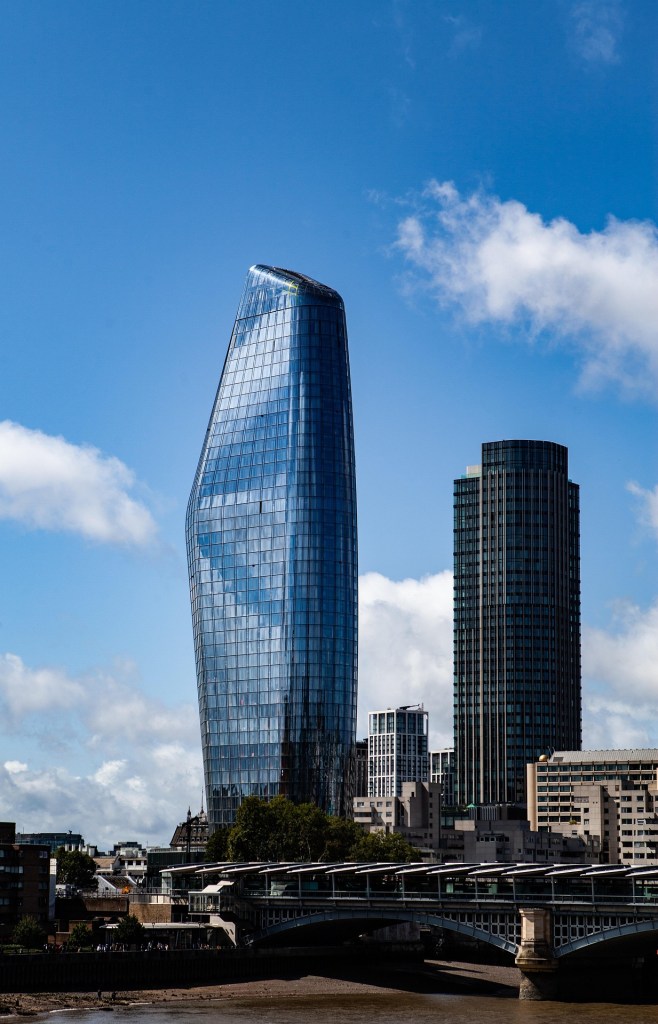
One Blackfriars by TheOtherKev, Pixabay
Last year I had a room on the first floor overlooking the waste ground behind the hotel. It gave me a view of what was behind a tall wooden fence – the rough ground and weeds and wildlife of a site ready to be built on. This year, I was given a room on the third floor, and on the side facing the Thames. Not that I got a view of the Thames. I was looking directly at One Blackfriars, the curvy glass tower that is on the same scale as the Gherkin and the Shard – after planning objections cut its height by a hundred metres or so. As with all residential developments, it came with a side-order of ‘affordable homes’ – in this case, in a separate concrete building on a nearby street, thereby dividing its inhabitants from the gorgeous views and smart facilities enjoyed by residents of One Blackfriars itself. I couldn’t see the topmost towers without putting my face to the glass of the window and really craning my head. It was spooky from evening onwards, and I couldn’t help but think of the Twin Towers every time I saw it. Lovely for its rich inhabitants, but a crap neighbour.
This year I knew that things could be different. I walked to the show each day and I knew the route included a few hundred metres along Stamford Street (traffic, June heatwave, noisy) before reaching a cut-through to the Thames through a pair of quiet, cool parks called the Bernie Spain Gardens. From the entrance of the southern garden you can see through the trees to the buildings on the north bank of the Thames. The first garden is a sunken lawn built on the basement hollow of a demolished building, with flower beds all around it and narrow paths diverting through stands of trees and tall shrubs. From the centre of those small paths, all you can see in any direction is tree or shrub. Lavender and honeysuckle kept the air scented everywhere.
Just beyond the wall enclosing the park are flats. Three stories tall, unintrusive and looking out onto the gardens – I would have loved to live there. Very different from the side-street block of the One Blackfriars affordable housing, where the view was of a non-descript building across a dark street.
At the northern end of this park is a road with speed humps to slow the traffic and just across that road is the wide lawn and bushes of the northern Bernie Spain garden. From here, the Thames is in view. It’s a straight amble to the Thames across the garden alongside Gabriel’s Wharf, a group of independent shops and street-food businesses. There’s a line of food trucks and shack-type restaurants all the way along the South Bank from here to the Festival Hall.
The signage at the entrance to the gardens answered my question about who Bernie Spain was. She was a psychologist living in Waterloo, in the Coin Street area, and seemed to be always a campaigner. She worked to have a community hospital built in Lambeth and spoke out on behalf of her patients. When she heard about plans to build a huge complex of office buildings between Coin Street and the river, she organised the residents to form an action group and begin fighting.
If the development company had won, one resident described their plans as a “Berlin Wall” that would have completely cut off access to the South Bank for the residents living just a few hundred metres from the river, meaning a long walk along busy London A-roads to the nearest bridges. Bernie wouldn’t give up. She set up signs saying; “London needs another office block like it needs another plague”, and fought the company all the way through the courts. The company gave up its plans on one site just before Bernie’s death in 1984 and gave up the second site months later. The Coin Street Action Group bought both sites and organised a community gardening scheme to have both sites planted and maintained.
I couldn’t help thinking that Bernadette Spain might have had other plans for the last seven years of her life, something that didn’t involve standing up against teams of corporate lawyers intent on making wealth for their clients. Seeing what she did achieve with those years made me very glad she didn’t just give in and move. The walk through those gardens was something I looked forward to in the months approaching the Self Publishing Show.
And yes, I got the answers I was looking for. But as is the way with all projects, more questions have cropped up since then. The first draft of ‘Shilling Cove’ is about to come under the eye of an editor who will definitely tell it like it is, and after that, I can release it into the wild and turn my attention to the next project. Just hoping this one will take less than five years to finish. Bernadette Spain, how did you find the energy?
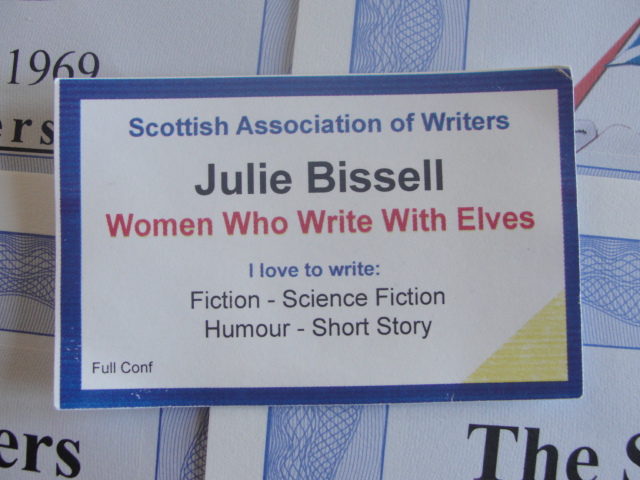
Back in March, we went to the annual Scottish Association of Writers’ annual conference at Cumbernauld, with a few days walking around Northumberland as a treat along the way. I had to go to hand back the Largs Shield, and this time I knew I wouldn’t be winning it back because their rules (very sensibly) forbid anyone from entering the same competition for two years if they have just won it two years in a row. It was sad to hand it over, but I had given it a good polish and hoped it would cheer up somebody else for a year or two.
Bit of a strange one this year, as we had so much trouble booking a room back in October last year that I gave up. Face it, if you ring a hotel and ask to book a room some months in advance, you don’t expect the clerk to hesitate and say that he wasn’t sure if he could do that. I understand now that I probably caught them on the day when the staff had been told that the Westerwood had been sold to another chain, and that the clerk didn’t know what would be happening to the place in six months’ time. I’m sure next year we’ll be able to book a room with no trouble. The accommodation we found instead was a warm and spacious cottage run by a friendly couple in the house next door, so no complaints there. I did promise to friends at the Westerwood that if there was another fire at their hotel, we would be there in ten minutes with a vehicle to sit in and some warm clothing while they waited for the fire brigade.
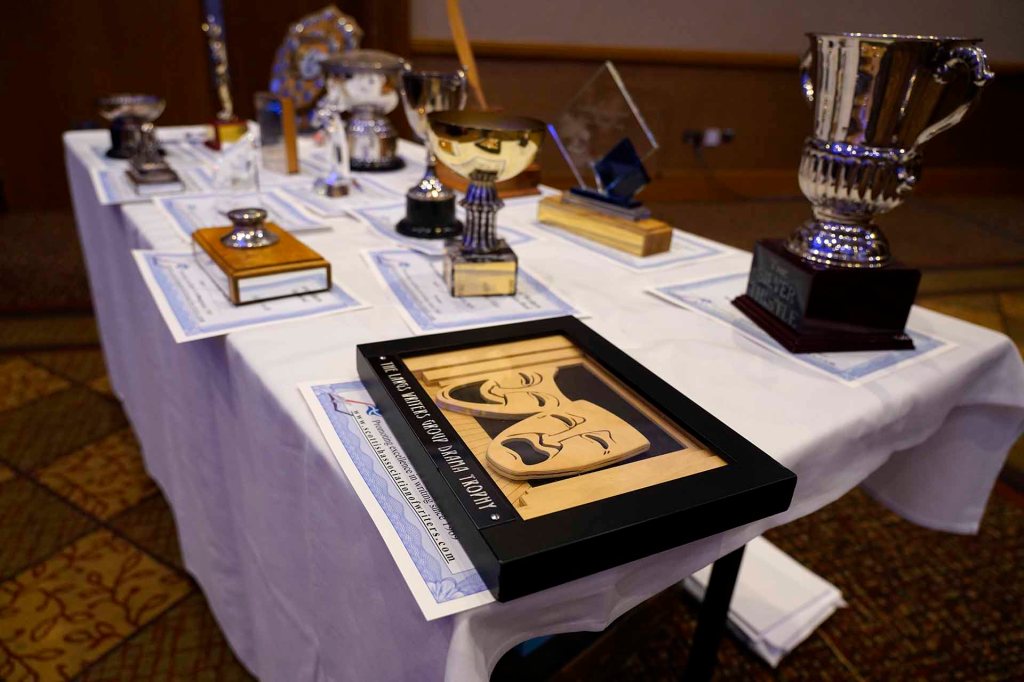
The trophies laid out ready to be presented. Photo by Grahame Anderson
I may have given back the Largs, but I went in hopes of getting a mention for a different competition. Not disappointed. I got fourth for the humorous short story again and had a special mention for the best first line of all the entries in that contest. Nice start, shame about the punchline. Fourth place for a 30 minute TV pilot, even though I don’t watch TV series (Broadchurch and The Detectorists have been the only exception in the last ten years). Third place for a general article. I put in a novel extract at the last minute, and I do mean last minute; I submitted the entry with ten minutes to spare before the deadline. The idea was one I wrote as part of the 29 Plays Later challenge in February 2024, but I wrote the prequel to that play as a prose novel extract all on the last day – woke up at 8am with the thought that it would make a good novel idea and spent the entire day writing it out. It was rough, and I didn’t expect it to get anywhere, but I was interested to know what the judge thought of the idea. The feedback the judges provide is always worth the entry fee, even if they let you know you were sitting at the bottom of their list.
Sometimes, the judges surprise you. It helps that this was a twelfth century princess and the judge had a soft spot for historical drama.
My friends got their own mentions. Sue took second place for the Largs Shield, Elizabeth picked up a series of certificates and Mairi won the Helensburgh Shield for her TV pilot – described by the judge as good enough to pitch to a TV station, although he admitted that all the stations were looking to reduce their drama offerings.
Add to that, the Northumberland highlights… the Vindolanda Trust has broken the turf on this year’s excavation site (the final quarter of the soldiers’ area) and has started excavations at the Roman Military Museum seven miles away; the Sycamore Gap stump is sending up sprouts; and I finally got to see the Falkirk Wheel in motion. It’s still shut for repairs, but that’s just an excuse to go back next year for a boat trip (and the Kelpies).
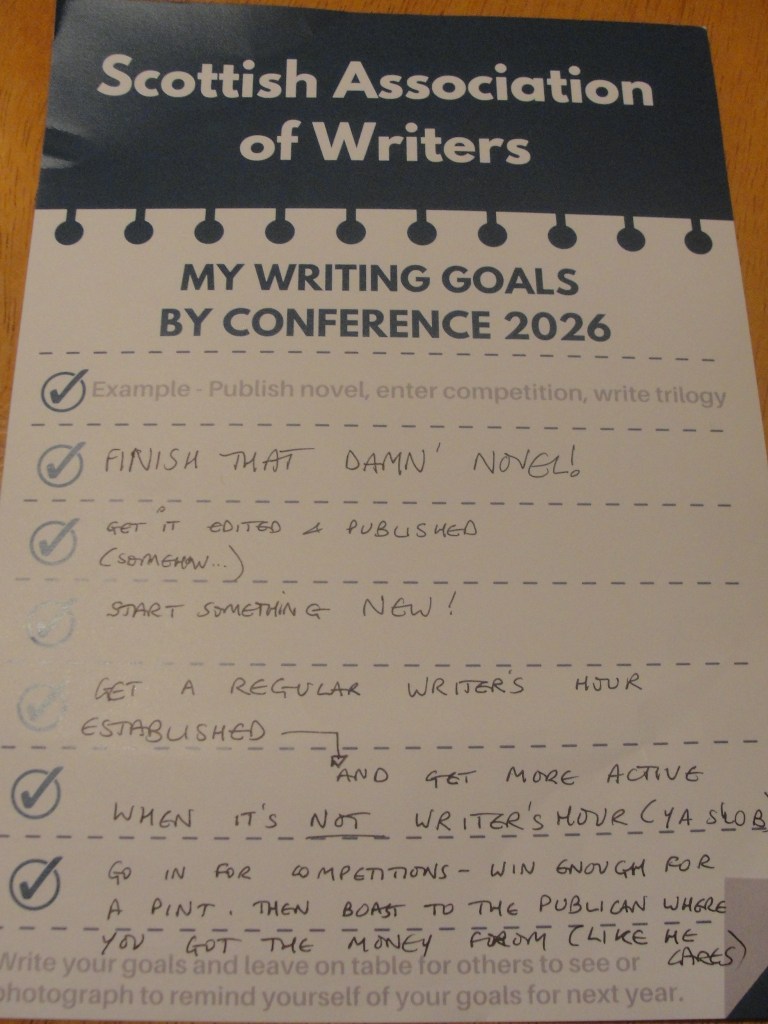
This year, SAW invited us to fill in sheets saying what goals we set ourselves for the next twelve months. We’ll see.













 Julia Chalkley