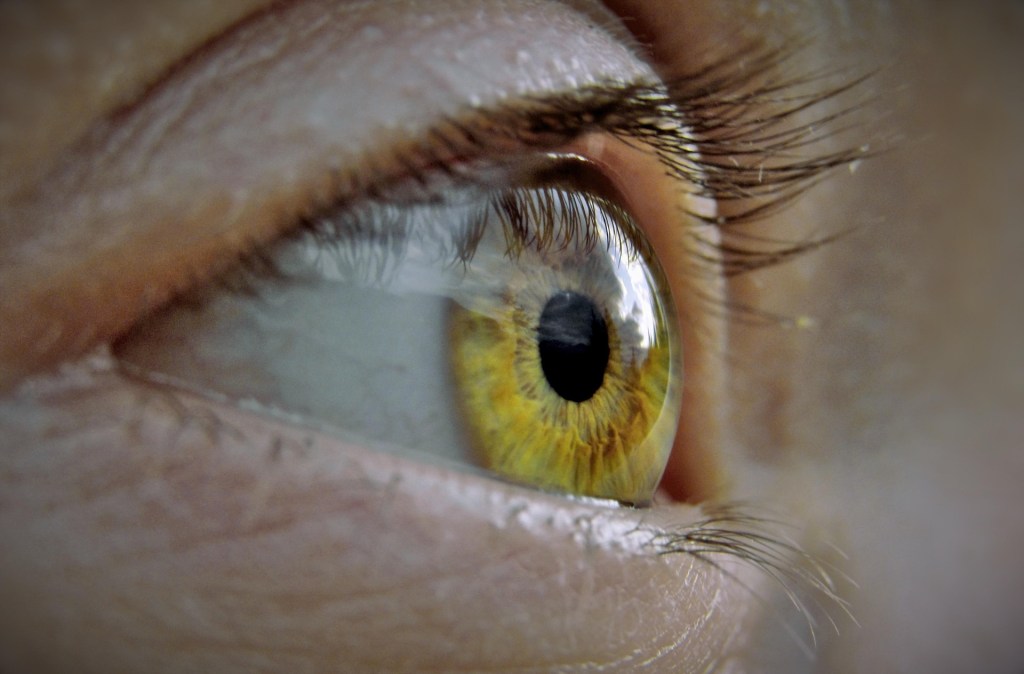
Someone commented recently that I hadn’t posted for a long time. It wasn’t for lack of things to say; more because I’ve been struggling with my eyesight.
The last post was made just after our holiday in north Norfolk. During that holiday, I came out of a shop into a sunny October day – pale blue sky, low sun – and something flashed in my eye. I thought at the time it was the sun reflected off a car windscreen or mirror, but it was intense – more like a flashlight shone directly into my eye from close range. I could see a bright spot right in the centre of my vision. That’s happened before when I’ve caught a flash of sunlight, but this was different. This didn’t fade away.
I’ve had worsening short sight all my life, and worn spectacles since I was nine. I got my first migraine at eleven, when I lost half the sight in one eye for an afternoon. Then I had that weird spot on my retina (that thankfully cleared up) – and the possible retinal tear that panicked my optician into sending me to Moorfields as an emergency (false alarm, thankfully) – and the cataracts that went from slight to operable within two years. I have had enough sight scares to have a fair idea of how fragile the line between seeing and blindness can be.
The cataract operations were terrifying, but they gave me near-perfect sight and freed me from my specs – apart from reading specs, which half the time are on my nose and the other half the time are set down somewhere so safe that I cannot find them. I’ve had almost five years enjoying – really, seriously enjoying – being able to see clearly all the time. The thought of losing sight in one eye was horrible.
I spent a couple of weeks suffering headaches if I tried to read or write for any length of time. The word I was looking at directly vanished into a blank spot, leaving the rest of the text clear around it – a kind of literary hide and seek. Look at a word and it’s gone. Exactly like the worst of my migraines.
The optometrist was amazing. She examined my eye very carefully and said that one eye had just undergone the natural process of vitreous separation, that it had completed without any perceptible problems and that the retina had probably caught very slightly and been ‘twanged’. She advised taking no action other than returning immediately if I noticed any worsening of symptoms. That was fine by me, as I’m a coward about eye operations.
Fingers crossed as I write this, but my sight seems to be fine now. I still have that clear post-cataract vision; the missing text came back within a fortnight and is still visible. I’m starting to believe I can keep this clear sight for at least a few more years yet, and lifting my head up to see what’s ahead for me.
A couple of months ago I sent two stories in to a Globe Soup contest. It was set up as historical fiction; buy a ticket and be assigned a historical period at random. I ended up sending in two stories, one about a blacksmith’s son who achieved his ambition of getting a place in the Roman fort near his village and one about a teenage girl who was one of a very few in her village to survive the Black Death.
As always, I spent more time on one story than the other, and grew to be more fond of the characters (that doesn’t mean I didn’t treat them badly, mind; just that I felt sorry for them when I did). And as always, I was looking elsewhere when the results came out. I was shortlisted for one of the stories – not sure which, but I suspect my native blacksmith – and a friend of mine, Sue Cook, was shortlisted for her Roman Empire story.
The winner of that contest was yet another Roman Empire tale. I know Globe Soup has writers from all over the world taking part, but it does seem that the Roman Empire set off a lot of different tales. The winner’s story revolved around the trade in purple dye – my hero ran the bath-house and scrubbed Roman backs. In both cases, the Romans caused a big problem for the native workers they employed.
Sue has finished her story for the Christmas crime anthology (available to pre-order now at https://www.amazon.co.uk/dp/B0DKG4TP9Q ) and has gone back to writing her novel based in mediaeval times. I’m fighting through one of those really cluttered times – one or two appointments every day and a lot of driving to get there – but after that, I will go back to my novel about what happens when you tell a real whopper of a lie and get away with it for a bit too long.
And of course – there’s Globe Soup’s short story competition. And the question of where to send my Roman bath-boy next.
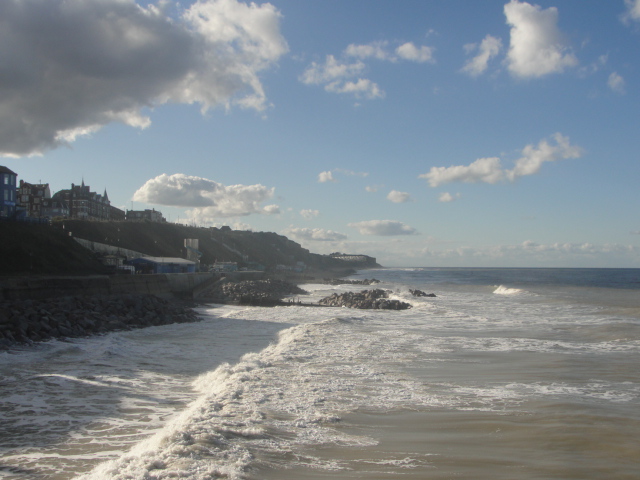
It’s Cromer, but maybe not as you know it. The beach is closed for about half a mile near the pier for ‘works’ – looks like a shipload of granite blocks have been dumped next to the esplanade with a couple of hills of granite left thirty yards further out in an attempt to protect the sea wall itself. Sadly, that often impacts on the cliffs just beyond the protected zone, so there may be more erosion along the walk to East Runton in future. Good for fossil hunting – not so great for the houses and businesses on the cliff tops.
We were staying a mile east of Cromer this time. We walked down from the cliffs to the beach where the Banksy was sprayed onto the wall. There’s not much left of it now after two years of fierce storms on a stony beach and one graffiti attack – I was looking at the wall it was on without seeing it, and from recent reports it’s down to some faded paint blotches and a white square with some black marks. From there we had a good walk to Cromer itself.
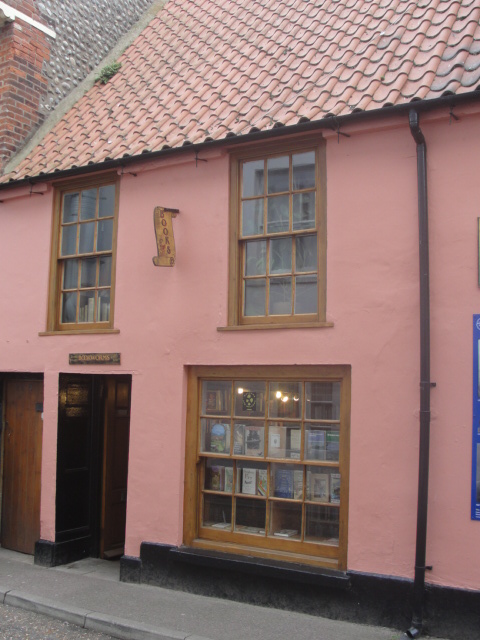
Bookworms… last surviving secondhand bookshop in Cromer
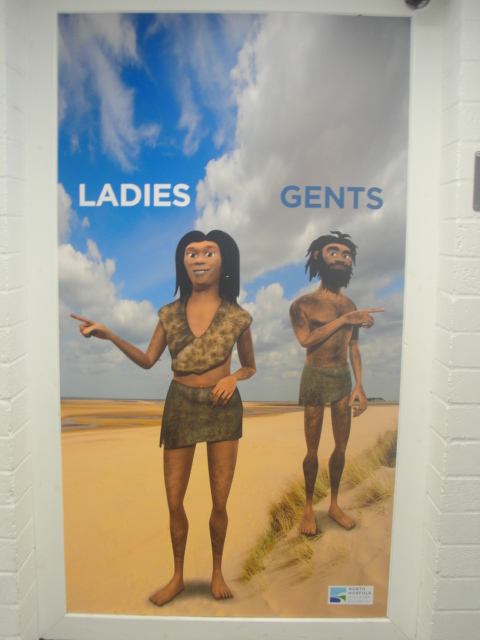
We had a list of places to visit, too long for us to make it all the way around. We did get to Bookworms, the tiny secondhand bookshop near the pier, but the other two secondhand bookshops have closed for good (one’s an art gallery – one is closed with all the stock still gathering dust on the shelves). No. 1 the chippie is still there and serving the best fish and chips (and veggie alternatives) in Cromer. And the Neanderthals from the Deep History Coast still point the way to the correct toilet.
Ladies pee in the sea… Gents water the dunes. Actually, no, please don’t.
We did get the chance to eat at The Grove Hotel’s Sundowner marquee – brilliant tapas and mild jerk chicken pizza. And visit Felbrigg Hall, though yet again we didn’t get as far as the house – arriving on the one day of the year they hosted a massive sponsored run. The place was packed, and everyone seemed to have brought at least one dog with them. We’re really not keen on crowds. We had a long walk around the walled gardens in the cold, then went to rescue a large bagful of books and six plants. In two cases, ‘rescue’ is the right word; two big peony plants that might be dead right down to the roots, or might be waiting for spring to fetch them back. Fifty pence for plants that cost sixteen pounds originally, it’s worth the risk. Our peony plant in Chingford suffered twenty years of neglect from us and came up with beautiful silky red blooms every June.
Three days in Cromer, and then on to Pentney. Along the way, we went to Holkham Hall. We’d walked west along Holkham Beach on our previous visit, and this time we wanted to walk east, as far as Wells Lifeboat Station. Great walk in the sunshine; about four miles in total, though any walk on soft sand feels like twice the distance. We drove down to Holkham Hall afterwards for lunch and got tempted into booking on the Cellar Tour the following day (and the Attic Tour next Wednesday).
No photography allowed in the cellars, but photos really can’t do it justice. It’s a world all of its own. The original builder of Holkham Hall spent his Grand Tour studying the architecture of great halls in Europe, and brought home his favourite ideas. What lies under Holkham Hall is a network of comfortable walkways connecting servants’ stairs up to key rooms above, windows opening onto the north to chill the larder, a huge woodstore and a stray Tudor window.
Buddha’s Hand citrus in the Walled Garden at Holkham
We finished the Cellar Tour with a visit to the Walled Garden. Apparently, one of the early Earls got fed up with the busyness right next to the hall and had the Walled Gardens relocated – almost a mile away. If you have a back yard of 25,000 acres, I suppose a mile is ‘nearby’. It was worth the walk, but it would have taken another mile of walking to cover the whole lot. After a couple of greenhouses, the Melon Pit, the Pineapple Pit, several flower beds and the vegetable garden we were done in.
Our accommodation in Pentney was at the Energise Spa. Small, but excellent. Outdoor pool with jets, indoor swimming pool, saunas and steam room. I had the entire pool to myself twice during our visit, and there is nothing much better than a pool full of warm, clean water and empty of everyone else to swim in.
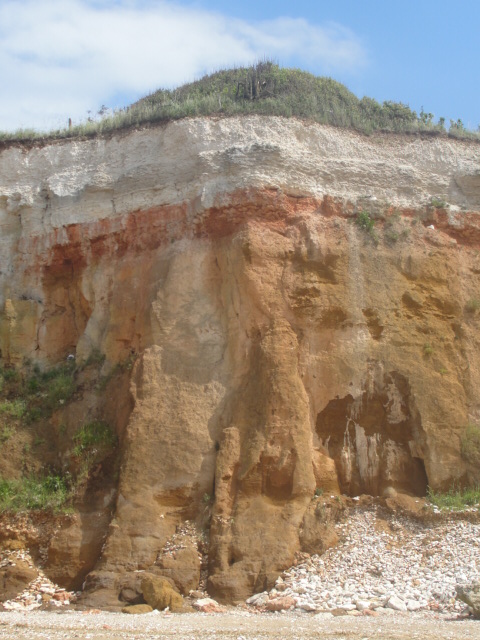
The cliffs at Hunstanton. 113 million years of geology.
Our final day in Norfolk was a return trip to Hunstanton. Sunshine, warmth, a walk from the lighthouse to Hunstanton along the beach and back along the cliff top. Not sure there’s a much better day to spend a birthday.
Now back to real life. Looking after two elderly cats, getting the garden ready for winter and starting on the next stage of getting the house in order. And – writing.
While I was clearing my father’s house I found a platform ticket for… Llanfairpwllgwyngyllgogerychwyrndrobwyllllantysiliogogogoch.
Yes, I still have it. My brothers remember my dad stopping the car outside the station on holiday and the short argument that followed; rain hammering on the car roof and my mother getting out and running across to buy a souvenir ticket to say that they had at least been there. It’s just a ticket. It cost three old pennies – about the same as a modern penny – and I can probably get a replacement on Ebay, but it wouldn’t be this one. The one the station master sold to my bedraggled mother, knowing that she was probably not going on to stand on the platform (like most of the people who bought platform tickets from Don’tMakeMeSpellItAgain).
I don’t remember the incident, or our family holidays to Wales. I was probably there at the time, sitting on that odd little booster seat in the back of the Hillman designed to lift toddlers to adult height. I don’t have any photos, but trust me on this; if you survived a Sixties childhood, well done you. That child seat was a padded block set into the centre of the backrest of the back seat and folded down on its hinge for the child to sit on. It was dead centre of the back seat, not fixed down, no seat belt (no seat belts anywhere in that old Hillman). Great view from there – nothing between me and the windscreen. Nothing at all to stop me from flying forward between the front seats and straight through the windscreen in the event of a sudden stop. The brakes were probably not effective enough to fly me to the bonnet, but hey.
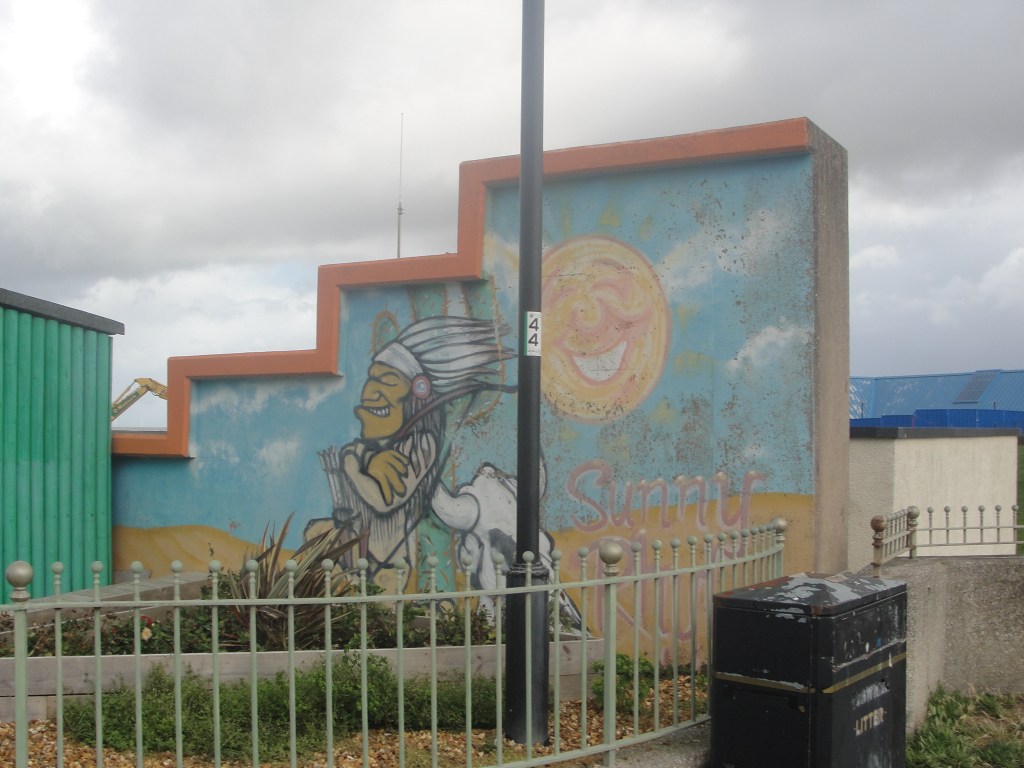
‘Sunny’ Rhyl. Wet, windy, the beach fenced off for major excavations and everything closed.
Our holidays are a joint agreement. He wanted to go to Chester; I thought that would be interesting, and made it a six day trip so that I could go back to some of the north Wales beaches the rest of my family remember clearly. As a toddler, it was all just beach. My clearest memory was being carried screaming to the first aid post with a piece of broken bottle embedded in my foot, and that could have been anywhere. I’m going to be mean and suggest it was Rhyl because we went to Rhyl this year and we didn’t like the place. The beach was fenced off for Balfour Beatty to do something to a stretch of it with diggers that left great piles of sludge-colour sand. The cafe and toilets were open until the end of September – except that metal shutters were padlocked shut on both doors. The seafront was a solid mass of tawdry-looking money traps – bingo halls, slot machine arcades. The tourist information booth had given up and gone dark, and I don’t blame it. You can put as much lipstick as you like onto a pig, but nobody wants to kiss it.
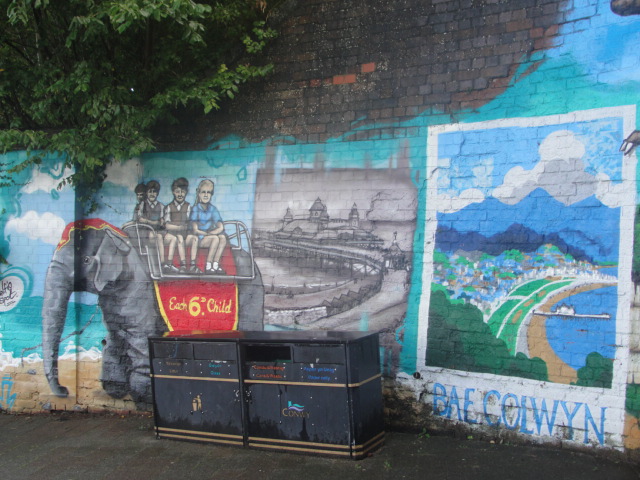
Colwyn Bay. Don’t be fooled by the blue sky, it had just sent down a hailstorm.
Next stop along the coast was Colwyn Bay. Much better. Still wet and windy, and the car park we chose had maybe fifty spaces, but the Flat White Cafe was open and serving great coffee and cake. We walked to get down onto the beach and got caught in a hailstorm, arriving in the train station soaked and laughing. The station master and another customer stood chatting with us, and the customer came out into the filthy weather to set us on our way.
If we’d had a full day here, we could have walked along the beach to Rhos on Sea along the seafront of Colwyn and Rhos. Our landlady told us we should have gone, so maybe we’ll come back and have a better look next year. The toilet was haunted by a tourist who desperately needed a pee but wasn’t willing to spend twenty pence to get in – she managed to get in when the previous user left, but wouldn’t have been able to lock the door behind her. The same door was then haunted by an official who was clearly wanting for her to come out. We scarpered before we saw whether he was going to ticket her for not paying or just get in for free himself.
Conwy Castle
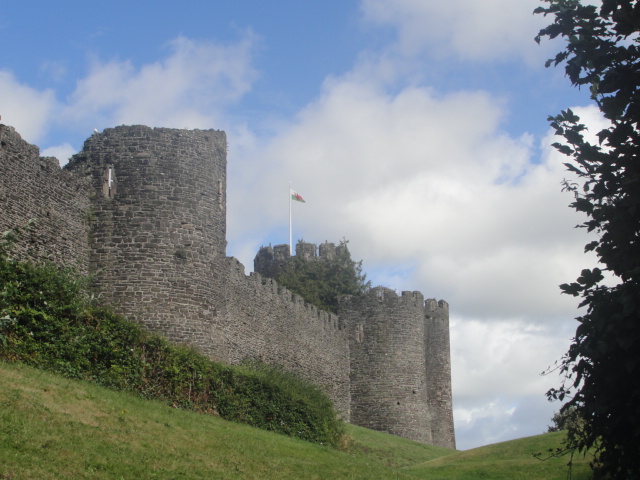
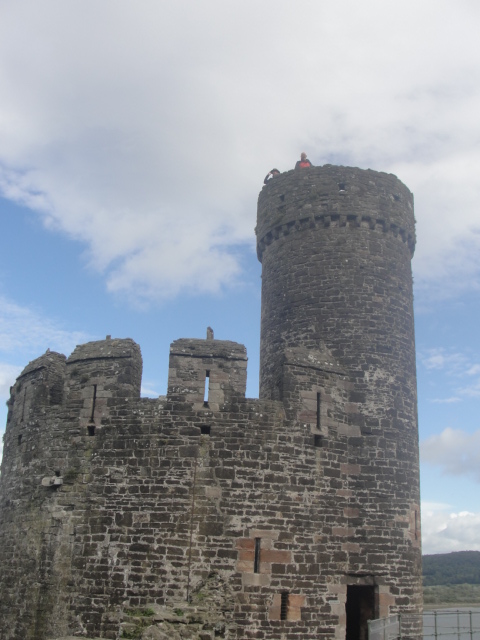
Final stop of the day was Conwy Castle. Magnificent. Walls pretty much intact and the chance to walk around the top of them; clear signage to tell visitors what each bare space had been and what went on there (dining and dungeons very close together – good story material). I could have climbed a set of spiral stairs up to the top of the towers. I didn’t. I should have. I’m afraid of heights, and it annoys me to have that fear keeping me from enjoying great views from high up places.
Only the brave
There will definitely be a next visit to Conwy. One in which I will get to the top of that twenty metre high tower, hopefully with the same clear visibility. I enjoyed the walk around and the information boards. The castle was probably whitewashed when new, so that it was visible for miles as a big imposing thug on the landscape. Bits of tower still stand along the seafront with modern buildings embedded in them, and a long wall stretched away from the castle, climbed the hill in the distance and over the top out of sight. A castle town.
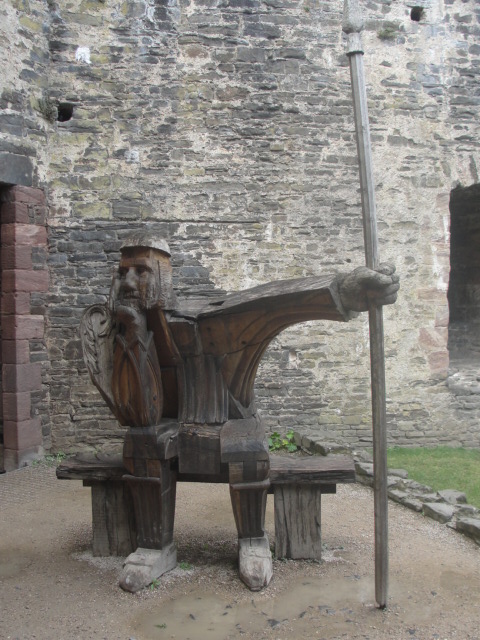
Have to go back. If the guard lets us in.
The other day we spent not walking around Chester was a free one – where did we want to go? Nowhere, not until the rain stopped coming down like surf on a Hawaiian beach. We waited in till midday, discussing places to visit nearby. The Sandstone Trail was a good walking path, but with no peaceful walking route to get to it, and no parking places. The pub with a reputation for great food and magnificent views had changed hands a few months prior and was now serving greasy spoon food at haute cuisine prices. The village across the main road had nothing to recommend it except for a craft shop which was closed unless you were attending a paid workshop. The sun came out and we drove to the only local attraction left that appealed to us – Beeston Castle.
Beeston Castle. Fantastic views.
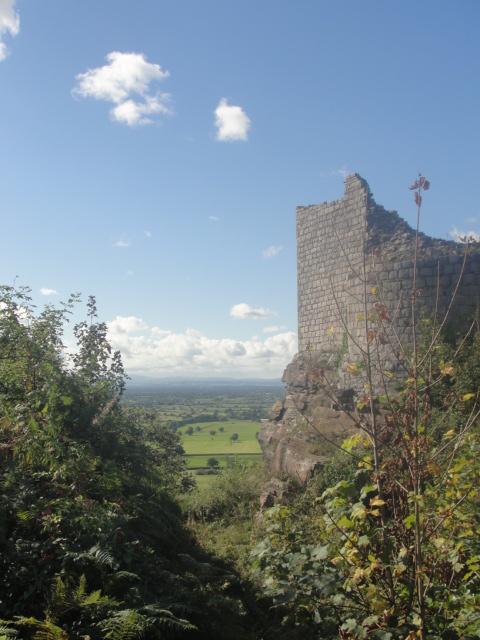
There’s not much left of Beeston, but it must have been some fortress in its day. You climb uphill to the car park, then uphill to the curtain wall, then up again to the summit of the hill and the castle itself. The castle was short of domestic luxury in its day, with the inner space set on uneven ground and all the living space in the towers, but as a fortress it had balls. It was built as a show of defiance by Ranulf of Chester, who returned from the Crusades in 1220 to find the new king Henry’s justiciar confiscating lands of other men who had (in Henry’s view) was more wealth than they deserved. Ranulf’s castle was built to say; “Come up here if you want to take my money.” Henry waited his time and seized the estates from Ranulf’s heir in 1237, granting the castle and the earldom of Chester to his son, the future Edward I.
Looking west… yes, that probably is Wales on the horizon.
The castle was taken by Parliamentarian troops in 1643 and taken back by Royalists in 1644. After the series of Royalist defeats elsewhere in 1645, the garrison surrended to Cromwell’s forces and the castle was ‘slighted’ – damaged so as to make it indefensible in future. Chester Castle was spared that damage as its position near the River Dee and the Welsh border made it more valuable to hold as a fortress.
This is the point when we learned that, from the top of Beeston Castle crags, you can see the great dish of Jodrell Bank just thirty miles to the east. If I had known how close Jodrell Bank was, I would have planned a trip there. Seems we’ll have to go back for another stay in the area. I’m hoping to get the chance to stay in The Smithy again, with a lovely garden and silence at night, and hope The Grosvenor Arms in Aldford is still serving great food and good beer.
This was our first day in Chester. Not very impressive weather, but it matches our first view of the city itself. We were staying about five miles out, relying on the Park & Ride to get us in each day. No problem with the system, the bus or the drivers – £2.50 to ride around all day, free parking and helpful drivers. But having got onto the bus we had to do the whole route round the city to get back to the car, and the first sight of the city wasn’t impressive.
Fat Boys Pizza and Kebab. Rows of shops but virtually no customers. Metal shutters on a fabric shop? I dunno. Maybe you can exchange ten yards of that polyester curtain fabric you just robbed for a bottle of whiskey round here. The weather wasn’t helping much, and we spent most of that first trip wondering whether we’d made a mistake coming to Chester for a few days – maybe a long weekend in Qaanaaq would have been better?
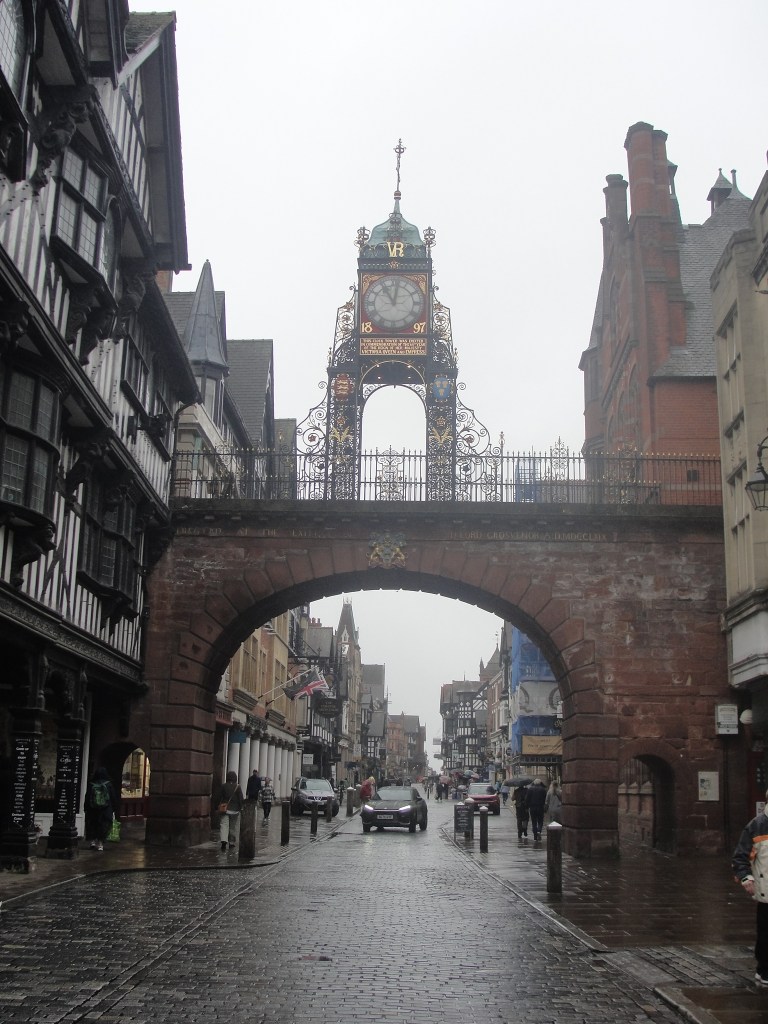
What we came to realise was that there’s two parts to Chester – you’re either inside or outside the wall. Outside – on the route we took – it looks like any town these days. Vape shops, people shouting as if drunk or drugged, rundown houses. Not the kind of place we’d get off the bus to explore. The fourth bus stop is Foregate, the city centre – about two hundred yards from that famous Eastgate Clock.
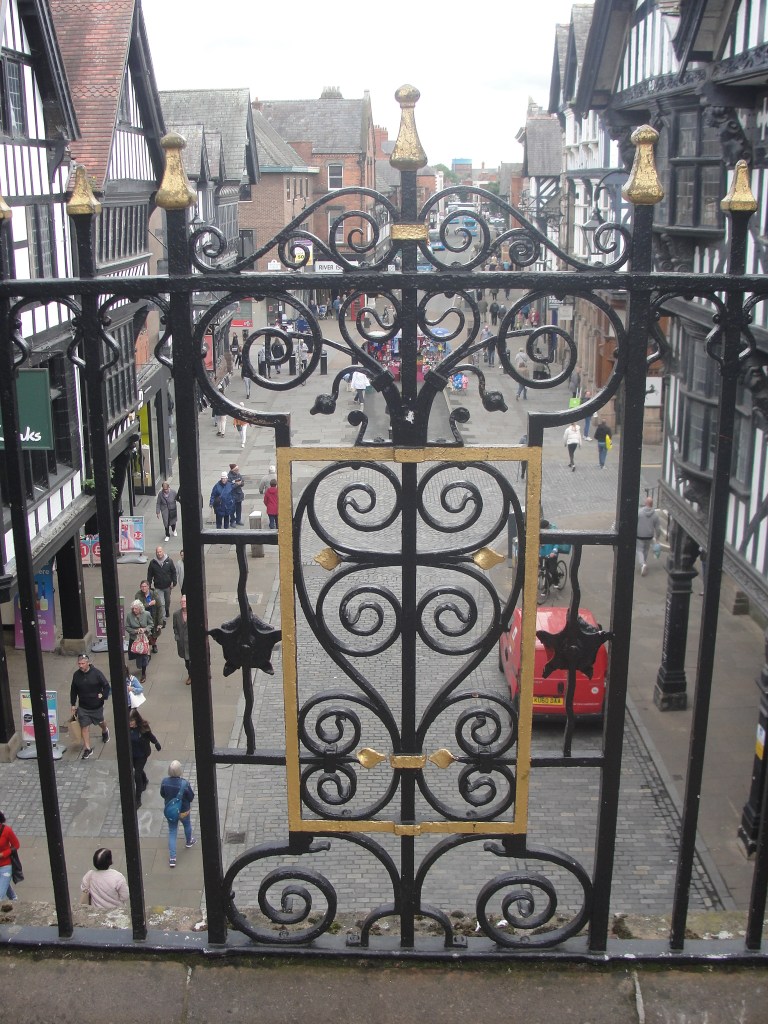
First objective was to get up onto the wall and set ourselves to walk all the way around it. We had real trouble finding the wall and the way up onto it… Anyone who’s been to Chester will be laughing by now, but come on. It isn’t immediately obvious that the clock sits on the wall itself, as there were no tourists on that stretch of the wall on that rainy Tuesday morning.
View from under Eastgate Clock towards Foregate
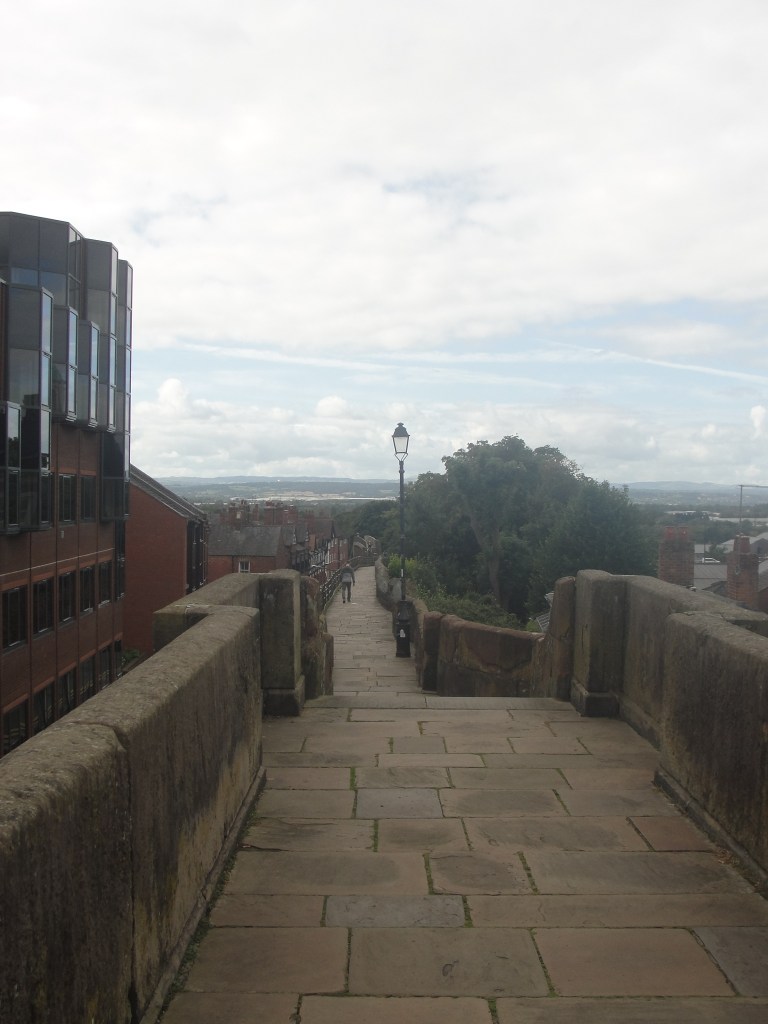
We walked down to the Roman ampitheatre that first day. Maybe because it was raining hard or maybe because we were tired from the drive over, but we were not impressed. We found a dead end up onto the wall from the Roman Gardens that was blocked off completely. We backtracked to a set of stairs up onto the wall (hidden at the end of an alley that ran between the back of a business and the side of a disused church) and set off.
We got about halfway around that day. We stopped at the Little Roodee Cafe – huge car park full of cars and about a dozen coaches, but inside the cafe we were outnumbered by the staff. Something to eat and a good coffee and we were off. Himself wanted to see the Agricola Tower. Which hides between the University of Chester and the complex of the courts, council offices and the Military Museum. And is also definitely not Roman.
The Agricola Tower
The solid square shape should be a clue. William the… Conqueror, or what ever name you know him by, had it built as the gateway to a castle. Interesting, that when that tower was newly built, the king gave it a name from a thousand years before his own time to give it substance. That tower is still there almost a thousand years later.
Our second day in Chester was entirely different. Dry, sunny and warm. We turned up early and got straight up onto the wall, heading in the opposite direction. This was definitely the pretty side of the city. We walked behind the cathedral, found a collection of independent shops (including one that sold great coffee) and got as far as Chester Racecourse. The races were on and the crowds were arriving. The racecourse was built on the silted up bed of the River Dee, apparently. The things you learn along that wall.
The countryside over there is Wales. Chester’s ring road is only just on the English side of the border.
Just beyond the racecourse was the Little Roodee Cafe; the point where we had got off the wall last time. This time, we headed up to the Military Museum and spent an hour looking around. Then another half hour talking to the volunteers who run the museum, and that was just as much of an eye-opener as the exhibits themselves.
The final trip to Chester was to visit one of the Civil War events at Chester Castle. Although we’d been drawn to visit for the Roman ruins, Chester played a key role in the Civil War. It declared itself neutral but warned that it would be fortifying the city in case either side felt the need to nudge that neutrality. The walls were repaired and strengthened. Despite the ‘neutrality’, the area was strongly Royalist, and the Parliamentarian forces set up a siege of the city that lasted for sixteen months, with frequent attacks from both sides. There’s an information board in the Roman Gardens which explains that the city walls were destroyed in places, with a vertically-mounted picture on a sheet of glass showing the troops fighting around a V-shaped gap in the walls. If you crouch down and look at the wall through the glass, the V-shaped gap on the picture lines up with the repaired section of the wall beyond it.
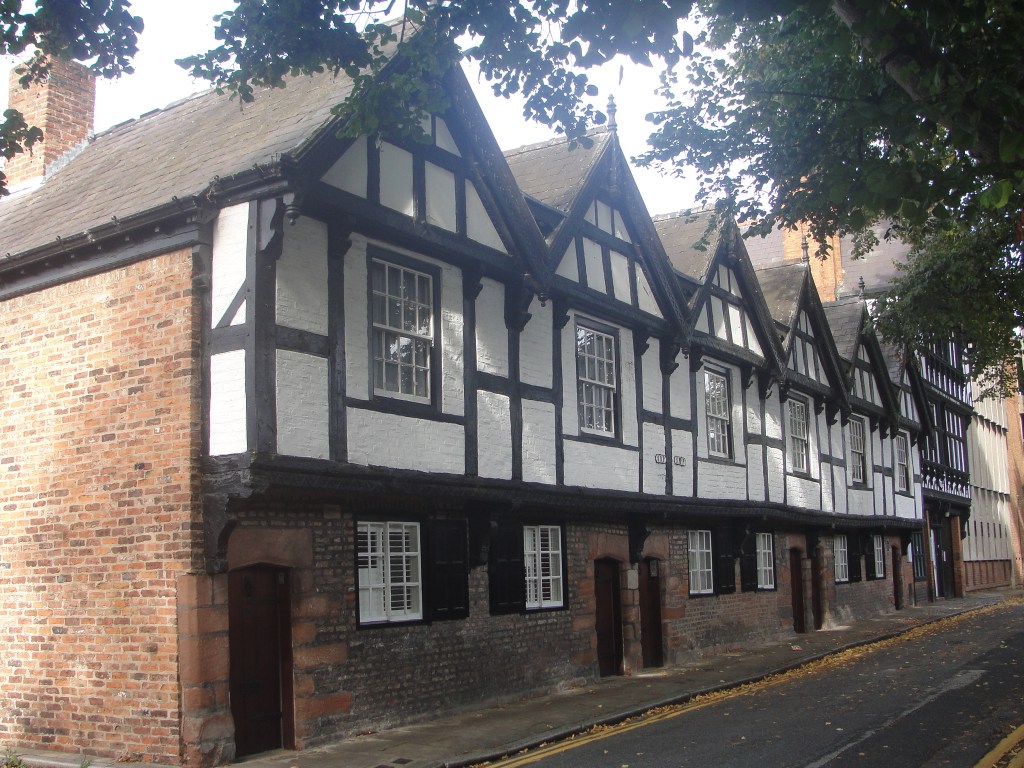
The six remaining Nine Houses – on the other side of the wall to the Roman Gardens
The Civil War exhibition went on for two days, with re-enactors firing muskets, explaining life during the siege and the timeline if the siege itself. The highlight was the visit to the top of the tower, where the guide explained the geography of the siege and we got a good look around.
On the way back down the tower, I dropped in to the chapel on the first floor. The re-enactor who had retired from fighting to become a mural painter had explained the paints to us – effectively, dyes that were painted onto fresh lime mortar. In the Old Chapel, Victorian murals on fresh plaster had flaked and faded and fallen off the walls in patches, and modern restorers had found the original murals underneath. Not just surviving, but reviving as the chapel was visited; the condensation from the breath of visitors is bringing the old images back, faces and angels and leaves appearing on the walls and ceiling.
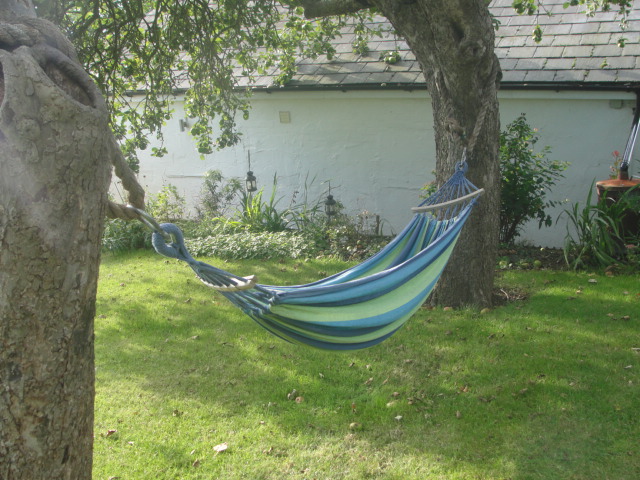
The hammock in the garden of our accommodation. Surprisingly comfortable.
That was the city half of our visit to Chester. Given that a lot of disputed cities must have had walls around them, it’s a shame that so few survive. Chester’s walls were built between 70 and 80 AD by the Romans, and by a quirk of luck have been strengthened, extended, maintained by levying a murrage (tax) on goods entering the city, repaired, adapted to accommodate Georgian walks and modern traffic. It’s good to walk around the walls. It gives a view down onto the city, a different perspective from the usual street-level city tours, and an insight into the different uses of this wall throughout almost two thousand years.
I blame Tom Cox. In one of his books he mentions attending an event in an old chapel lit by lanterns in which an actor recreated the experience of M R James telling his ghost stories to his colleagues. I remembered hearing about this, and it was a quick job to trace the company – Don’t Go Into The Cellar – and find that they were running an event in Dunmow. Too easy, this internet. A few clicks and we were set up for a scary evening.
It wasn’t a cellar, and it wasn’t lit by Victorian lanterns – it was upstairs in the Dunmow Maltings, a building I had passed many times without registering it was there. It’s been restored and set up as a museum and community hall. It was quiet as we went in at 7pm, and we wandered around and eventually found the audience sitting in the upstairs space. The lights were bright enough to play football in there at first. The custodian turned off two sections, leaving a strong uplight and two ‘floodlights’ beaming down from the ceiling. Tom Cox described the eerie atmosphere of the dimly lit chapel, where the sudden thud of a bag dropped at the appropriate moment made the audience jump. Well… not here.
By 7.30, there were eighteen people sitting whispering in a semi-circle and two empty chairs. The music died away and Jonathon Goodwin came slowly out of the back room and took his place in the spotlight. The light shone up onto his pale face and spiky hair, and I would not have liked to be stuck in a lift with someone looking like that. You’d want to check they were still breathing. He introduced himself as Montague Rhodes James, mediaevalist and author – “But do call me Monty.”
Just as he explained (in elaborate Victorian phrasing) that he would leave it to us to choose the story to be told, the main door creaked open. Of course, the whole audience turned to look. Three women in their twenties came in and gawked at us all. Poor old Monty was left struggling to call our attention back from this gust of twenty-first century manners. He should have waited. Three women? Two spare chairs? A lot of hushed (but loud enough) haggling over who was gonna sit where and Monty’s assistant was left to sit on the floor to let one of the gigglers sit next to me. She was shifting her chair around about as noisily as possible, nearly knocking my drink over. Monty said to her; “When you’re quite ready!”
We were given the choice of two stories. We voted for ‘Tale of the Wailing Well’, and then (close vote) for ‘Whistle And I’ll Come To You’, although the alternatives sounded just as good. I admit I have never read M R James; I find the Victorians over-dramatic at times. Still, what else do you want from a ghost story but the drama? What you don’t want is three women who missed the twentieth century altogether fidgetting and giggling around you.
There was a break for us to grab a drink from the front desk and visit the sanitary facilites. The three gigglers were first out of the door, and I happened to know that there were only three thrones in the Ladies. I nicked the Disabled loo instead, so I missed hearing what they had to say. Shame, really. That would have been a prime bit of eavesdropping.
Back we came, settled in that semi-circle, and ‘Monty’ came dead-marching back to resume. The three gigglers hadn’t come back. I was dreading it for a full five minutes, expecting them to come thudding and sniggering in, but soon the third story took all our attention. We chose ‘The Ash Tree’, a tale of Hopkins witch-finding and revenge. Not the kind of story I’d want to be hearing if I had to creep along a corridor to a dark bedroom afterwards.
Applause. The sinister Mr James bowed and took his leave of us. Those of us who were left drifted out through the museum exhibits and out into the real world. Sad to report, the three young women… were never seen again.
Update; pretty sure I spotted the three of them giggling outside the chip shop as we drove out of Dunmow. But why spoil a good spooky finish.
High time I came back to writing a blog. I’ve spent too long head-down in serious work – making progress on the novel that took third prize in March and helping to get the new shower completed at home. Blogs are fun to write, and I’m in the mood for more fun.
What else I’ve been up to – I took part in Globe Soup’s ‘Inspired by Art’ contest earlier this year. It looked simple. They put up 24 pieces of original art ranging from the fantastical (flying car, dissolving face) to portrait to landscapes. We were asked to choose one and write a 500 word story inspired by it. Like an idiot, I thought; “500 words, easy!” and bought a five-story ticket. Managed one story I spent hours refining and three others with a bit of a slapdash splash to them. The thing about Globe Soup is that it has a lot of writers, and that many of them write smart and polished stories, so it’s quite an achievement to be even mentioned. Most of the time, my stories sink without trace.
Fast-forward to August 19th, and suddenly my fellow Soupers were pinging my phone with messages of “CHECK THE WEBSITE!!!” GS email the winner to get their permission to publish, so I knew full well I hadn’t won – but I had been named as having a story shortlisted. Twice. Given that only twelve stories were shortlisted out of around 1,500 entries, getting two shortlist places was a proper ‘sit down and remember to breathe’ moment. I’m still really chuffed. One of the shortlisted was the story I spent a dog’s age revising and editing and polishing – one was a real surprise, a strange idea that took barely an hour to write and was sent off twelve minutes before the deadline. The story that was my second favourite – yes, sank without trace.
The winning story was a corker, and it’s published on the Globe Soup website for anyone to read. The shortlisted stories appear only as titles. And as they are unpublished… I was free to submit them to other competitions. Three of them are out there right now, under different titles and anonymous, so they have another chance to be chosen for a longlist elsewhere.
Globe Soup have a historical fiction contest going on right now. Deadline Monday night. One story has finally escaped the obsessive editing process and been submitted; another one being written as soon as I finish this blog. Wish me luck.
Interesting times at the Scottish Association of Writers’ Conference 2024. Half of the awards were announced on Friday and half on Saturday, with the winners of the short form writing being asked to read out their work to the assembled crowd. That’s enough to put you off entering the competition in the first place. You look out over that crowd of people smiling encouragingly and you just know that some of them are probably thinking; ‘Get on with it!’
As I said in the previous post, my daft sketch about the astronauts on the ISS discovering that their journey home is definitely economy class won the Largs Shield. I got fourth place in the humorous short story competition, with two writers in my group taking second and first place for the same competition. Given that there’s only nine of us in the group, we got a lot of attention for that.
Not much attention, but it pleased me – I was awarded third place in the Constable Stag competition for the best novel extract. I’ve never seriously thought of writing a novel; putting in my entry was more of a test of how good the basic idea was. Good enough, it seems.
After the Gala Dinner on Saturday (this time I dressed a bit smarter than blue jeans and boots) the president had a game of Tops and Tails – everyone stand up, listen to a question and choose answer A (hands on your head) or B (hands on your bottom). Usually it’s all over within five or six questions, but twenty five questions later we were still cheering the two women choosing the right answer every time – one of them from our own small writers’ group. In the end the president ran out of questions and Sue asked for the prize to go to the other person as she wasn’t able to enjoy either the chocolates or the bottle of red wine.
After the gala dinner I ended up chatting to a man who turned out to be the adjudicator of the Constable Stag. I do love that about this conference, that the people who judge the competitions are there in the room and ready to talk. He was enthusiastic about my entry – he encouraged me to get on and finish the novel. When I told my writing friends, they said “That’s what we keep telling you!” Looks like I have a new project for the year.
It was past eleven when I rejoined my group in the bar, and not far short of midnight when we all dispersed to our rooms. At quarter past midnight, the fire alarm went off right over my bed. I’m used to setting off the smoke alarms at home, so I spent a minute trying to work out what I’d done to set this off before thinking of opening the door to the corridor.
All the alarms were going off, and a couple of people were heading for the fire exit (about twenty yards from my room). It’s always some idiot smoking in the loos, so I slung on just enough clothes to be decent and grabbed my room key on the way out, thinking I would be going back in soon and would feel a right prawn if I couldn’t get into my room.
Some people had done the sensible thing and left the building immediately. Dress code ranged from full jacket and boots down to bare feet and bath robe. Two women near us had thought to bring a duvet from their room and were standing wrapped in it.
Two women in bathrobes and slippers told us that their room was right there in the corner. The thick column of smoke was coming from the room directly under theirs, getting denser as we watched. They told us that they had rung the night porter twice in the last forty minutes to report a smell of burning; at midnight they had opened their window as the room was uncomfortably hot and smoke had blown into the room. They had just put on their bathrobes to go to Reception for a third complaint when the alarm went off. They were on a free spa weekend as compensation for a previous visit that had gone so badly wrong, that it was like a Fawlty Towers episode.
By now they had the three of us and a growing group of SAW attendees gathered around listening and we were asking them all kinds of odd questions; ‘What was the story behind that bad experience?’ ‘What did the smoke smell like, did it make your eyes water?’ ‘What were you thinking as you ran to the exit?’ They asked us why we were all here, and we said we were on a writing conference. “Oh, writers!” they said, as if it explained everything. “We were told the hotel was full of writers.”
There was frost on the cars when we arrived in the car park. Some people were offered refuge in other people’s cars and the staff allowed some people access to the hotel’s entrance hall, the tiny space between the doors to the car park and the doors to Reception. The rest of us spent two hours in the car park in falling temperatures and increasing breeziness watching six crews from Scottish Fire work on the hotel, followed by almost an hour in Reception and the bar with the alarms still screaming for about half of that, and we finally got back to our rooms. Mine was far enough away from the site of the fire that I got just the whiff of burnt-toast (though I have very little sense of smell, so it might have been stronger). I tend to be organised anyway, so it was automatic to me to put out tomorrow’s clothes in order of putting on, just on case.
It’s a long drive home from Cumbernauld, so I’d booked an extra night. That left me free to go to the final session and to Dragons’ Pen (five people pitching their novel idea). I was looking forward to a restful night and an early start. Laws of Sod, the fire alarm went off at 10.30pm. False alarm this time, but it left me keen to drive home.
The SAW Conference 2024. Drama right to the very end.
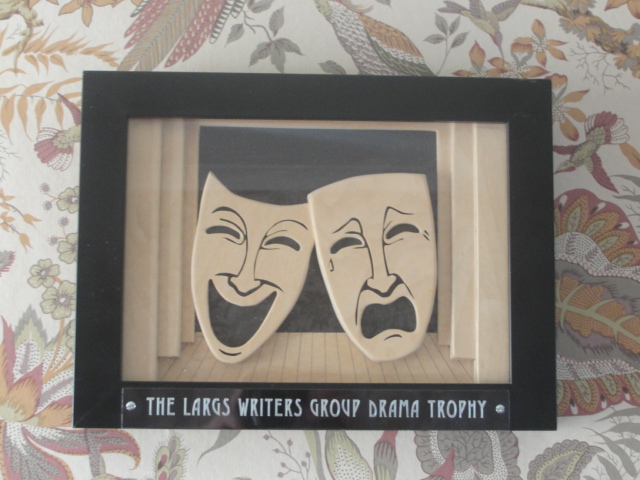
Yes, I love the wallpaper… This is where my Largs Shield trophy has hung for the last twelve months.
March and April have been busy times, though looking back, it’s hard to see what I was doing. Writing, yes; doing all the peripheral jobs for Himself as he worked on replacing the shower; taking the first batch of seedlings from the propagator and setting them up in pots in the unheated greenhouse (and then worrying every time the temperature dropped overnight). There’s two whole shelves of seedlings coping with temperatures between plus one degree and the mid-thirties Centigrade in the greenhouse and a new electric shower up and running, as proof that we have been achieving something.
Getting the new shower into place was made easier and tougher by the house itself. The house is old with 20th century extensions, and the shower room is in one of those extensions, backing onto the kitchen. We discovered that there is a gap between the two walls, wide enough to accommodate the old gravity-fed shower mechanism and as much cabling and piping as we want. Whoever installed the old shower tiled over the gap afterwards and cut access points in the tile for the controls and water outlet, so we cut out the damaged tiles and found a way to replace them, as best we could. The only sensible way to get the old shower out was to cut a hole in the kitchen wall and reach in from the back to unbolt it and yank it out. He ran the new pipes and cables from the new source (mains fed) and removed the old piping that ran in interesting configurations from the tank in the loft. Yes, we still have a tank in the loft. We’ve had to explain that to a few people who have never lived in a house with a water tank.
Aside from the shower project, there was the trip to Scotland to the Scottish Association of Writers’ Conference. I had to return the Largs Shield for the next lucky winner to pick up, so I had to go – no hardship, as I did enjoy the weekend last year. I took the Shield down from the wall and had a think about what was to go up there now, though the day after I packed the Shield into my luggage I got an email to say that I was in the top three for this year’s Largs…
It’s back!
… and Laws of Sod applied. I ended up dragging the only male writer in our group up to the front of the conference to read the part of Tim Peake while I was pretending to be a not-very-focussed call handler in a Texan car hire company. The good news is that however much I am tempted to enter this contest next year, I can’t. The rules state that anyone winning a particular contest twice in a row is banned from entering that contest for the next two years. Next year, I will be sitting in the audience cheering for a different winner.
The conference was fun, and I think it deserves a blog post of its own. Drama and comedy, and that’s before the winners began to read out their entries.
I am still hammering away at the 29 Plays Challenge, which leaves me not a lot of time for much else. It hasn’t been so inspiring this year. Partly because the briefs are repeats of previous years’ briefs, and there’s a one in five chance of picking up a brief I have already written a play for – and partly because there’s a feeling that this is the last time, and I’ll never get the chance to write in the company of talented actors and playwrights again.
My favourite briefs this year (so far) have been the command to write a trilogy, three connected plays that are complete in themselves but even better when seen together (think Alan Ayckbourn’s ‘The Norman Conquests’) and to write the stage version of a film, novel or poem we know and love. The trilogy was based around three generations of one family, starting with the youngest and working up to the grandfather. The film, of course, was Moon. We were asked to add our own take on the original, and I took the chance to bring to the fore the story of the original Sam Bell and his wife Tess. I could not improve on the last speech by the radio show host, about the returned clone being either a whacko or an illegal alien, so that stays as the last line. None of these plays will be performed, so the original scriptwriter is unlikely to sue.
So far, I don’t have any plays that are begging to be re-written and sent off to anywhere, and that’s the saddest part. Twice before I have started March with at least three plays worth editing, but time’s running out this year for a play I’m fond of.
I have had time to send off a micro fiction which made the longlist – it’s currently sinking to the bottom of the public vote, but just getting top twelve was an achievement, so I am not disappointed. I couldn’t help but vote for one of my rivals, who wrote a story that was sinister and deep – in 100 words.
We have had time for other things this month, surprisingly. A visit to Norwich to see Janey Godley, including a visit to what must be the best Mediterranean tapas restaurant in the east of England. If you’re in Norwich, try Haggle – the staff were the absolute best and the food was ‘gimme more’ delicious. Janey Godley was a treat. I can believe she returned the favour to the young thug who stood on her car bonnet and kicked in her windscreen, and I wish I had her balls.
Next up, just a few days later, we were in Bury St Edmunds to see Brian Bilston and Henry Normal. Never heard of Henry Normal before; I wouldn’t have bought a ticket to see him alone, but there he was with Brian Bilston, so… His publicity shot showed him looking very stagily ‘common man’ with a book on his head. Don’t be put off. His poetry started out as almost kid’s joky rhyming stuff, but the life story he told was very down to earth in a way that didn’t ask for pity or admiration; just, ‘This has been my life so far.’ The poetry got more intense as he neared the end of his act, and at one point he struggled to continue reading a poem, taking off his glasses at the end to wipe tears away. Yes, we loved seeing Brian Bilston again, but Henry Normal is now up there as someone worth seeing in his own right.
Himself is ripping up the floorboards in the bedroom for a perfectly good reason; re-routing the plumbing with a view to putting in a shower that is a tad better than our current one – not a hard act to follow, as it resembles a dripping gutter at times of low pressure. Four more plays and I can join him full time, being gofer to the Man who Does.








 Julia Chalkley