This probably sounds like an odd project, but here goes.
Two months ago, I went on a tree pruning course in the community wood, led by Dr Anna Baldwin. She was asked for her opinion of our orchard, and gave it as “Seven out of ten”. Part of her reservations stemmed from the tree-guards we were using – solid rather than mesh-type, which allowed the soil to build up around the base of the trunk – and the fact that the straps holding the trees to their supporting stakes were now tight enough to restrict growth of the trunk. Two of us set to work on that within a week, and that problem is now gone.
Dr Baldwin suggested that we map the orchard and keep records of each tree individually, stating the type and variety, date planted, date pruned and any damage or disease noted. She’d seen that most of the trees had no label and five or six labels had been bleached to blankness over the years. We weren’t able to provide even the simplest information about most of the trees, and I mean, whether they were apple, pear or plum. As plum and cherry trees need to be pruned in summer and apple and pear are best pruned in winter, that is a basic necessity.
It’s been a job I meant to do in our own orchard, where about half of the trees are survivors from before we moved in – our orchard was so badly overgrown by six foot tall nettles and brambles that we didn’t realise there were fruit trees there. It took us two years to clear away the nettle roots and dead trees and rubbish (alongside putting in the fence and hedge all around and keeping up with the immediate repairs like stopping the kitchen tap from leaking at the rate of a gallon every four minutes). When we’d cleared it, levelled the ground and planted grass seed, we found that some of the trees had stakes beside them with variety names, date of planting and rootstock – many of these were cleared away before we realised they weren’t part of the general chicken wire, sandwich wrapper and broken bottle rubbish slung there by a previous owner. By the time we spotted that the trees had been meticulously laid out in rows, a lot of information had been lost. Just like the community wood.
If you’ve ever heard the legends of standing stone circles where the stones themselves move around and cannot be counted – well, don’t laugh until you’ve tried to count them. It’s taken me eight weeks of nipping back to the community orchard for an hour, cussing over GPS apps that helpfully tell me the lat and long of the nearest road but not the tree I’m standing next to, counting trees, writing a draft map, counting again and pacing the distances to get a roughly accurate map of the orchard. As of last Friday I can safely say that there are 64 trees, laid out in a grid pattern.
Previous neighbours who helped to plant the trees in 2011 have told me that there were ropes laid out in lines to determine where the trees were to be placed. I haven’t asked them who shifted the southernmost row halfway through to let the last three trees of that row veer off course, or who thought it was a smart idea to plant a tree right in the middle of a row in each direction – think of the dot in the centre of a five on a dice, and you’ll get a rough idea of where this stray tree ended up. The pattern of dots on a five-face on a dice is called a quincunx, by the way. Scrabble glory awaits, when those seven letters turn up on my rack with the right eighth letter and enough space. Watch my opponent spoil it by plonking some mundane word there before I can stop him.
The original planting crew didn’t leave a list of trees, a chart or a numbering regime for the community orchard in any record that survives. Five of the trees are numbered, though Tree 25 is next to Tree 27 with no room between for Tree 26 and no possible scheme of numbering could let us surround trees 7, 13, 25, 27 and 41 with logically numbered neighbours. Which is great, because it left us free to devise our own system.
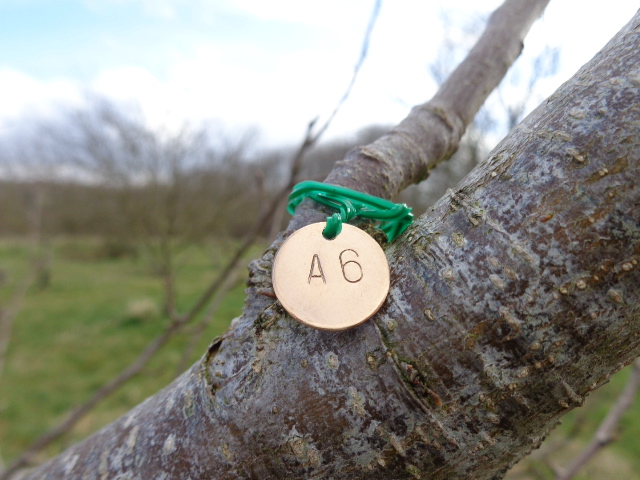
So. Ten rows of trees, each with five, six or seven trees in them. I called the rows A, B, etc, all the way to J. The traditional English way of numbering left to right would be scuppered by the fact that the rows are soldier-straight on the eastern edge and ragged with gaps on the western edge, so I chucked tradition in favour of practicality. There’s a beautiful carved bench at the south-eastern corner of the orchard. I started the numbering system there, with the tree closest to the bench being designated as A1. There’s a straight line of ten trees running downhill from the bench – A1, B1, C1 all the way to J1 – and the line of six trees heading up to the upper entrance of the wood – A1, A2, all the way to A6. If you know the tree’s designation, you can find which row and which column it’s planted in.
Okay, there’s strays. C6 and I2 are missing, presumed dead and uprooted long ago. J6 is on its last legs, and C2 is a tiny tree with all the bark eaten away at the base, so they may be gone within the year. D6E is on its own between D6 and E6. H12 is an extra tree between H1 and H2. Two of the spaces are taken up with fruit bushes instead of trees. But broadly – 64 trees, of which 14 have labels clear enough to read in part or full. All of those trees now have the little medals you see pictured above, as of today – tied on with garden wire rather than traditionally nailed. Yes, I know the magpies are probably untying them as I write this. I don’t care. I have the chart drawn up with the bench marked and a North arrow. I know which tree is which.
It will be a long project. When the leaves and blossom appear, I will try to identify tree type and add the information to the chart, and to the file I will make up and leave in the cabin. If we’re lucky enough to get fruit on them this year, I’ll see whether I can add a variety type. Though even finding out which is apple, cherry, pear and plum would be an achievement.
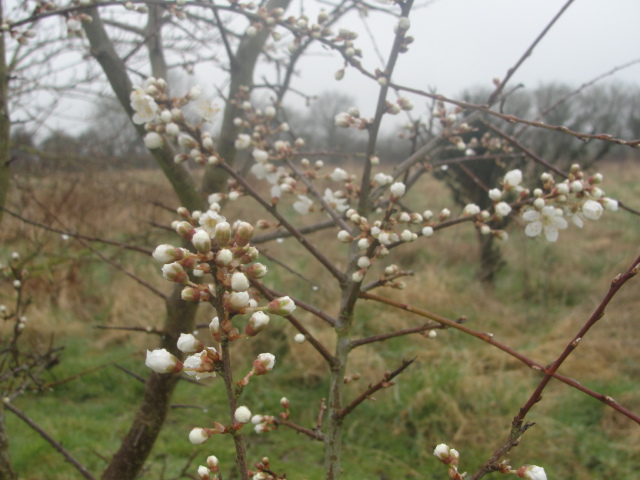
The trees have made a start. Some have blossom on them already, and one is breaking into leaf-buds. Better yet, the bulbs I planted last winter are sending up shoots. Spring’s here.
 Julia Chalkley
Good luck with this! It sounds like a long project, but worthwhile.
LikeLike
Thank you! The whole orchard was planted in honour of the donor’s birthday – since then, it’s become something that’s just there, and no-one’s taken on the job of passing on the information about it. Hopefully I can get it written down so that it doesn’t get lost.
LikeLike
What about a cotton wool bud tree? Hope you enjoy your cherry pie tonight. Anne.xx.
> > >
LikeLike