I’ve been quiet. I’ve been busy. We’ve been travelling.
Roll back to November, and the post called ‘A Tale of Two Breakdowns’. We were both due to spend a night in Melrose before I stayed with friends and he went home to face the builders – but his Landrover broke down and I escorted him home before driving back up to Scotland alone. After my visit to Melrose, I was going to visit Seaham on the north-east coast to fossick on the famous sea-glass beach… except that my car broke down. I spent three hours on the A186 waiting for the best RAC rescue man in the North-East and three hours being cared for by Team Valley Services while they repaired my brakes and let me loose on the A1M after dark.
Unfinished business. Now finished.
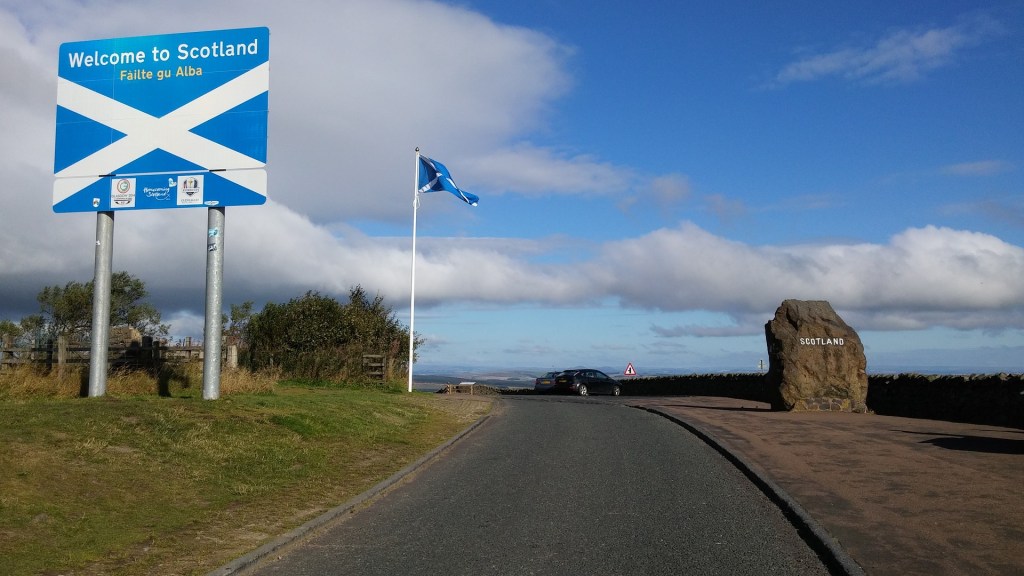
We drove up to Melrose along the route I remembered from November. I didn’t warn him about the lovely approach to the border, where the A68 wound up and up and finally flew over the border like a bird and zig-zagged down into the Scottish borderlands. It was a land where raiders fought and either side was full of houses fortified against hostile visitors in the seventeenth century. Northumberland and the Scottish Border counties are equally scenic and quiet, but the three hills of Eildon are unmistakeable.
In the 1970’s, I listened to Steeleye Span’s ‘Thomas the Rhymer’, telling the tale of True Thomas’ encounter with the Queen of Elfland and his seven years of servitude in her country. It’s the version of ‘Thomas the Rhymer’ set out by Sir Walter Scott, who lived within walking distance of the Eildon Hills, and it ends when True Thomas accepts the invitation of the Queen of Elfland to serve her in her country for seven years. The stories in Steeleye Span’s songs fascinated me for decades – it was the only introduction I had into the kind of folklore that others in Celtic, Gaelic or borderlands take for granted.
I drove myself to a summer residential school for the Open University in the 1990’s, on a GS motorcycle designed for fun offroad. I got a mild rebuke for exceeding 5mph on a mud road at the accommodation and protested that I couldn’t keep the bike stable on a rutted dirt track without standing up on the pegs and giving it enough welly to get it up to 15mph. Call it 20mph, but I got away with it. On the way home, I passed the sign to ‘The Rhymer Stone’ and could not resist. I turned off and parked up on a minor road under the Eildon Hills and looked up. I was expected home at a certain time and could not spend three or four hours climbing a hill. Especially not while wearing bike gear that wouldn’t fit into panniers already crammed full of dirty washing and academic texts – gear which cost a month’s salary if it was stolen while I was climbing and weighed roughly two stone (that’s just over 12 kilos for the younger readers). Try it, in leathers that don’t bend well and weigh a soddin’ ton. So I just stood and looked and sang the song quietly to myself. A father and daughter walking down the hill told me that there were great views from the top, but I had to drive home without seeing those views. Another day, I promised myself. It was several years before I admitted to the other half that I was off chasing fairytales when I should have been driving home.
2022, and I took the other half to Melrose to see the Eildon Hills for himself. The three hills stand 300 metres and more taller than the surrounding plains, in a bend of the River Tweed. The legend of Thomas the Rhymer says that he was offered the choice of ‘harp or carp’ on leaving Elfland; of being able to play any instrument he was given or to foretell the future, in one version (never to tell a lie, in another; a set of faerie clothes in yet another version). He chose the gift of prophesy, and foretold many events, such as the bridge across the Tweed that would be seen from the top of Eildon Hill. Depends on how bad the weather is, I suppose, but Leaderfoot Viaduct is just visible from the top of Eildon Hill.
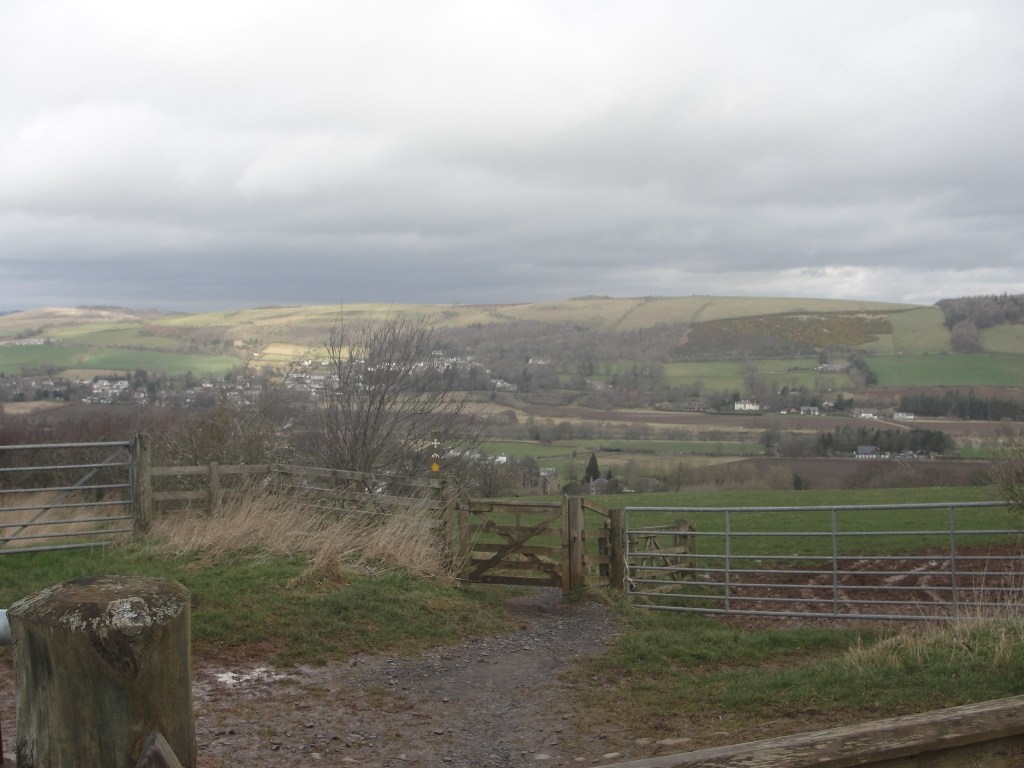
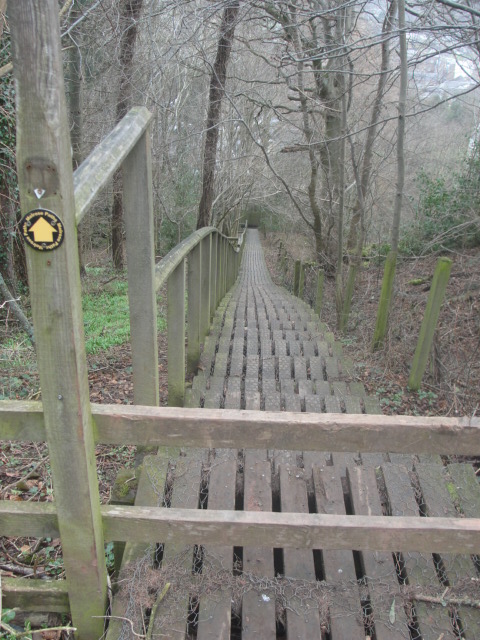
No, I didn’t get that far this year. We set out from our B&B to climb the Eildon Hills as far as we could with a forecast of sun till 3pm and rain thereafter, and felt rain on our faces before we’d climbed beyond the lowest foothills. It was steep, too. I’m really, really unfit. From the upper part of St Cuthbert’s Way, we felt the wind strengthen and the drizzle increase, and from the saddle between two of the hills we could see heavier rain falling to the west and blowing our way. Just before noon, we admitted defeat and started our way down. As soon as we settled in a tea-room in Melrose, the sun came out and the drizzle stopped. Laws of Sod will always apply.

Melrose is a small town but a pretty one. The abbey is a ruin – no access to the interior while Historic Scotland is repairing the upper parts of the structure, gardens closed till April and the whole lot closed for lunch when we arrived, so we didn’t get to see it close to. Instead, we visited the Trimontium Museum, to see the very brief touch the Romans had on the borderlands of Scotland. The Emperor Septimus Severus made it his vanity project to push the borders of the Roman Empire as far north as Melrose in 210 AD, briefly, before he retreated to York to die. The Roman Empire shrank back to Hadrian’s Wall in Northumberland.
Dinner was mixed. Provender was the restaurant we were apprehensive about – with a Michelin star, we were ready to be turned away for not meeting their dress code, but it was the better of the two. The menu was varied and the staff were pleasant and relaxed. No-one was bothered whether he wore a tie or not, and they could see we were both too old and knackered to out-run the staff if we chose to dine and dash. The Italian restaurant Monte Cassino was less of a hit the following night. The starter was incredible, the pizza was good but thin and soggy in the middle and our polite ‘Not at the moment, thank you’ to the dessert menu immediately after the pizza plates were collected triggered a twenty minute wait, followed by a realisation that we’d out-stayed some unspoken time slot and were now invisible to the waiters. We paid up and left. Driving home, we saw two single headlamps descending the Eildon Hill saddle at some speed. Cyclists racing down the steep, muddy path by the light of a full moon.
The following morning, we left Melrose for Seaham, and part two of our short break.
 Julia Chalkley
Making me ‘homesick’. Such a lovely place and I never managed it up the hills either.
LikeLike
Well, that makes me feel better about failing to get all the way to the peak! It’s gone on our list as “have to go back and finish”. And see the Abbey. And the gardens.
LikeLike