We drove down from Melrose to Seaham on the back of a disagreement. I plan my journeys by Google maps (adding 15% to Google’s estimate of journey time because, well, Laws of Sod) while he relies on paper maps. Our paper maps of Melrose and Seaham are bang up to date, unlike our 1982 OS maps of East Anglia (still used, with caution), but Google warns of roadworks, road closures, alternative routes – and can be used to provide a driver’s eye view of a crucial junction. We were pulling over to, er, discuss the route all the way to Belsay, where we turned off and concentrated on getting it right.
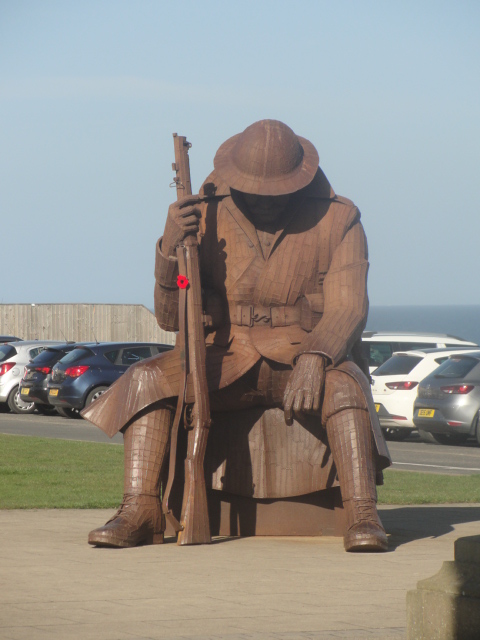
Driving along the seafront at Seaham, we sat back and breathed again. Brilliant sunshine. We passed the Tommy Statue I’d seen on the internet and I knew to turn off there. Parked the car in a side-street, found the accommodation and headed for the beach. I love a beach. Take me there now.
What I was there for, of course, was the seaglass.
Seaham was home to several glass factories in the late Victorian age, with the largest (Londonderry Bottleworks) operating from 1853 to 1921. At the end of each day, the waste glass – the broken bottles, warped vases and cracked ornaments – were loaded into a cart and dumped over the cliffs to the north of Seaham. Perfectly acceptable Victorian practice. In the century and more since, those waste glass scraps have been tumbled in stones and salt-water to become sea-glass.
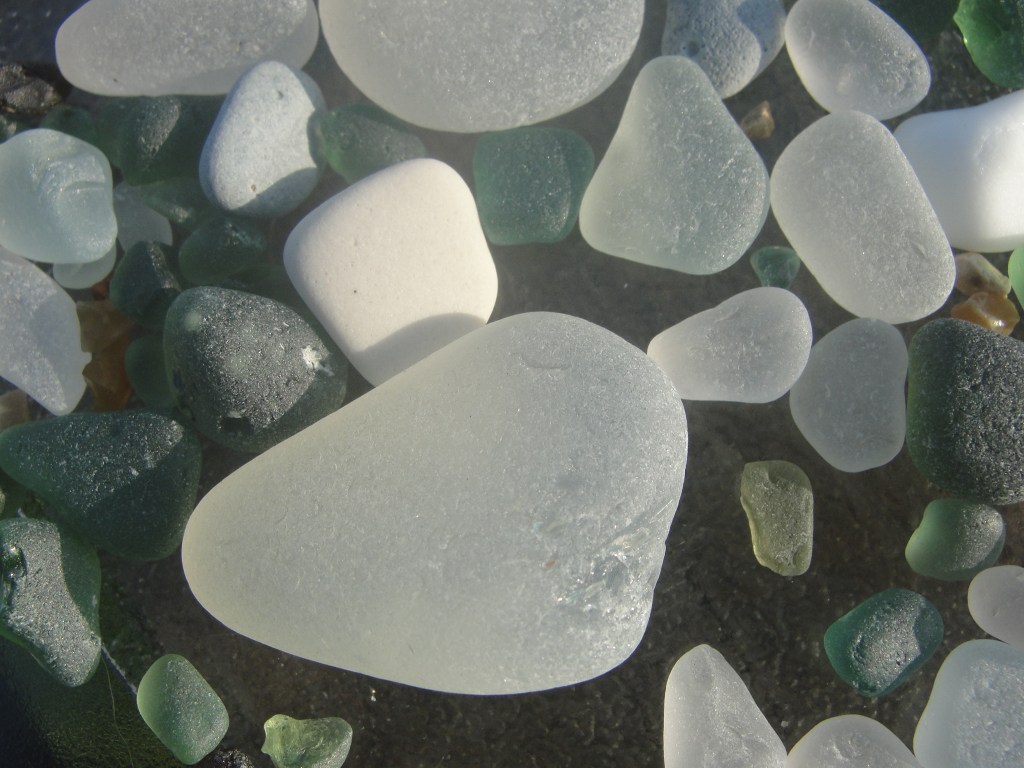
I’ve been picking up sea-glass for decades. As a child, I saw it as gems, not realising that the smooth specks were glass – the same substance that sliced open my instep during a trip to a north Welsh beach as a five year old. When I heard about Seaham’s beach and its glass, I had to visit. Work, illness and lock-down stopped me from going for years, and my planned 2021 trip failed when the car ate its brakes on the way there. I’m chuffed to have finally got there. Finding sea-glass would be a bonus.
We got onto the beach immediately on arrival, racing the tide. It was my wish to go there, so he tagged along – though by the time we reached halfway to the northern end of the beach, he was hunting just as enthusiastically. The commonest colour is clear glass, followed by mid-green and beer-bottle brown – the rarest colour is red, followed by purple, blue and black. Some collectors focus on particular colours or on shapes such as the codds that stopped up the bottles or the barley-twist glass walking canes that the apprentices were asked to make as their master-pieces. Plain clear or green glass is strictly for the novices like me. But they miss a trick.
We reached the northern end of the beach and spent twenty minutes in the North Beach Coffee Bar, getting caffeined and getting cheered up by the happy waitress and the good service. And the excellent coffee. Before the long walk back to town.
The accommodation was superb, and we walked a hundred yards to a chippie with great reviews. True vegetarians beware – Downey’s fry the traditional way, with beef dripping. My objection to eating meat is the texture – chewing meat makes me feel sick, so meat-textured vegan burgers make me barf worse than flaky fish. Even so, beef dripping. It was fine, but I think I prefer the oil my local chippie fries with.
We were feet up and asleep by nine in the evening, and wide awake by six thirty. And out on the beach by eight. Breezy, sunny day, tide falling to a low, low tide just before ten and very few people out hunting. The most valuable thing we found was a serious collector who came over to advise us where to find the best glass. The biggest chunks hide among the biggest stones and the unusual colours and patterns are generally found at the northern end of the beach. He showed us his favourite pieces; a dark blue marble, some chunks with dark ‘eyes’ in them and a swirled dark purple and violet piece that looked like a black stone until he held it up to the sun. He gave us an enthusiasm for returning to hunt again, and for longer this time.
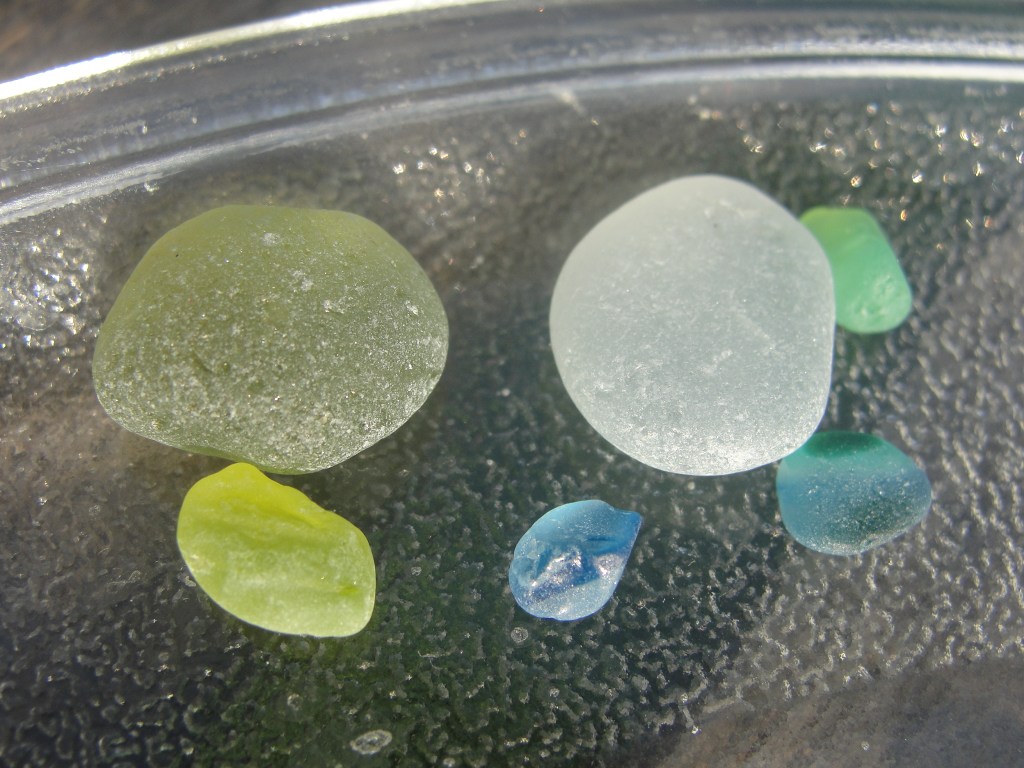
We found mainly tiny specks, but in such lovely colours that this was enough. A clear speck with a blue layer in it, a green striped piece and a dark blue iris in a clear and pale blue glass. Add to that the people – cheery and helpful – and we’ll definitely be back.
Even if we have another journey home like this one – two road closures and the chosen lunch stop closed just as we arrived. Sometimes, life’s like that.


And there was me thinking sea glass was a colloquial name for an egg case or something! You live and learn.
LikeLike
The real connysewers distinguish between sea glass and beach glass (tumbled in the sea or in a river), and they go out after dark with a UV light to track down uranium glass. I was just after a wander along the beach in decent weather picking up some shiny stuff.
LikeLike