
Earlier this year, I reported on the odd project I got involved in. I’m a member of our local woodland trust, helping out as a volunteer. As part of that work, I volunteered to chart the orchard that had been planted in 2011 as a present for the founder’s 90th birthday. I thought it would be a simple job. Hah.
When I started pacing out the orchard, I admit I was annoyed at myself. I kept thinking of Terry Pratchett’s famous stone circle that had only one stone, but nobody had been able to count it. Every time I went down to the orchard in the first three or four days I came back with a different number of trees.
When I understood that the basic pattern was ten rows of trees in a square pattern, I counted 64 trees – though one that got included in that count turned out to be a blackthorn tree that was probably coincidentally in line with one of the rows, and another has proved to be completely dead. Back in March, there were no leaves and little blossom to serve as a guide to what each tree might be.
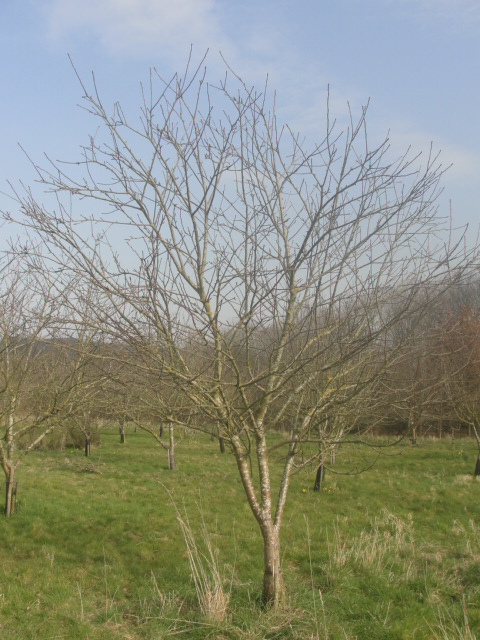
Now, though, the trees have come into their own and the guessing game can start.

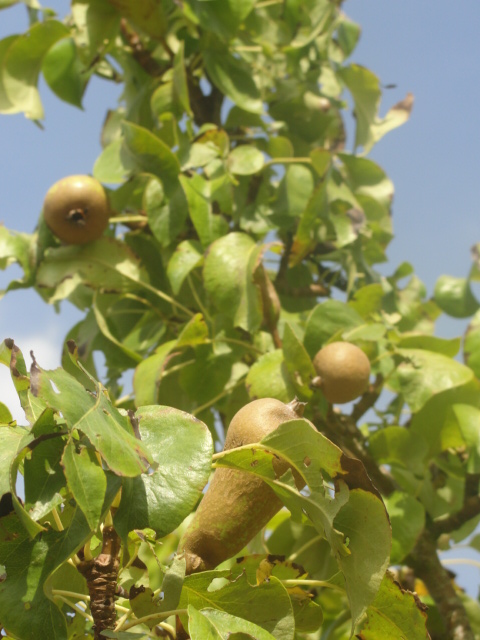
So – sixty-two living fruit trees and two bushes. Fourteen had legible labels; I found three more labels and deciphered two of those. About two-thirds of the trees have fruit on this year, so I can say that 22 are apple trees, five are pear trees, ten are plum, gage or damson trees, three are definitely cherry and two are quince. I can make a reasonable guess at eleven more trees, and have not enough idea of what the other nine might be to suggest it. With 23 varieties either known or probable, I’m making progress.
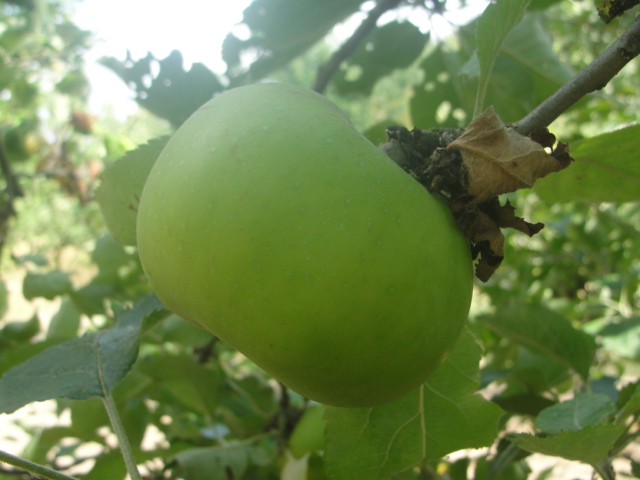
I’ve had help so far from the Orchards East project, which has found in their records that they sold eight fruit trees to the founder of the project in late 2010 – two St Edmund’s Russet apples and six varied plum trees, none of which featured in the fourteen legible labels. Having seen the yellow-brown russetting on the apples in two of the trees, it was a fair bet that both might be the St Edmunds, and finding a label saying “St Edmunds Russet” buried at the base of one of those just confirmed it. The almost purple blush on another apple suggests a Howgate Wonder, and the sweet red gooseberries are most likely to be Hinnonmaki Reds.
We have another visit planned in September from the orchard expert who set us running on identifying the trees, and I hope she’ll take the chance to look at the unidentified apples and suggest a variety. What I will do is to take sample fruit and leaves to the Orchard East people in Norfolk later this year and ask them to identify the mystery ones.
However it pans out – going from a group of fruit trees with no chart, no labels to most of them and no memory of what they were to sixty two trees and two bushes charted out and 44 of those identified is not bad going. Anybody could have done it, Nobody did it – I’m proud to be the Somebody who got stuck in. Watch this space.


Crikey, this sounds like a mammoth task. Well done and good luck.
LikeLike
It sounded like an impossible ask at the start, but as the apples and pears and plums started to come out, it looked to be more do-able. With the Orchards East project saying they’ll identify the apple varieties for us later this month, it suddenly looks possible.
LikeLike