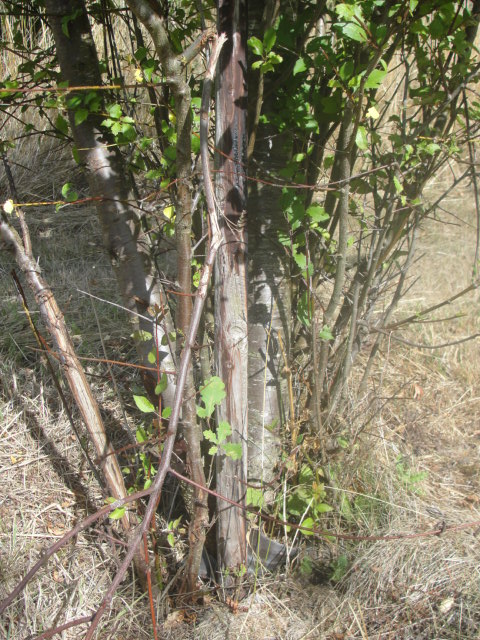
When the orchard expert came to teach fruit tree pruning in January, she told us that we needed to remove the shoots that had grown from the base of the trees, to let the tree have the full benefit of any water and nutrient in the soil. As nurseries graft wood from the trees they want to propagate onto rootstock of other trees, the rootstock sometimes attempts to continue growing and sends out shoots. Several of the trees in the orchard looked more like bushes – see the tree in the photo above for an example.
I’ve left it this late for a reason. We weren’t sure what each tree was, and as hard-stoned fruit like plum and cherry needs to be pruned in summer I wasn’t keen to cut into the shoots and find that I’d killed the main tree. But now, with most of the tree types identified, I set to a few weeks ago and cut the shoots off the pear and quince trees. These were about as thick as my thumb, and the trees looked better without them. I ran out of time before I tackled the plum trees. Ran out of courage, too.

Anna returns next Friday to teach us how to prune hard-stoned fruit trees, and (I hope) to give a verdict on how the orchard is faring. Meaning that I needed to gather courage and remove those huge shoots from the base of the plum trees. Himself gave me a hand, luckily, and even at that it took several hours to cut away the shoots carefully and pull them free without damaging the trees.I took the advice to cut as low as possible, and in one case we dug down to find the point where the shoot emerged from the root itself. Finding not just the root, but a buried tag from the tree.
I had contacted the Orchards East project to ask whether they identified mystery apples, and they had asked me where the orchard was. When I told them, they found the record of having sold eight trees to the founder – six plum and two apple. Since then, I have found two buried tags and deciphered a third that was green with lichen – the buried tags were for a St Edmunds Russet and a Coe’s Golden Drop plum, both types bred in Suffolk. The greened tag, cleaned up, faintly showed it was a …nny Mount Pear. Frantic searching all over the nurseries and resources online failed to turn up any good candidates for the full name, until I went back to the Orchards East website. And there it was. Johnny Mount Pear, developed in Colchester around 1900 and now fairly rare.
It’s clear that the founder chose the trees in the orchard carefully. All but two of the trees I have identified so far is a variety developed within greater East Anglia – Essex, Suffolk, Cambridgeshire or Bedfordshire. The more I learn about this orchard, the more respect I have for the vision behind it. It’s a live museum of local fruit trees. Very different from our own orchard – a mix of a previous owner’s randomly chosen apple, pear and plum and our own love song to the cider apple and perry pear varieties of western England (with a few intriguing eaters and a Braeburn rescued from B&Q’s sale to keep them company).
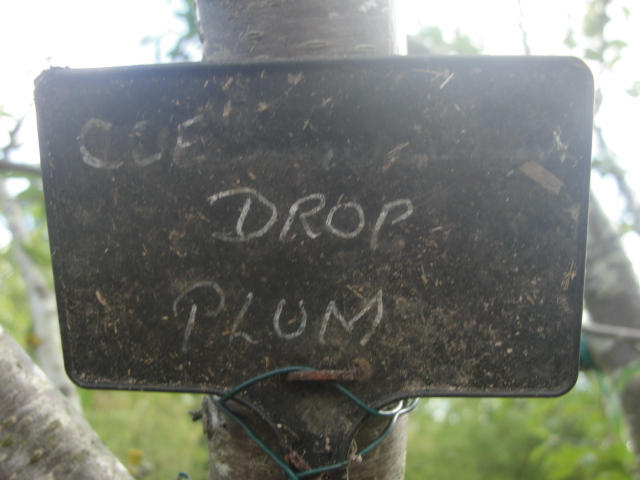
The chart of the orchard is being filled with details, and when the plum tree pruning course begins I can point out plum, damson, gage and cherry trees with confidence. I can’t wait to hear the rating the orchard gets next week.
 Julia Chalkley
Take my hat off to you for all this dedication and hard work, Julia.
LikeLike
Thank you! Hope the orchard expert gives us at least a nine out of ten this time – we were all fired up by our ‘seven out of ten’ in January and just wanted to improve.
LikeLike
Good work!
LikeLike