At sixteen minutes past midnight GMT on November 18th, Voyager 1 reaches a milestone on its journey; one light-day from Earth. If we were able to see it, we would be seeing an image of what existed one day ago.
It’s taken 49 years to reach that point, and nobody setting up the project in 1975 thought that Voyager would still be sending back messages in 2026. The equipment was designed to last for five years, just long enough to accomplish its stated goal of surveying the planets of the outer solar system.
This was a project that began with a chance observation. An employee at NASA spotted that the orbits of the outer planets were going to be aligning over the next few years in a way that a spacecraft flying in a straight line could pass close to each outer planet, one after another. This happens once every 176 years. The last time there was such an alignment, the only people to lift off from Earth and set down safely had done so in hot air balloons. The next time it happens? Who knows, but I’m not optimistic.
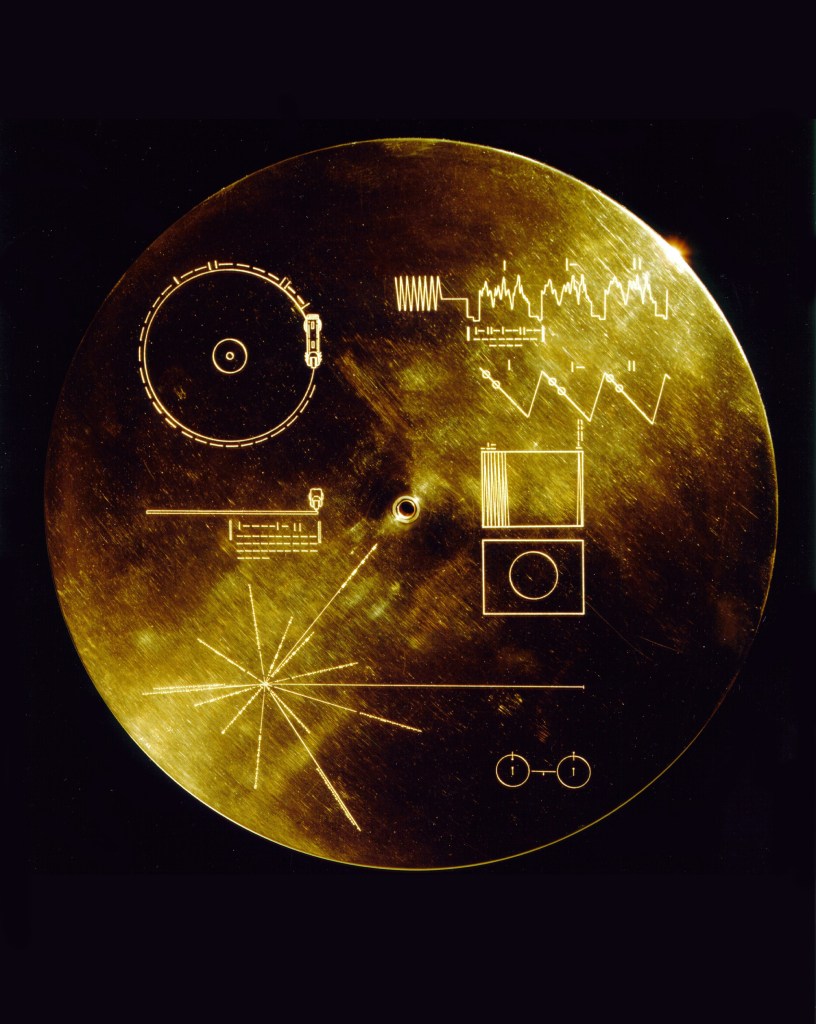
I’m impressed that NASA managed to negotiate for a mission to send off the Voyager craft, and to bargain for a cheeky get one almost free extra. The two craft have sent back some amazing pictures of the planets over the years, and both are now beyond the envelope of space where the major gravitational force acting on them is from the Sun or its planets. Not so sure that anyone or any thing will ever play those golden records but hey, the scientists had to try. I’m still amused that the records weren’t allowed to include any song by the Beatles because they couldn’t find a license to play their music in space.
Most of the instruments aboard the craft are now shut down to divert power to one or two functions, but both craft are still transmitting back to Earth. The cameras are not working, but NASA has asked everyone to go outside tonight or tomorrow and flash a light at the sky. They have a program on their site that will flash your phone in the Morse code for VGR, Voyager’s call sign. The last time they asked everyone to acknowledge the craft was on February 14th 1990, when we were all asked to wave at the sky. Carl Sagan had persuaded NASA to turn Voyager 1 around at four billion miles out in order to take a long series of photos of the entire solar system, and he wanted everyone on Earth to feel they’d been included in the ‘family’ photo.
No chance. The famous pale blue dot that was Earth in those photos was less than one pixel wide, so even if we’d all waved huge banners and flashed our brightest lights, nothing would show up. A photo now, from that far out? Not even a pale blue dot.
Even so, at sixteen minutes past GMT midnight on November 18th, I will be standing outside in the privacy of my own garden, waving the brightest torch I can find. Because, why not?

