Yup, slightly alarming title. I admit it was a bit scary for me, too. We went to a talk on foraging wild food on Thursday evening, and the speaker laid out a load of plants on his table and began to talk to us all about foraging. He was a little nervous, as he usually took people on a wander around the Wethersfield Eco Project and the surrounding grounds to see the plants themselves in their natural habitat – this was a new format for him and he was worried that it wouldn’t engage his audience.
He started by talking about water. Foraging water. The topic of foraged water continued for about twenty minutes, and he could have continued all night as far as we were concerned. He had only drunk water from the spring on the farm for the last two or three decades and loved it – and he’d brought along a two-litre jug of it for us to share. ‘Anyone want some?’ he asked. At first we all shrugged – the glasses we had were full of ginger ale, gin and tonic or mead. The second call, I’d drunk my ginger ale and was the first one up. Tim filled my glass. ‘Please, don’t die,’ he said, as he began to pour. He was joking. I hoped. The water was fabulous, cool and slightly chalky in a very pleasant way. It was a small compensation for having missed out on the chance to slug back some glacier meltwater in Milford Haven in 2014 (we were later told that the glacier itself was due to melt completely, with the last of that ancient ice flowing into the Sound by 2020. I haven’t wanted to check. In my mind, it’s still there).
He walked down the aisle distributing sprigs of plants he’d foraged over the previous 48 hours, inviting us to crush, smell, take a nibble of a leaf and pass it along. Nobody around me appreciated the yellow samphire he’d gathered from the Heybridge Basin, so I ended up with an evening’s supply – likewise the wild garlic leaves (‘The stems are the best’), though the Herb Robert was thoroughly crushed and the chickweed had been eaten to the stems. Never mind, we have plenty home here.
The variety of weeds that can be eaten and enjoyed is stunning. Our local council is about to charge for the garden waste collection service, and we’re deciding that paying £3 a time to have the weeds removed is not worth it – especially as there is only us to stop for within a hundred metres, as our neighbour doesn’t put out his green waste bin more than four times a year. I think Tim Wells has suggested the solution. Eat those weeds.
We even tried the sequioa sprig. Lovely, piney (of course) and definitely in the category of spice notes rather than bulk filler. In the end, the organiser was tidying up the glasses as discreetly as she could and Tim realised he’d gone an hour over his allotted time and wrapped up quickly.
We went home with a new determination to dig out our kitchen well this summer (weather permitting) and test the water. The sky was dark and the grass was frosted as we walked back to the car. Well worth the time to visit.
I was sorry that The Literal Challenge didn’t run their Scriptly Challenge last October. I got some really good ideas from their 2021 Scriptly, and I would love to have put together the music video I wrote for Hugh Laurie’s ‘Didn’t It Rain’. When TLC announced that they would return with 28 Plays Later this year, I was chuffed. I told my writing group that I would sign up. A couple of them reacted as if I’d pledged my allegiance to a particularly vicious cult. I’ve been reminded that I couldn’t write anything for the whole of March 2022, having wrung out my brain on daft play scripts all through February.
Well, I’m almost through it. The third week is the second hardest part of the challenge. By the time Brief 15 drops into your email inbox, you’ve had two weeks of asking your other half to take up the slack on household chores, two weeks of that initial panic followed by hours of blank brain or hours of brilliant idea being hammered into play shape. It’s taking a toll. And all through that second week, you know the Rules brief is looming.
This last week has given me prompts for an emotional or geographical journey, a creative take on a true news item, send your actors round a circus ring and dive into the abstract world. They have also let us off the hook a little with a dead easy prompt that had my mind go blank for almost a day – the simpler they are, the less my mind works to bring up a good idea, and the more time I spend not writing. The dead easy prompt was a small reward for having given us the Rules Brief.
If you’ve ever slogged your way through 28 Plays, you know The Rules Brief. Ten rules that you must adhere to, each one utterly crackers, and the only play in the series with a minimum line count (at least 198 lines of dialogue). Last year’s Rules asked – among other things – that the last letter of the last word in each line be the first letter of the first word in the next line. That was surprisingly easy to adapt to, though my teenage lad switched from being Max to being Roy, just to let me start the next line with ‘You….’ This time around, I said no. Not writing a rules play. Sticking to all those rules is great practice for writing to a competition’s very specific brief (‘only three actors, represent the Massacre of Peterloo…’ ‘set aboard a French cargo ship in July 1826…’ ‘One character speaks no English and the other is completely deaf…’). However, I was feeling the strain and other projects are looming. So I refused the Rules brief and wrote something else instead. Something that was enough of a challenge in its own way, and left me with a good idea that might warrant being expanded in the future.
Since then, I have slogged my way through Briefs 20 (AI Chat thrown in like a hand grenade) and 21 (a revolutionary type of theatre that I have never heard of before) and now I have the final week to go. Most of the way through the challenge and the hardest part is yet to come. Because if you have written 27 plays in 27 days and you’re tired and feel like you’ve been moulded to your seat and your friends and family are hinting that they’ve been carrying your share of the household work for EVER; that 28th prompt is your chance to fail at the last hurdle. The 28th brief is always so easy that the only thing that comes to mind is ‘I can’t think of anything to write for this and I don’t want to try.’ And if you don’t write that 28th play, the other 27 are not part of a success story. You missed it. You were Devon Loch, yards ahead of the rest of the field and then falling flat with the finish line of the Grand National within spitting distance.
I know I can finish. I’ve nothing to prove. I’ve refused The Rules Brief this year, so I’ve failed already, in a way. There’s no money at stake. If that 28th brief doesn’t give me something I can write into a play… You will find me feet up in the garden with a mug of tea, sitting in the sunshine and cheerfully admitting to failure.
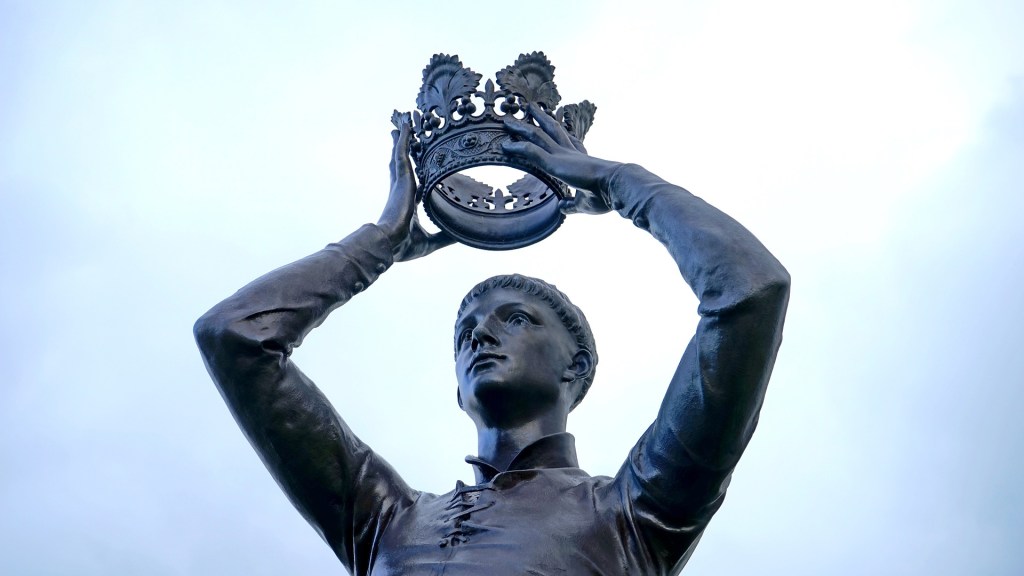
Sums up the revised Hamlet… by Mike’s Photography, Pixabay
28 Plays rolls on. Two weeks in and still keeping up – the fourteenth brief arrives at 8pm tonight, so by this time tomorrow I could well be halfway through. Which is no comfort, as they save the toughest assignments for the second half of the ordeal. Challenge, I should have said.
Last week’s joys included a command to write freeform (improvisation set in a supermarket), a traditional Noh play, a jukebox musical, based on a news story and an invitation to write the most extreme play we could think of. I had some help on the last one, as I’m not a fan of violence (apart from Quentin Tarantino) and said so on the 28 Plays FB page. Someone immediately suggested that I start by writing the sweetest, most innocent play ever and see where that took me… remember the two nuns who removed the starter motors from the Nazis’ cars to stop them from following the Von Trapp family? You wouldn’t believe where I took them.
The week also included the dreaded first line brief. The first lines we’re given are words picked at random from a weird magnetic poetry box, they must be, and they never suggest a logical story. Having said which, one person wrote a play with the suggested first line and the suggested last line, connecting the two with a hilarious story that she claims actually happened to her during her nursing career. One person’s stumper is another writer’s inspiration.
My two favourites last week were to write a play that could only be produced as a sound play – resulting in a radio script that will get a serious re-write in March and will definitely be sent elsewhere – and an alternative ending play. Take a play you know and love well and rewrite the ending. Someone re-wrote ‘The Merchant of Venice’ into a chilling tragedy, using largely the words from Shakespeare’s version, and I re-wrote Hamlet as a cold and decisive man who took revenge for his murdered father within an hour and landed himself in so much trouble for it. The man was tragic but the play was a comedy. We got the suggestion posted of an alternative Shakespeare company and I’d pay to see the new Merchant of Venice – maybe back-to-back with the original version.
The next brief arrives in my inbox at eight o’ clock tonight, and I’m ready to go. Just hoping it’s not the even more dreaded Rules play. It’s out there in the next fortnight. This year it might stop me flat.
Someone said to me last week; ‘Last time I looked it was Boxing Day and now it’s February! Where did January go?’
It was an odd month. I had a vicious cold just before Christmas which I passed on to himself, and which he passed back to me for a January present. I’ve just about come to and January’s done. Meaning it’s time for 28 Plays Later. The Literal Challenge has made it easier this year in one way – no timed route, so you can in theory take the whole month off and submit all 28 plays on the final day of the challenge. I’m still sticking to the timed route, myself. It does mean that I’m not likely to mix up the prompts. As if that could be done.
TLC asks contestants not to reveal the details of the prompts themselves, but we’re allowed to tell others the rough outline. So far, we’ve been invited to write a play about time, a play that can be performed only once, a play relying on riddles and a traditional farce. The top puzzler so far is to take inspiration from the life and work of a singer who was so famous in her own country that the national radio station devoted one hour a week to broadcasting recordings of her singing – every week, for almost forty years after her death. None of the playwrights responding to that one had even heard of her. Well, we certainly know about her now.
TLC are kind enough to let us go off-brief if it stumps us too much, though in the final reading session they will only consider plays that fit the brief exactly. The whole point of 28 Plays for me is to push myself to write something that I would never have thought of before, and the first six days have done that. Every evening at 8pm, the email pops up on my inbox with the next brief and the process is always the same. First; “I can’t think of anything around that!” followed by research on the subject. Sometimes immediately and sometimes hours later I have a weak idea that turns into a wicked idea that ends up as a play. With 24 hours to write and submit before the next brief arrives, none of them are long enough or polished enough to believe that any theatre company might be interested. That’s not the point. The point is to train you to drop the time wasting and write a first draft, something you might pick up later and turn into a full idea. It’s working so far. One of last year’s daft drafts got edited and sent off to a competition, and probably going on the ‘No’ pile right now but it’s a start.
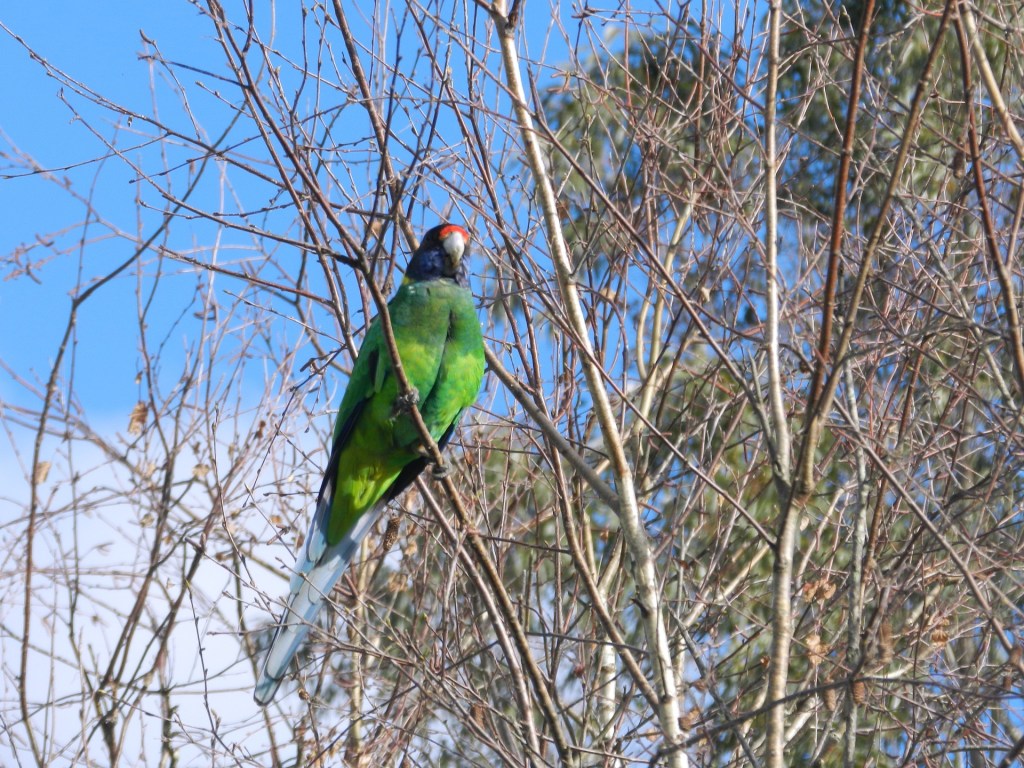
The bird in the picture at the top of the page is a Twenty Eight bird. A kind of parrot whose call is ‘Twenny Eight… twenny eight…’ Probably all I’ll be able to say by the end of February.
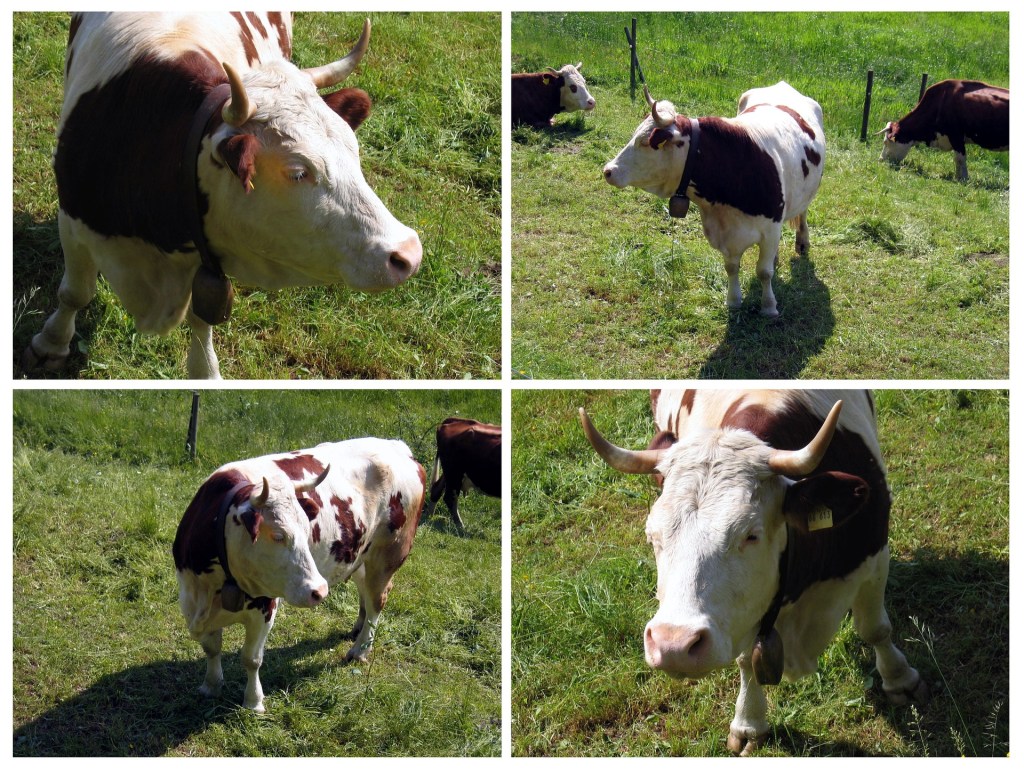
Take ten points if you recognised the quote from Cold Comfort Farm by Stella Gibbons. Those are the names of the four cows under Adam’s lacklustre care, but honestly, it also describes how I’ve been feeling recently.
We took down the decorations on January 5th and switched off the strings of lights decorating the garage, the verandah and the Christmas tree. Everywhere went dark, and the weather slid into gunge territory – not anything as exciting as snow, just rain, mud, dark clouds, cold winds. General early winter yuk. Too wet and windy to enjoy a session of clearing the greenhouse for next year’s seedlings, too muddy to rip up weeds without a pint of mud sticking to roots, clothing and hands, too cloudy at night to go stargazing. This is the time of year when we could do with a small celebration of light rather than signalling the end of festivities.
Festivities ran on much longer this year. I can safely say it here, as none of my fellow cat-maniacs follow this blog – I’m part of a group of cat servants on FaceBook, and we ran a Secret Santa. For our cats. Low spending limit and this year the kind of outright chaos that happens when an automated Santa program has a Skynet moment. Elfster is great, if you keep it in its place, but this year it went off on its own and drew in previous participants (who no longer wanted to take part) and assigned partners before shutting itself down. Add the postal strike, and only half of the group received presents (whether they wanted them or not).
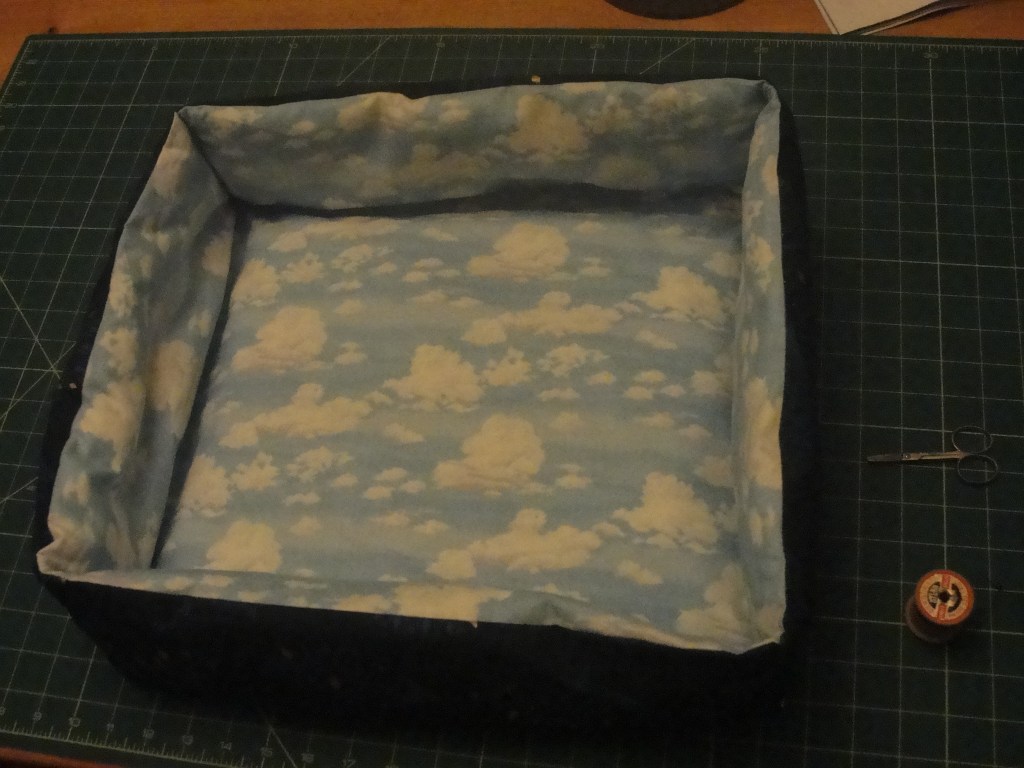
I took the lazy route and ordered a cat bed from that famous South American online store. The seller wouldn’t send direct to my recipient, so I was resigned to receiving the bed and sending it on to her. Best laid plans… six weeks after that order, the bed has not yet arrived, even though other parcels have broken through the blockade. I gave up after four weeks and got into that Soddit mood. Soddit. I was going to make a cat bed. How hard could it be?
Do not ask. I’m about ten miles from any good frivolous shops, so I was relying on the craft stuff I’ve built up over the years. I did manage to get hold of a large bag of sheepskin scraps for a low price and stitched four of them together to form a fluffy base. I had quilt wadding and wool stuffing left over from a project in the distant past and enough cloth remnants to start a shop.
It took three days, and one of those days I got into a proper mood about it and stayed up till 4am to follow through the idea I had for connecting the whole lot together. When you see the Sewing Bees run up an evening dress from a binbag and three staples, it’s skill. Mine was more of a comedy act with vintage thread and sheepskin. But on the third day, it was finished. It looked a bit wonky, but that stitching will not come undone. Well, famous last words. I once sewed a catnip mouse for a friend’s ginger tom with cat-proof stitching. Within one day, the ears had been torn off, the tail was severed and the woolly guts were being extracted bit by bit through the gash torn in its belly seam.
But I have faith in this cat bed. The three toms who got it as a ‘Christmas’ gift have taken peaceful turns to sleep in the bed and show no signs of wanting to take it apart to examine the stuffing. No better thumbs-up than to see a cat choosing to sleep in a cat bed you’ve made rather than plonk their furry bums on a clean jumper or your smartest black trousers.
She posted three photos showing one cat after another taking a turn to settle in the bed before one staked his claim by curling up and going off to sleep in the bed. It was worth three days’ work to see them enjoying their present. The job of sorting out the whole mess of who got a present and didn’t want one and who sent a present and hadn’t received one in return goes on, though the man who took on the task planned to finish it by Friday 13th January. In the meantime, there’s three cats asleep on my handiwork tonight and my fortnight of feeling dull and unable to get up and get on with things is coming to an end as I take heart on the projects I could get on with.
We get around to December and all our preparations for Christmas look like a siege. We declare the last shopping day before Christmas, the last trip out, the last set of Christmas cards written and posted. After that, we close the doors against the world and don’t go back out into the traffic again. We’ve walked to the local wood for a session of carols around the bonfire, walked to neigbours’ houses, but no more daft trips out to the beach, no more journeys to relatives’ houses and definitely, no more shops.
Our last trip out this year was to see the Christmas decorations at Holkham Hall in Norfolk. The photo above is of the Marble Hall at Holkham, before the decorations went up. It was a birthday treat for Himself, chosen to get us into the mood for Christmas. We’d gone for a candle-lit tour of Audley End in autumn 2019, and since then ill health and lockdowns had stopped any such outings.
It was spectacular. I won’t spoil the surprises for anyone with a tour booked, but if you didn’t manage to get there you can see the tour of the hall filmed by Channel 4 if you tune in at 8pm on December 22nd. The rich can certainly do it differently – their decorations took over the entire room. What cheered us up was that their decorations looked fantastic, but many were composed of small items saved from previous years’ displays and others were put together from left-overs, broken cases, scraps of wood. We could probably put up a display just as impressive (though much smaller).
The interesting insight came from a volunteer manning the gate as we left that evening. We stopped to chat, aware all the time that we had just finished the last tour of the night and that every person on the staff was preparing to shut down and go home. She listed out the number of staff at the hall. It was less than the number of staff needed to maintain the buildings and canteen for the much smaller office block where I used to work.
We drove home carefully. The temperature had dropped to two degrees above zero on our way there, and I switched the car on to find it was now zero, dropping to minus figures within minutes of setting out. We’d been warned that the weather would turn cold on the north Norfolk coast, but as we drove home it dropped to minus half, minus two, minus 2.5 before settling at zero by the time we arrived home.
Since then, the entire east coast of Britain has been hit by a blast of freezing weather. The threat of light snow and minus three last week turned into 10cm of snow, icy roads and cars stuck in every ditch and hedge for miles around. Motorways across the south and the north of Britain were closed by multi-vehicle crashes and cars went skating on minor roads. Our county council claimed to have salted our road, but maybe they have some kind of stealth salter… certainly nothing passed our house between 8am and midnight. By 9pm, there’d been so many crashes at the junction to the west and on the gentle hill to the east that no traffic at all disturbed the snow on the road outside our house until the early hours of the next day.
The snow is still as deep and widespread, a week further on. The temperature hasn’t risen above zero for more than a couple of hours a day, and the lowest low of the region was recorded at an official weather station a few miles from here – minus ten, not as bad as Braemar’s minus fifteen but bad enough. It’s due to drop further this week. It will be a few weeks or months before we understand how tough the damage has been to our trees and plants. Roses, geraniums, nasturtiums and fuschias were still sporting flowers the night before the freeze started, and the chard and kale was still as good as autumn. Now? I have some scraping up and composting to do when the weather clears. The good news is that this kind of cold will kill off some of the vicious bugs that attack our fruit trees in spring and summer, so we may have a decent crop. We’ve already thinking of what seeds need to be set off in January.
After a frantic few weeks of organisation, our OU writers’ group met up at Cromer in the last weekend of November 2022. Six of us arrived at West Cottage; the other three turned up on our screens thanks to Zoom. For the first time since 2015, we had all nine of our group gathered together.
We’ve had a long history. We were all students on the Open University’s third level creative writing course in 2010/11, nine of the dozen or so who had taken to the national forum for student chat and feedback on our work after we found that our regional tutor group forum wasn’t lively enough. At the end of the course, we’d all said; “I’ve loved chatting with you! We have to meet up in person! Where are you?” Four of us were based in Scotland, two in northern England, one in East Anglia, one in Sussex and one in Geneva. It’s a diverse campus, the OU. The 2009/10 graduate group from A215 met up in Birmingham, being a Scottish / northern / eastern / Devon / London mix that couldn’t have met locally, and met just the once; the A363 graduates met in the holiday cottage of one student on Tiree, in the Inner Hebrides in 2011 and we have met almost every November since then.
It was my turn to host this year, and I brought them to Cromer on the north Norfolk coast. We’d discussed bringing the reunion south before, and a few people had noticed Cromer as a possible destination. This year I went looking for houses that could allow anywhere up to nine people the chance to live, write and sleep.
Sue Cook has posted on her blog about how the weekend went, and about the value of a writing retreat – you can join a commercially organised one, or you can gather your writing friends and make your own. This is what we look for. None of us want to share a double bed with another, so there has to be a bed or a comfortable sofa to sleep on for each person. There must be a big kitchen (we take turns to cook and wash up, but as with every party, people tend to gather in the kitchen). We need a comfortable space big enough for everyone to sit and talk, and a dining room large enough for everyone to sit down for lunch and dinner. Above all, places to sit and write.
We started the weekend by talking. And talking. We meet like this once a year and we have a lot to say to each other when we do. This year, three of us had had novels published while others had won competitions or had short stories accepted for publication and one person had won a prize for his novel at a conference. We’re a varied lot, writing short fiction, novels, poetry – in various forms, from romance to crime to science fiction.
We went out for walks – in town, along the beach to the lighthouse, along the beach to West Runton, in every bookshop in town (there are three) and out onto the pier. Sue was running an online writing sprint with her other book group, and we all joined in; Mairi ran an online meeting with her writing friends and some of us dropped in to wave. Enza and I discovered that the twin room in the attic we were sharing could only be accessed by spiral stairs that led through the corner of Sue’s bedroom, and we had a quiet battle with the heating before finding that the cleaners had left the thermostat turned so far below ten degrees that only a snowstorm would have switched the heating on. We finished the weekend with our usual look forward to the next year. This was what we always referred to at the next year’s opening meeting… “You said you’d finish that novel! Have you?” “You said last year that you were going to write every morning for twenty minutes…”
This year, we began by saying how we’d done this weekend. Everyone had written something they were proud of – a plan for a novel they’d had an idea for, morning pages, an episode of a serial they’d been commissioned to write. Everyone except me, who writes better after midnight and into the early hours. We finished by saying what we’re going to do next year. Crucially, we’ll hold a Zoom meeting in May that will hopefully focus our minds on these goals (or our excuses for not having met them!).
We left the cottage on Sunday morning and went on to Felbrigg Hall, only two miles up the road, to walk around the Walled Garden and the bookshop and the tea-room. We split up from there, five people going west to join the A1 and on to the north, and me going south, back to my home. Of course, with a few days left on my week-long parking ticket, I brought Himself back to Cromer a few days later, so that he could see the sights and the bookshops, and take a guess at how many books there are in Felbrigg Hall’s Christmas Book-Tree. That’s another story.
Our latest trip out was to Ely Cathedral. It’s the third time we’ve been there, and every time that first sight of the cathedral is a Wow moment. All those miles of flat land and then that enormous pale building on the skyline.
The first visit was for my graduation from the OU with a BSc in Earth Sciences – priority given to students from the East Anglian region, so I was able to book a ticket for my husband and father to watch as I went up on stage to collect a blank scroll of paper and shake the hand of the Vice-Chancellor. The second visit was to the 2018 Christmas Fair – stalls lined up along the aisles of the cathedral and the Lady Chapel. This time, we’d been drawn in to see the Table.
In 2012, a farmer in nearby Wissington found a tree trunk buried in a field he was ploughing. Whatever made him call the experts, I have no idea; what they found was a thirteen metre long section of black oak that had fallen in the Fens 5,000 years ago. When the experts tried to work out which end was the rootball and which was the canopy, they realised that it was barely tapered – that it was a section from a much larger tree. The height of the complete tree was estimated at 50 metres, almost twice as tall as the tallest oaks today.
The Canadians sent their largest mobile mill over to England to create planks from it, and the crew found that it was easier to set up the mill in the field than it was to move the tree trunk. They got ten planks from the trunk, and dried them out over the course of ten years in a purpose-built dehumidifying kiln. The planks lost nearly 1,800 litres of water – 1.8 metric tonnes – along with half of their thickness, a quarter of their width and 150 mm from their length. There was still enough left to make a table. The Jubilee Table.
The grain and colour and shine of the wood is amazing. The sign on the table invites visitors to touch it, luckily, as the first thing I did on reaching it was to run my hands over the surface. It’s beautifully designed and put together, and they would have to put up some barrier to stop people from stroking it.
Having travelled all the way to Ely – and got up early enough to get a parking space – we were going to make the most of the trip. We’d booked tours of the Octagon Tower and the ground floor and entry to the Stained Glass Museum. The West Tower was closed, and frankly, I’m now pretty relieved that it is. The Octagon Tower was tall enough. I was lucky the guide realised that I was afraid of heights and took it easy on me. Thanks, Dave.
The journey up to the top of the tower is in stages, via three sets of spiral stairways – we came out onto the gallery overlooking the ground floor at first, then on to a walkway along one edge of the northern transept (with a very low stone wall between you and the lawn some thirty metres below) to the inside of the octagon. Impressive enough to see the huge struts of oak supporting the tower, and then to hear that it cost £2,000 in mediaeval times (they still have the invoice in the archives) and weighs 200 tons. Then he opened Door number 2.
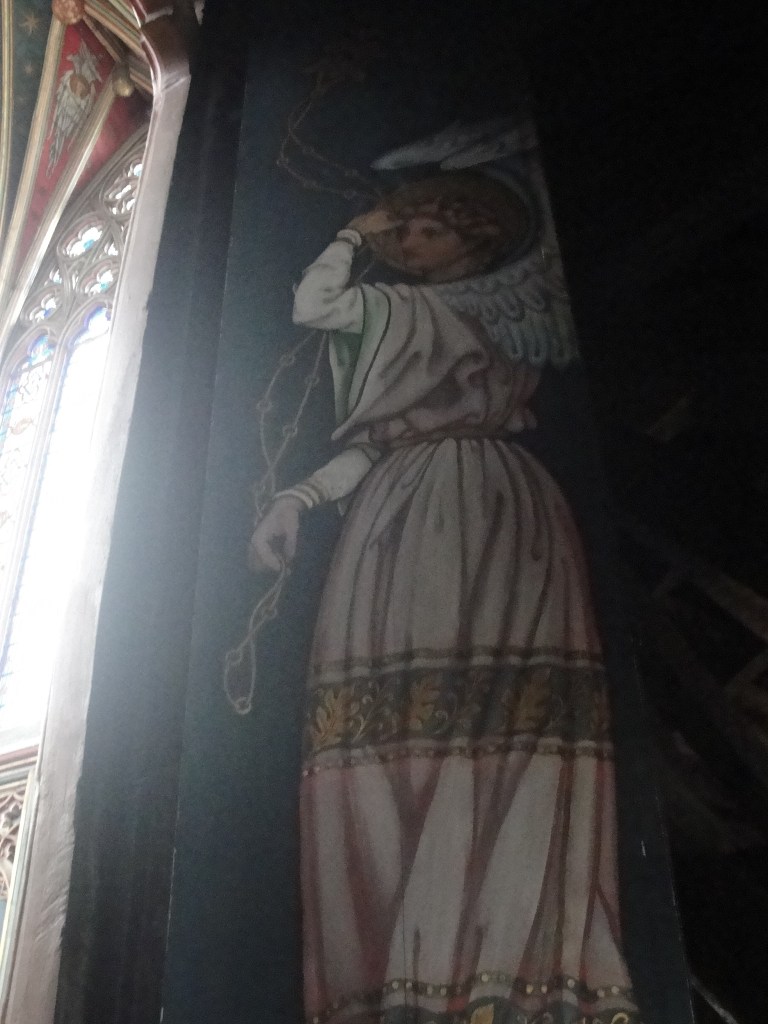
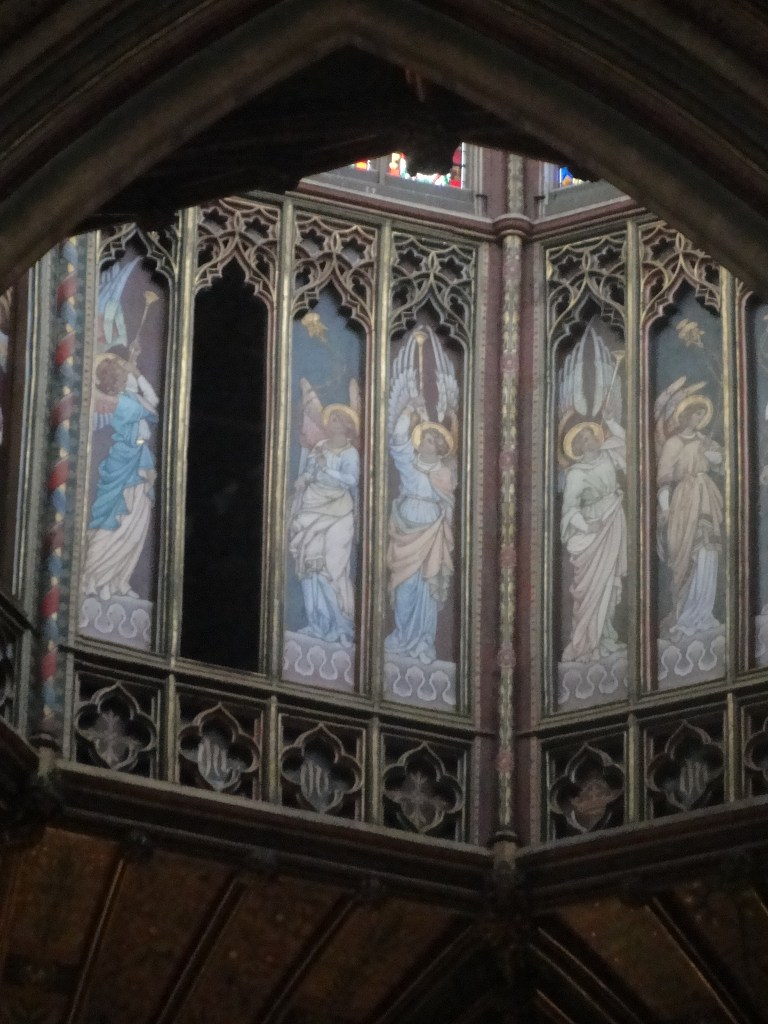
There are 32 angel panels around the Octagon, and each one is a doorway. Open it up and look straight down 142 feet to the floor of the cathedral. I managed that, just. Above each angel is a stained glass window, and our final stop was to get onto the walkway around the outside of those windows. Up one final set of stone spiralway with a rope for a handhold and out through a door designed for a ten year old. Onto the roof of the Octagon.
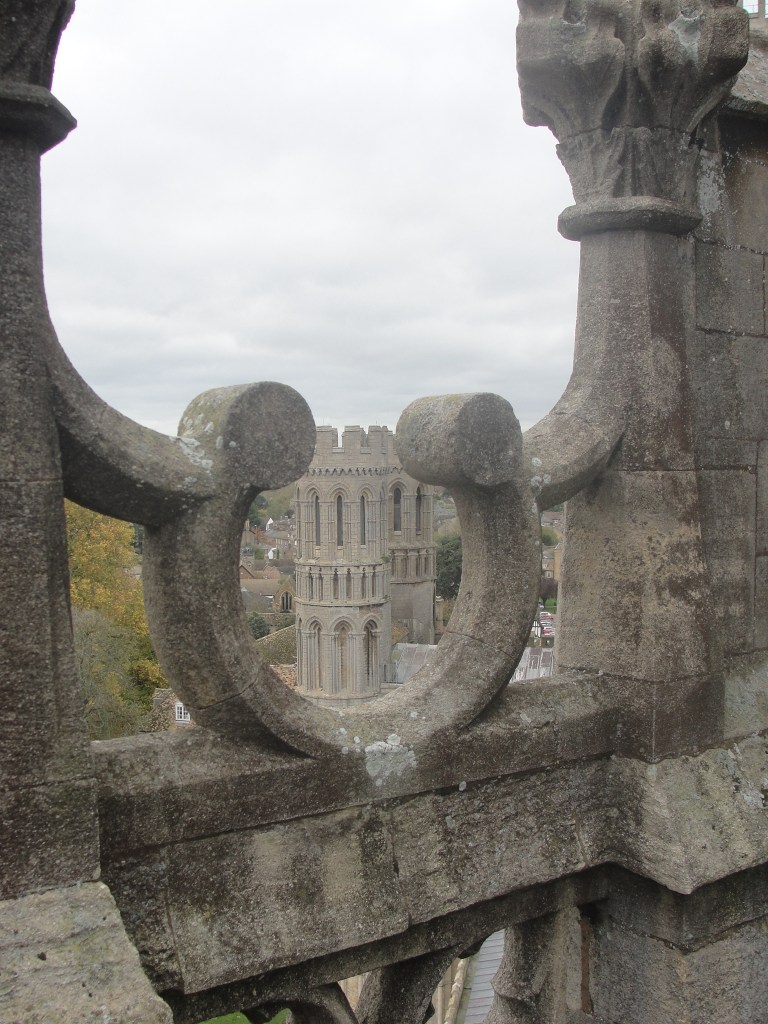
The view was spectacular. There’s a taller stone balustrade between you and the lawn below, but visitors walk around a steel platform set a metre back from the stonework, with its own scaffolding handrails. It was almost like not being a fatal height above the ground. I think this first view might be across the fields where Pink Floyd set up two giant heads for the cover of ‘Division Bell’. Take a close look at the distant background between the heads on that cover and you’ll see Ely Cathedral.
There’s another 200 tons of lead protecting the wooden structure below, so a total of 400 tons on the roof of the tower. We’d already been told that the original tower collapsed in 1322, and that the cathedral is built on very shallow foundations on soggy Fen land. Now Dave pointed out that the West Tower – the main tower at the front of the cathedral – is a few degrees tilted off true, one side sunk a little further than the other into the soft ground. The whole structure was built to be a huge impressive statement of victory at long last over the rebels who held the Isle of Ely against WIlliam I for longer than any other part of Britain, and I doubt anyone would have spoken up to the king about the sense of putting a tall, heavy structure on shallow foundations.
We walked the full circuit around the walkway and then back the way we came, down past the angel doorways and along the walkway to the next set of spiral stairs, down to the floor of the nave. I thanked Dave for putting up with my fear of heights – I like to test myself, and sometimes I fail. We went off with wobbly legs to wander around the Stained Glass Museum. It’s small but it packs a lot in. We were hoping to see the Seven Ages series again, but it was one of the exhibits that had been moved on and been replaced by something new.
And at last, the tour of the ground floor.
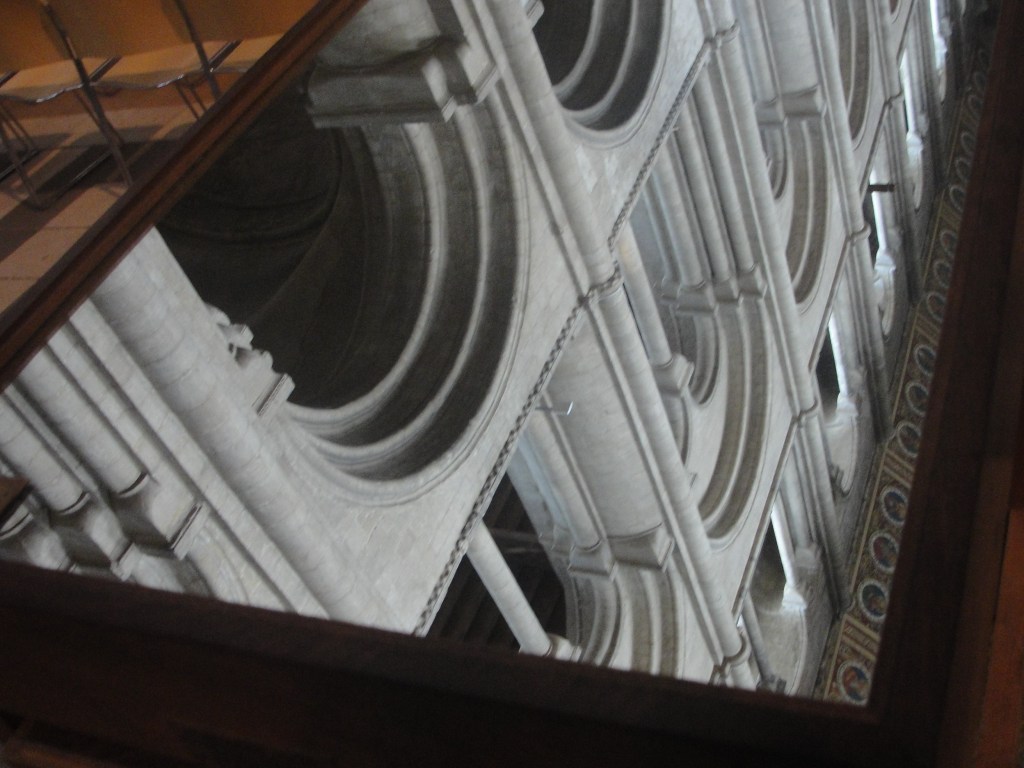
It’s the kind of place where you can’t help but look up, so these mirrors on the nave showing the details on the ceiling are valuable for visitors. Our guide pointed out the painted figures and faces along the ceiling, including one of the prophets who had been painted with the face of the dean of the time. While I was looking up, I noticed that the next tour of the Octagon Tower had the angel doorways open in the gloom – the same door with the pink angel that I photographed earlier.
We left the cathedral after the tour, having spent almost the whole day there. One last long sweep along the table, and we were out in the gloomy afternoon. We didn’t have time to visit Oliver Cromwell’s house, just a few hundred yards away, or the Thursday market or the local museum. We will have to come back one day. Soon.
As the saying goes; ‘When you’re up to your ass in alligators, it’s easy to forget that you went in there to drain the swamp.’
I started this blog two years ago after a (more successful) writing friend told us about ways to advertise your writing. I write for fun, but the idea of starting a blog sounded like fun as well, so I did. Since then, it’s been a blog about all the other things I do – gardening in a large space, star gazing, getting the trees in our community orchard identified, travel, cats. Occasionally, writing. Rarely, writing, which is the original point.
I haven’t stopped writing for long over the last two years, though there have been times when I haven’t written or read a single original word for a fortnight. I had one of those times in mid-September to early October, starting with a small set-back and snowballing to being unable to even think of writing. What set it right was someone giving me an honest critique of something I’d written before the standstill and saying that they really enjoyed it. This is someone from a hard-boiled critique group, where they know they have to point out all the flaws that let the whole piece down (“He tells her that he’s from the future and that she should invest her life savings in a tech start-up she’s never heard of… and she does??? Hmmm. Wouldn’t you think – ‘Scam’?”).
That one enthusiastic ‘Like’ set me to writing again. I’d entered Globe Soup’s Historical Fiction competition with a will in early September, had three weeks of not being able to write and had three weeks to write four stories. Two of which I had no idea what I could write about (GS sold tickets in five assorted colours, and you chose a ticket without knowing which time period you’d be assigned). I had pretty much written off any chance of writing any coherent fiction based on Ancient Egypt and I know a lot of the contestants were struggling with the kind of racist language that both sides would have used without question or alternative during the American Civil War. But I had a decent World War II story and now a 1920’s one that somebody else liked… And I was off and writing, three new stories in the historical challenge finished in three weeks flat.
Strike rate this autumn so far; the fastest rejection ever for my Crazy Cat Lady story, five varied historical stories sent to Globe Soup (including a very strange one set in Ancient Egypt – and one set in the American Civil War without any words that might be offensive to anyone unless they’re from Edinburgh). Bought a couple of tickets for Globe Soup’s next competition – Paranormal – and got assigned the two categories I wanted. Not a peep about the Shallow Creek competition, and The Literal Challenge has stopped sending out prompts.
I’ve spent a lot of time over the last few weeks arranging a meeting for my OU writer’s group this month – we studied online and chatted through the OU’s forum for a year and agreed to meet up at the end of the course. We’ve been meeting up in person or virtually every year since 2011. Every year, we start with last year’s resolutions and admit what we have or haven’t done – spend time catching up, exploring the area and writing. We end the long weekend with a session where we each say what we mean to do over the next twelve months, and one person writes it all down and circulates it later. I organised this year’s meet with the knowledge that again, I belong to a group of nine writers where six have at least one published novel, half of them have sold a short story or two, one has won an award and one helps to run a literary magazine. I’m the comedy act at the end of the session with null points.
With days left before we meet again – I got an email. I had won the short story competition in Writers’ Online, please send photo and author bio, payment to follow shortly. Yes, I checked it wasn’t a scam. No, I don’t quite believe it. But still, I’m going up to Cromer in a few weeks with a shortlisted and a win to my credit, with another five stories in the judges’ in-box that might get a mention – or a home somewhere else.
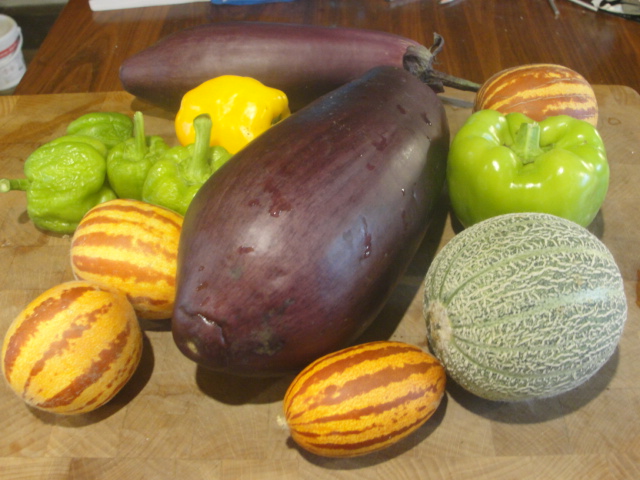
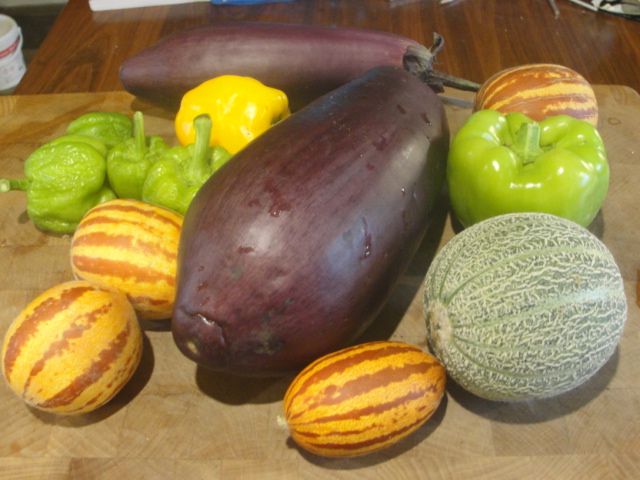
Last year we planted eight melon vines and were rewarded with two melons. So I planted the last of our melon seeds with more hope than expectation this year. I ended up with fifteen surviving melon plants and no-one else offering to take them in, so I planted the lot in the polytunnel. Laws of Sod, they all produced melons except for the Collective Farm Woman melon vine (on strike, I think) and every damn fruit turned ripe during our September holiday, and half were on the floor by the time we returned. We ate as many as we could. The cucumbers objected to the heat and produced cukes that were so bitter that I didn’t like to give the excess away. The aubergines went completely beserk, and the peppers (after a slow start) are providing a good crop. We grow a full salad here, with a glut of cucumbers in August, good crop of lettuce in September and a few tomatoes in October. We need a time machine to make the whole lot into a few decent, varied salads.
But the apples – the apples have made up for it all.
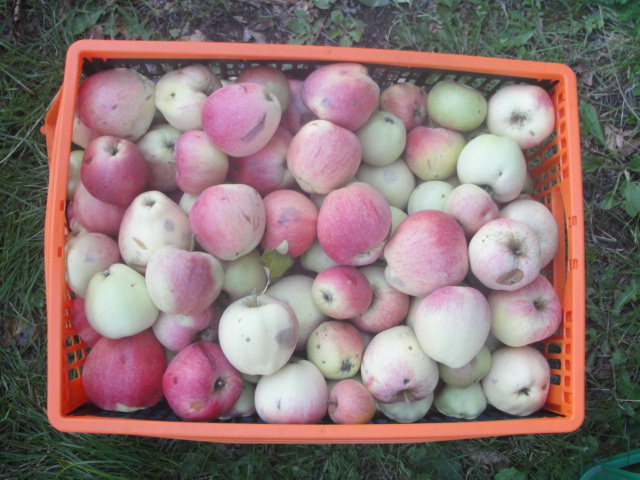
After four bad years, the apple trees have come out in force. Our neighbour told us that he was throwing his apples on the compost heap as no-one in his family were keen enough to keep up with its output. We volunteered and a day later we had five full crates of juicy eaters to deal with. When we’d finished with those, we stripped our own cider apple trees – planted in 2008, they have finally found their strength. The Yarlington Mill and Michelin was laden, and the Morgan’s Sweet offered four huge yellow apples. The Kingston Black, the Stoke Red and the Dabinett had a dozen each. Between them, they gave us four full crates. Next up was the Bramleys. You can make a good sharp cider from Bramley, as long as you don’t mix it with other varieties, and we stripped the tree. Five kilos for fruit for future apple crumbles, the rest went through the scratter.
Crate full of Yarlington Mill cider apples
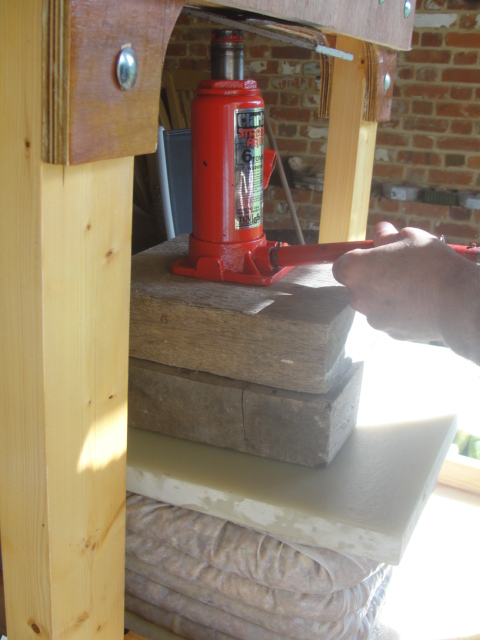
I admit we had an advantage this year. Our Gloucestershire friends are hoping to move house soon, and are clearing away some of the stuff they’ve acquired over their decades in their current house – including the cider press he built a decade or more ago. We took it home and have been testing its limits this week. It’s a serious piece of kit. It’s a wooden arch over a tray with a drain hole. The apple mash is formed into a pile of squares enclosed by fine mesh (‘cheeses’) in the tray and covered by a slab, or two or three… a car jack on top of the slab presses up against the arch and down against the slabs, pressing the juice from the mash. Efficient, quick and fun.
John’s Super-Duper Juicer!
The neighbours’ eaters gave us six gallons in a barrel and four gallons in four demijohns – the juice gushed out, pouring two gallons into the barrel even before we put pressure on. The cider apples were dry and stubborn, giving just six gallons of thick, dark juice and staining our hands bright orange. It took 24 hours of determined scrubbing to get the Tango off. Yesterday we pressed the crates of Bramley and got almost eight gallons of juice – a full barrel, a gallon demijohn and a few litres to freeze for apple juice in the depths of winter.
If you leave freshly pressed apple juice, the yeast from the skins will begin to ferment within hours – slow at first, then desperately quick and vigorous. The only ways to stop this is to pasteurise it (heat it to at least 63 degrees F for at least 20 minutes), freeze it or put in a carefully calculated dose of sodium metabisulphate. This is why extra gallons in demijohns are so much fun. Early batches of cider were half OK and half vinegar – these days, we can all but guarantee a decent cider in the barrel from a calculated stop and re-start with a yeast culture, leaving the demijohns for experiments. Fizzy? Double strength alcohol? Mild and weak? Oak or vanilla flavoured? We can risk a gallon to try out ideas.
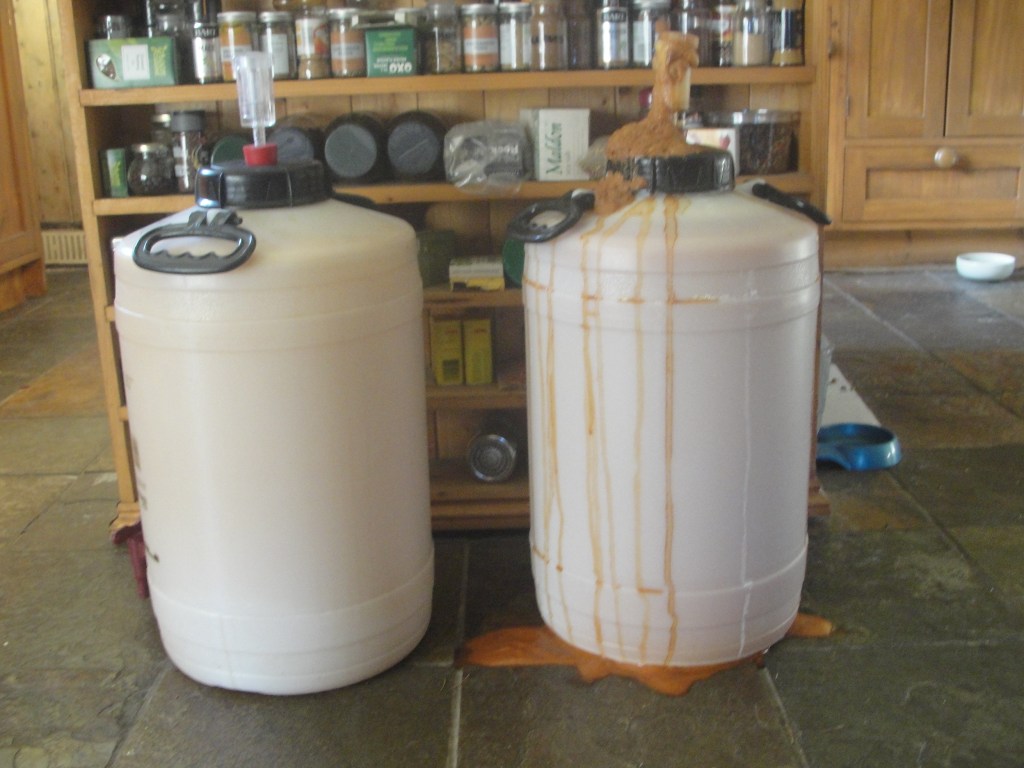
The barrel belching out dark orange sludge is full of pure cider apple juice…
The pure cider apple barrel is a thug, belching dark orange syrup out through its airlock every hour. It’s been like cleaning up after a messy kitten, mopping the floor and scrubbing the barrel. Next door’s eaters have been blopping away quietly and steadily and we’ve just put the E1118 yeast culture into the Bramley barrel, so we wait to see how well mannered this one is. The demijohns are lurking in the shower room. We are back to the days of explaining to visitors that we don’t drink all this in one year… honestly… and it’s been a real blast to be back making cider.










 Julia Chalkley