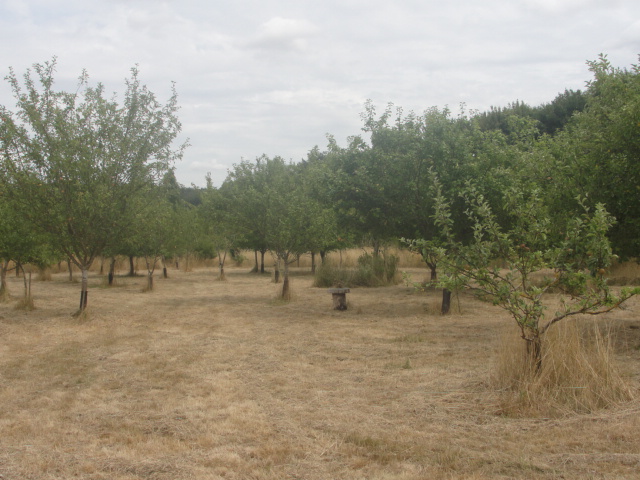
This is the orchard in August 2022. Dry, dry, dry.
Earlier this year, I reported on the odd project I got involved in. I’m a member of our local woodland trust, helping out as a volunteer. As part of that work, I volunteered to chart the orchard that had been planted in 2011 as a present for the founder’s 90th birthday. I thought it would be a simple job. Hah.
When I started pacing out the orchard, I admit I was annoyed at myself. I kept thinking of Terry Pratchett’s famous stone circle that had only one stone, but nobody had been able to count it. Every time I went down to the orchard in the first three or four days I came back with a different number of trees.
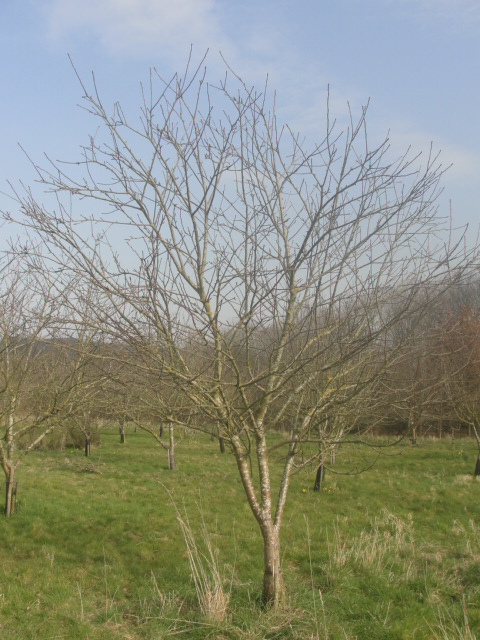
When I understood that the basic pattern was ten rows of trees in a square pattern, I counted 64 trees – though one that got included in that count turned out to be a blackthorn tree that was probably coincidentally in line with one of the rows, and another has proved to be completely dead. Back in March, there were no leaves and little blossom to serve as a guide to what each tree might be.
Tree A5 in March.
Now, though, the trees have come into their own and the guessing game can start.
Tree A5 is definitely an apple tree!
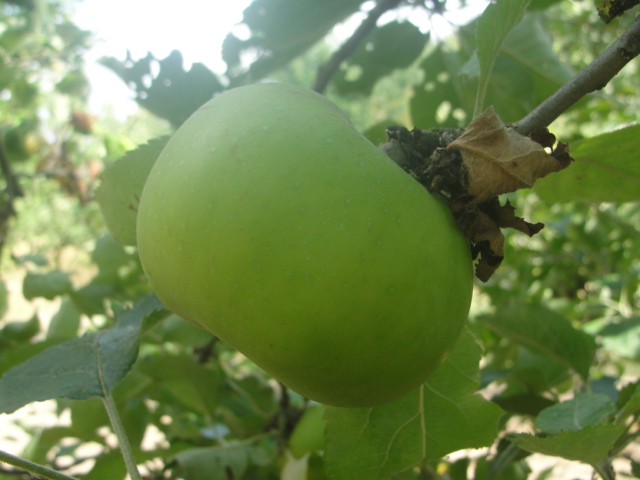
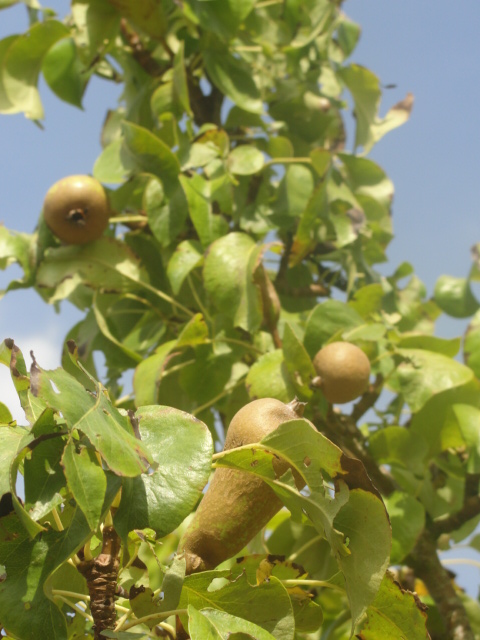
So – sixty-two living fruit trees and two bushes. Fourteen had legible labels; I found three more labels and deciphered two of those. About two-thirds of the trees have fruit on this year, so I can say that 22 are apple trees, five are pear trees, ten are plum, gage or damson trees, three are definitely cherry and two are quince. I can make a reasonable guess at eleven more trees, and have not enough idea of what the other nine might be to suggest it. With 23 varieties either known or probable, I’m making progress.
Be fair – huge, green, sour? Has to be a Bramley.
I’ve had help so far from the Orchards East project, which has found in their records that they sold eight fruit trees to the founder of the project in late 2010 – two St Edmund’s Russet apples and six varied plum trees, none of which featured in the fourteen legible labels. Having seen the yellow-brown russetting on the apples in two of the trees, it was a fair bet that both might be the St Edmunds, and finding a label saying “St Edmunds Russet” buried at the base of one of those just confirmed it. The almost purple blush on another apple suggests a Howgate Wonder, and the sweet red gooseberries are most likely to be Hinnonmaki Reds.
We have another visit planned in September from the orchard expert who set us running on identifying the trees, and I hope she’ll take the chance to look at the unidentified apples and suggest a variety. What I will do is to take sample fruit and leaves to the Orchard East people in Norfolk later this year and ask them to identify the mystery ones.
However it pans out – going from a group of fruit trees with no chart, no labels to most of them and no memory of what they were to sixty two trees and two bushes charted out and 44 of those identified is not bad going. Anybody could have done it, Nobody did it – I’m proud to be the Somebody who got stuck in. Watch this space.
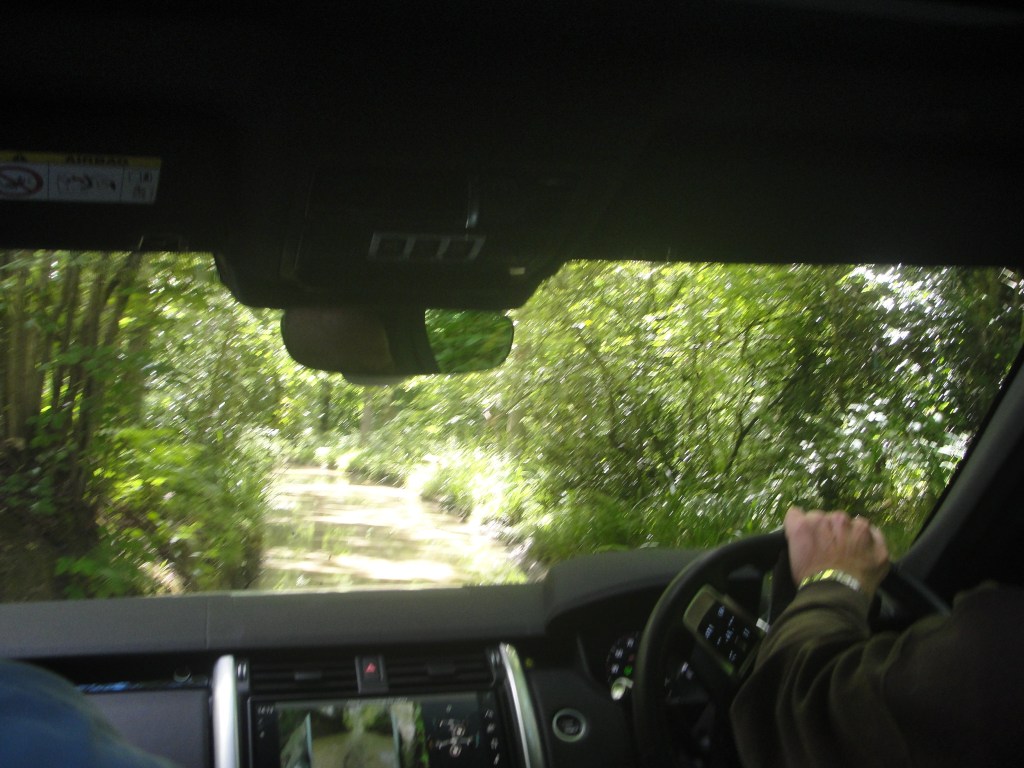
Well, the western half of England had enough rain to form puddles this summer…
Yes, that’s water you’re seeing through that windscreen. Himself was lucky enough to get a Landrover experience voucher for his birthday, and what you’re seeing in the photo is what he saw while driving. We booked it for early July, left the already parched grounds of our garden behind and went out to stay with friends in Gloucestershire for a long weekend.
The experience was based at Eastnor Castle. No, we didn’t get to see the castle – we were directed to a glass-walled showroom in the grounds, and taken out from there to where the Landrovers were parked. From there, he was settled into the driving seat of a new Discovery and away we went.
Just making this clear – I was in the back seat throughout. The driving experience was bought for him, with a follow-on session for the friend we were staying with. You get a different view from the back seat – the brake foot hasn’t got a pedal to land on, and you get the chance to take photos.
It was a good long ramble through the woods behind Eastnor Castle. We’ve both ridden off-road trials and trails on motorcycles many years ago, and we’re used to the principle of lining up on a muddy steep hill and giving the throttle some exercise to keep up the traction, standing up on the footpegs and letting the bike catch grip under you. If you’re sitting down, you can’t help but try to nudge the bike onto the line – if you’re standing up, the bike (usually) corrects itself and stays upright. That’s the theory. He was always better at it than I was.
Modern off-road super-cars are different. He was going to punch through the mud at about 15 miles an hour, until the instructor stopped him. Slow and gentle. Press the button on the dash for mud and snow… or press the button for downhill… you’ll excuse me, but press the right button doesn’t equal real off-road driving to me.
All the same, it was fun, sploshing through puddles up to a foot deep through a shaded forest. The instructor was great, always calm, and he encouraged both drivers to try The Peanut. This is a small concrete patch (accessed via a set of stairs) with a concrete hill in the centre and steep banking around it. Imagine sitting in a car with the right front and rear wheels jacked up by three or four feet, and you’ll get the idea of how steeply we were banked.
That was Friday’s treat. Saturday’s treat was a couple of seats in the audience at Ledbury’s Poetry Festival, listening to Brian Bilston read his poetry. If you don’t know Brian Bilston’s work, try it. He’s brilliant at the deadpan play on words and meanings with an occasional vicious kick at political stupidity. It was a good long hour of daft and smart poetry, and we went out cheered up.
Sometimes, a weekend away is as good as an expensive week’s holiday.
The ground under those trees is the colour of every lawn in East Anglia right now.
This dry spell has been going on for months, and now we are all used to it. It’s been over three months since we saw any reasonable amount of rain – even for a dry region like ours, this is definitely out of the ordinary. Local weather forecasters have said that we have had 1% of the expected rainfall for the area in the last six months, and are apologising for the lack of rain in the forecasts in the same way they were apologising for the constant rain we had over last winter.
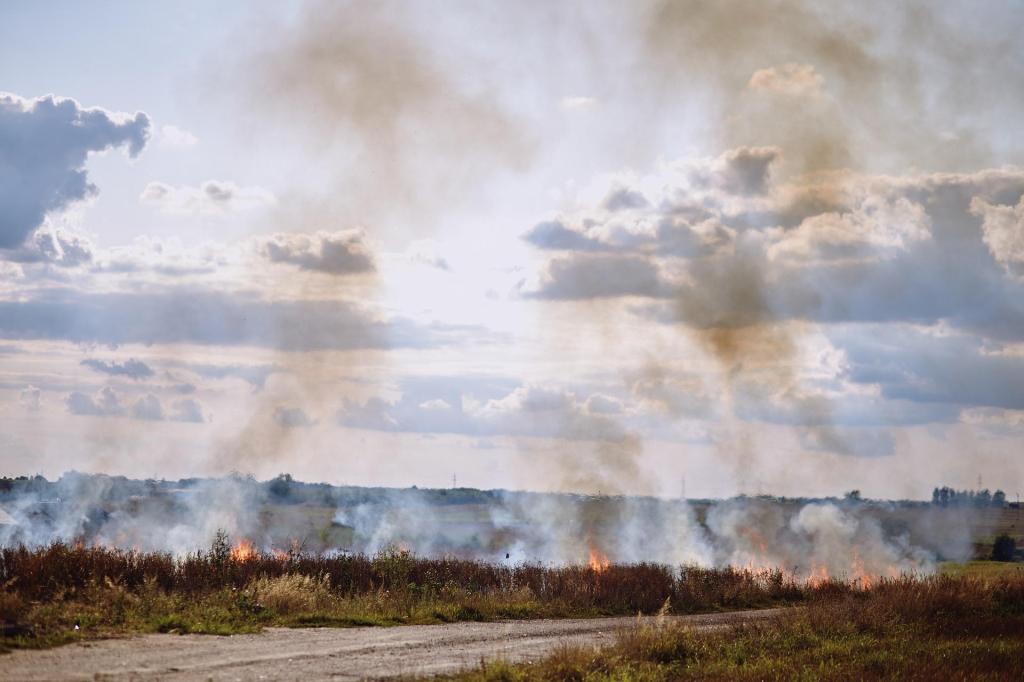
Photo by Bartek Zakzrewski, Pixabay – similar to photos of the fields that have burned locally.
One consequence is that the local fields are susceptible to dropped cigarettes, sunlight focussed through glass bottles and arson. One spark, one idiot with a disposable barbecue set, and the straw goes up. The breeze is enough to take out the rest of the grass, the dried out wheat crop, the haybales stacked in a corner, the combiner parked there – and the houses nearby. Most of a small village in Norfolk was destroyed by a fire that spread from the nearby fields within minutes, and three fields local to us have burned for a couple of hours, leaping the road and carrying on in the next field over.
Some of our trees have shed their leaves as if it were October. I think some of the rowans and the cherry tree we planted to mark our thirtieth anniversary have died, and a whole row of beech in a neighbour’s garden has gone brown. Beech are shallow rooted trees, so no wonder – over the last eight years we have been planting hornbeam to replace dead beech hedging, as it is more drought tolerant, but ‘tolerant’ is just delaying the day when the lack of water proves too much to survive.
We’ve all been asked to use less water, though our water authority has held back on imposing a hosepipe ban. ‘Using less water’ used to mean taking a shower instead of a bath, but now that most people only use the bath-tub for scrubbing down the family dog after a muddy winter walk, the advice has changed to ‘limit the time you spend in the shower’. Don’t use a hose to water the garden, fill paddling pools or ponds, wash the car. Fill dishwashers and washing machines to the top before setting them running.
I can see the time coming when we’ll be asked to stop using appliances like dishwashers and washing machines at all during times of drought, unless we’re caring for people who are ill, elderly or very young. It’s been suggested that eastern England might become virtually uninhabitable through almost permanent drought, though you can remind me of that when the rain starts this autumn and makes the ground squelch underfoot by Christmas.
Cucumber vines in the polytunnel five weeks ago
We’re still watering the polytunnel and the veg plot, but less than we were in spring. Enough has come out of the veg patch to make a ten minute plod around with watering cans enough to keep the plants thriving. Our shopping bill has gone up enough to make this food a real moneysaver, worth the water. Not successful across all plants – no surviving carrots or parsnips this year, though kale, courgettes and potatoes are doing better than last year and the bean plants are waiting their turn. Plenty of cucumbers, and the peppers and aubergines are threatening to give us a decent crop. If I have to give up a couple of showers a week to spare a can of water for these plants, I’ll do it. Thank Evans for Zoom meetings – on Zoom, no-one can smell your armpits, to paraphrase the Alien tagline.
We’re not filling the pond – most of the surface is covered by lily leaves and crispodea fronds, and that will hopefully slow the rate of evaporation. The birds are hopping straight into the shallowest part, rather than perching on the rocks, and one bird took a long splashy bath while balanced on a lily pad. It’s about a foot shallower than at the height of the rainy season. Tough to see it, but the fish are coping and it has another foot to go before they may be in any danger. I keep telling myself it takes two good thunderstorms to add a foot of water to the pond, but it is still hard to see the pond in this state. I’m moving the planted tubs down a level to give them the depth they need to survive, and hoping it will rain soon. If it doesn’t, the fish may find themselves rescued into the bath-tub. And then we really won’t be tempted to swap the shower for the bath ourselves.
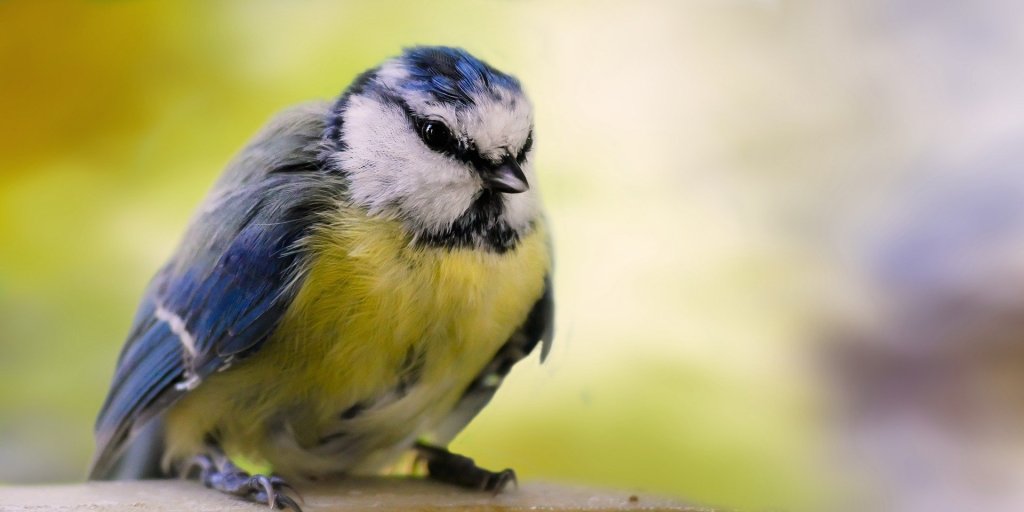
No, I haven’t posted. Yes, my last posts were gloomy, featuring a dead cat and a stunned bluetit. No, that’s not really me. Let me catch up on what I’ve been doing since my last cheerful post.
The first genuine holiday I took this year was to Combe Martin on the edges of Exmoor. I’d booked it as a treat for us in the winter, when we were still almost thinking we might be back into lockdown for another long set of months. The cabin was booked through Canopy and Stars, a company that specialises in accommodation that is comfortable but not luxurious. This cabin was… made of lumber and recycled items. Which sounds like sleeping under a pallet, but it really, really isn’t.
The view from the deck of Skylark
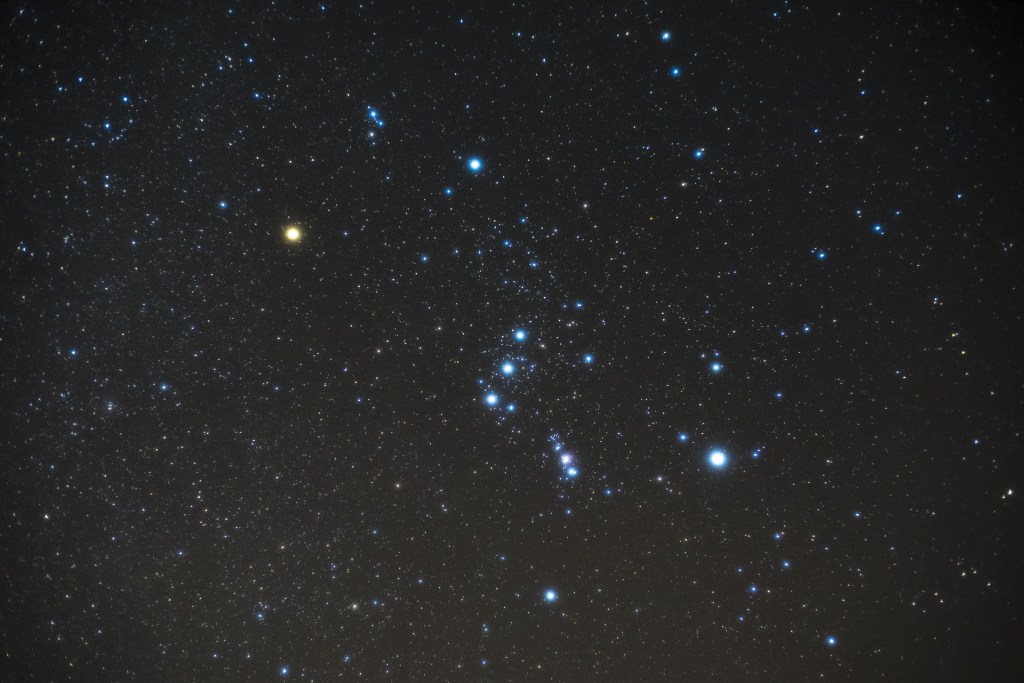
Let me admit upfront; the original idea was stargazing. Exmoor is a dark sky reserve, and with all the building going on around our house, the sky is getting more and more polluted. The thought of a really dark sky… Try this one for yourself. Go outside any time after mid-September and find the constellation Orion (start by looking east). The distinctive three-star line of his belt and the smaller three-star line of his sword is easy to spot. Follow the line traced by that belt up and away from the east, until you find a tiny group of brilliant blue-white stars. That’s the Pleiades, the Seven Sisters, a group of relatively young stars still full of energy. Light from those stars has taken around 425 years to arrive on Earth’s surface. Queen Elizabeth the First was still alive when the light you see now was emitted from those stars. That’s truly alien.
If you can see the Pleiades as a set of distinct stars, congratulations, you have a pretty good dark sky. If you can see a murky bright glob, you’re probably near a city. When we first moved here, it was worth the mortgage to see all ten major Pleiades without binoculars. Now? It’s starting to turn into a bright blue white mass, most nights. If the Ministry of Justice go ahead with their threat to build Europe’s largest prison in a rural beauty spot ten miles away, the 24 hour lighting of that monster will turn our view of the Pleiades back into a murky blue blob.
So, Exmoor. Dark skies. Cabin set in a sheep field. Telescope weighing enough to tear the arms of two adults out of their sockets. English summer. What would you think might go wrong? We got the only full week of cloud and rain in June. I’m laughing more than grousing. Lugging the telescope around was good exercise, the cabin had the most comfortable bed I have ever slept in, no kidding, and the rain was warm. I could easily live in a cabin that size (maybe half again as big as my living room) if it had a bed and a silence and a view of Jacob sheep being total hooligans in the field below from eight till half nine every night.
We finished off the four night stay with a visit to friends of ours, on the run from the crowding and general unwillingness of officialdom to fight back against the nastier side of too many people per square metre, now living in Devon. The peace and quiet of their view reminded us of the quiet we enjoyed twenty years ago, when we first moved in and looked up at the Pleiades and said; “Oh my word.”
Orion, by sl1990 of Pixabay. Follow those three stars in the centre up…
Ruffled feathers – this one courtesy of Pixabay, 9436196, as I was too busy helping to take photos
I put our cats onto the “What The Cat Dragged In” project in March 2021. The project was set up by a PhD candidate for her dissertation, and it aimed to measure the prey taken by domestic cats. Our two were not hunters, and I hoped their records would help to clear the name of Felis silvestris catus as a species. The Telegraph ran a righteous story just a week ago about how many millions of birds and rodents ‘might be’ slaughtered by pet cats, conveniently forgetting that snakes, hawks, dogs and people also kill birds and rodents in their millions.
As soon as I signed her up, Genie began to fetch us presents. She didn’t have our old ginger cat’s three rabbits a day habit, but two or three times a month (including one memorable two night spree in her cattery pen) she fetched in mice, shrews, voles – and birds. I still laugh at the memory of the two kittens fleeing up the stairs, chased by an irate blackbird chick they’d dragged in through the catflap. The chick swore at me while I tried to shoo it back outside to its waiting parents, but it made it safely – and as I didn’t find any gory remains later, I think it may have survived.
Genie is gone, now, buried next to her brother. I have tried to make up for her reign of terror – we feed the birds and have an area in our pond where they can have a splash-bath and a drink. We have two magpies that visit often, one with feathers sticking up in all directions (Scruffy Herbert) and another that is sleek and precise and tolerant of Scruffy, so I suspect they are related. And a blackbird that is willing to let us get within a couple of metres of it. Possibly the defiant chick that got away, all grown up and scared of nobody.
I got a chance to do some more birdy good today. I was lying on the bed, lost in a good book, when I saw a swoop of movement outside and something hit the window hard. When I went to investigate, there was a bluetit lying on the tiles of the sloping roof below our window. Upside down, shuddering, twisted – one leg trapped under its body and tail feathers stuck to the wet tiles.
It was just out of reach from the window, and out of reach from the ground below. I got a feather duster – I know, tactless, but the only thing long enough to reach – and gently turned it right side up. It tipped upright, shook itself and kept shaking. Its legs were splayed out a little, but it seemed to be able to move its head and sit upright, so I could hope it hadn’t broken its neck.
I left it a small heap of sunflower seeds and watched it from a distance. It sat there dazed for about fifteen minutes. It did occur to me that I should put it in a box to give it some protection from wild predators (our elderly cats slept through the entire incident, disinclined to move at more than waddle-speed for their food, but the local hawks would be less gentle). As soon as I climbed up the stepladder and reached slowly for the blue-tit, it startled; it flew away from my hand and hopped into the corner of the upper walls, sheltered from the rain and wind.
I left it there. I did keep an eye on it, always from a distance, and it pulled its wits together gradually. I could see that it was looking less dazed, more alert; it had stopped shivering and was turning its head, looking around with some purpose. About thirty minutes after the original head-butt, the bird had gone. I didn’t see it fly off, and I can only tell myself the comforting story that it flew away with a great story for its fledgings, and that it survives everything nature can throw at it from now on. Including windows.
Pixabay, Gerhard_C… this is what our Head-Butt Hero looked like after fifteen minutes
I haven’t posted for a long time. I haven’t had the heart for it. We had a three-week pause in April to stay away from crowded museums and beaches during the school holidays, and just as we were plotting a return to days out, our youngest cat was killed on the road. Just like her brother, except that she did not like going near the road. Something must have scared her, and we’ll never know what. We’re just grateful to a passing motorist who turned and came back to see whether the cat lying still by the side of the road was alive and who would be looking for her. There are some good people in this world.
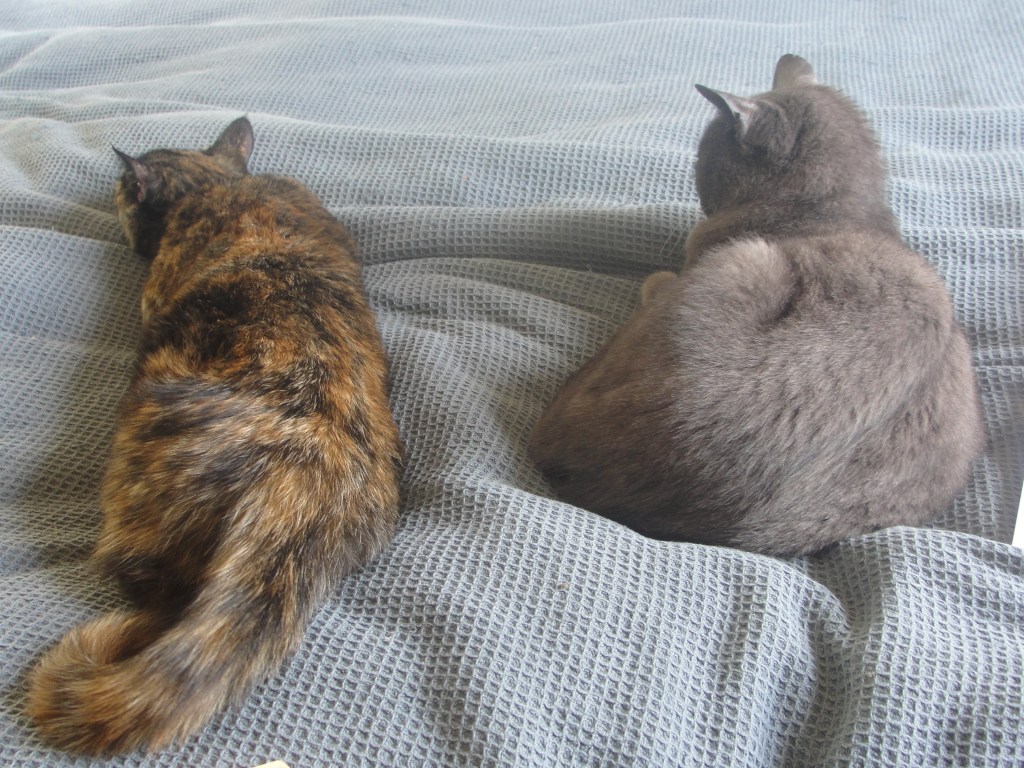
So all that greets us on our return home now are the two elderly cats. Their affection is enough, but I still hope there’ll be other cats in our future, and I hope one will be a sparky tortie like Genie.
I’m still writing. I took part in the last Shallow Creek competition, which is still in the judging stage (so not saying a word about what it was about yet, apart from being creepy horror – ticking off the challenge given to me by a friend in December to write a horror story). I put in an entry for Globe Soup’s seven day challenge in May – write a short story up to 2,000 words long on the theme stated, in the genre randomly assigned to you. I saw I had Historical as my genre – having just finished writing a Jane Austen themed story for another competition my thoughts went straight to the early 19th century.
If you ignore the pampered daughters of gentlemen that Jane Austen wrote so much about, the early 1800’s packed in a lot of history. I started looking up the small idea I had and was drawn into a history I thought I knew and clearly didn’t. Again, the research threatened to take me over – every time I chased up a source on what the lives of those in trade would have been like at that time, I found another reference to fact that I would never be able to pass as fiction.
Add to that an entry to a memoir competition, and by the end of May I was face down and not wanting to write anything. I was shot in the heart about the sudden death of our youngest cat and felt that there was not much to look forward to.
Luckily, our local cattery owner had asked the village via FaceBook in February whether we should have a village party for the Queen’s Platinum Jubilee in June. There are people who like the idea, and people who make it happen. We’re blessed in having a group of people who were determined to make it happen, and this Saturday we had a huge party for the whole village and anyone close enough to drop in. The weather did us all a big favour, and the sun shone from the moment the gates opened to the moment we walked home knackered after helping to pack away the stalls in the evening. I missed the Tug o’War, but I suspect there’s some sore muscles in the village today.
I won’t post photos in case I put up images of people laughing in the sunshine who told their boss they couldn’t work ‘cos they were ill, but the local grand house opened its doors and we filled their lawn with picnicking people. It’s cheered me up, set me back on the road to being human again. I went out to my greenhouse and polytunnel and for the first time in weeks felt there was something good to look forward to. Slugs, stay away from my tender plants.
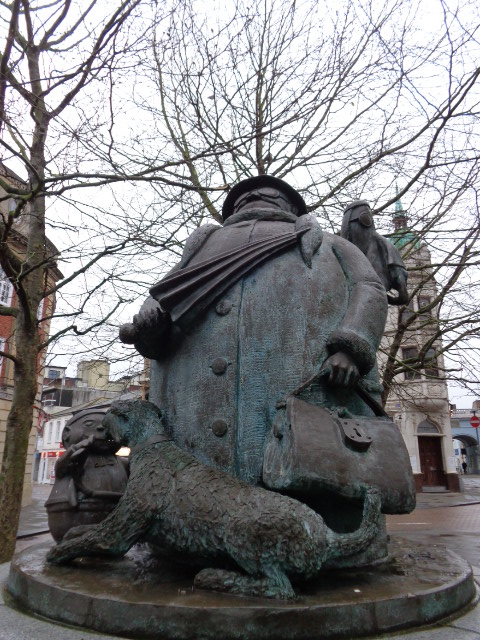
The statue of cartoonist Giles’ creations – Grandma, Vera, Butch the dog and the twins – in Queen Street, Ipswich
Just like Tuesday night – here we were, driving round a one-way system in a Suffolk town and looking for somewhere to park. Unlike Bury St Edmunds, Ipswich has a fast and lively road network and a town centre that dies at six in the evening.
We’d arrived early for an evening with Professor Brian Cox and his New Horizons tour (along with 1,200 other people; we’re not personal friends of the famous physicist…) and were hoping for a couple of hours exploring the town. We’d been here in 2016 for the Gin Festival and found Ipswich to be a mixture of expensive hotels and rough sleepers – this year, the rich had almost disappeared and the streets were blank and uninviting.
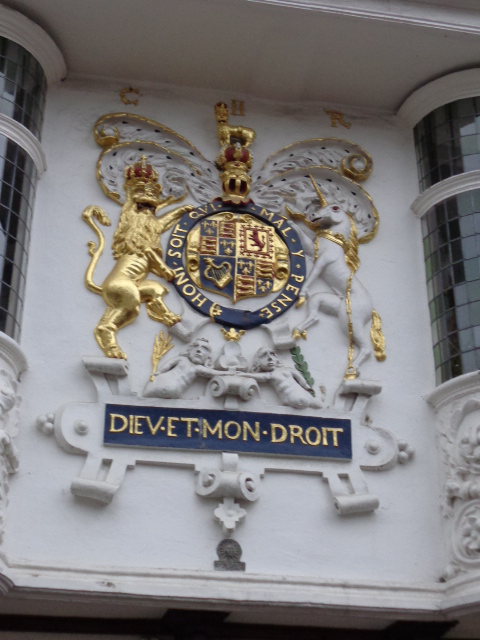
Look up, and there’s some magnificent decorations on the buildings of Ipswich. Street level? Not so great.
The weather didn’t help – cold, windy, snow in the forecast – but a warm cafe makes that kind of weather a treat. Finding refuge in a Costa Coffee that seems to be the only place open at 5pm isn’t the same, and when they closed at 6pm we were adrift. We went back to the statue set up to honour the cartoonist Giles in Queen Street (Grandma is looking straight at the window of the office where Giles worked for decades) and found absolutely nowhere open along the way to sit with a drink and a snack.
We spent our spare time in Ipswich queuing up outside the Regent Theatre for Brian Cox’s show and wondering whether it was worth coming here at all. But – it was. The show is described as a warm-up for his upcoming tour, but after these two dates in Ipswich Mr Cox will be off to America and Canada. He did do a previous warm up tour in 2021 for his New Zealand and Australia dates (cancelled), but hey, we’re glad he landed here before he takes off for foreign parts.
And yes, Robin Ince was there. Luckily, because he started the evening by reassuring everyone that we would understand absolutely everything Brian said… until we stood up, then the ideas would disappear like we’d shaken them loose, but neither did distinguished cosmologists understand it all. And we were off.
We weren’t allowed to record or photograph the show, but I hope we can see those great backdrops again. They were the cities of the future with space elevators, astronaut/tourists and communities living at the safest limit of black holes (and deriving their energy resources by chucking their rubbish into the black hole, if you believe Professor Cox). Great to hear that the Infinite Monkey Cage is recording its thirteenth series at the moment; it’s the science equivalent of Morecambe and Wise, with famous people keen to appear on it and the joker of the pair ready to biff the serious one into submission if he dives too deep into cutting edge physics.
Highlights of the evening? Learning that the peculiar black hole featured in the film ‘Interstellar’ was a realistic representation of the latest scientific research, courtesy of physicist Kip Thorne. Hearing the sainted Professor Cox say that he’d been invited to give his opinion to the world’s leaders gathered at COP26, and that he’d told them; ‘Don’t fuck it up’. Himself leaning over and whispering that he’d read this bit last week, and realising that bloody hell, he could have stood up on stage beside Professor Cox and given a fair stab at explaining the theory behind the preservation of information.
The final joy was to leave Ipswich behind and know that we never had to go back.
My first post for a week or so. As a friend of mine once said of her children; “It’s when they go quiet that I really worry. It means they’re up to something.”
We’ve been filling our days before the Easter school holidays, when all the visitor attractions really open up and all the families come out to play – and we stay home and enjoy a bit of space at home while everything else is busy. This week we had two days out. The first, rare for us these days, was a film recommended by Mark Kermode on the BBC’s ‘Film Review’. Mr Kermode is entertainment in himself. During lockdown, he commented that his postman found him sitting in front of his TV watching a really shite film and looking miserable. The postman asked why he was wasting his time watching that crap, and he replied; “I do it so you don’t have to.” Mr Kermode has saved us from some highly advertised turkeys before, and we trust his advice.
Mark Kermode loved ‘The Phantom of the Open’ and warned everyone not to look up the true story it was based on, because it was better to hear the fantastic (adjusted) truth rather than know whether it happened or not. We went to the Abbeygate Cinema at Bury St Edmunds for the full experience – our local cinema has twelve screens and standard seating, while Abbeygate has two screens and sofas to lounge in. And it has Bury St Edmunds outside.
Two years ago, I was wandering around Bury St Edmunds worrying while himself was undergoing two major operations, so I know my way around. I know where the drunks congregate in the gardens of the abbey. I know where the quirky shops give way to betting shops, newsagents offering money transfers to exotic countries and kebab shops. I found the museum, the beer shops and the cinema, but as a sci-fi addict for decades I knew what the early reports of Covid infection rates might mean, and I stayed away from crowded places.
This time, I went as his tour guide and we had a great time. Some of the major chains had died after the pandemic shutdown, but the quirky little shops have survived and the Georgian buildings are always there. We had a toastie and a cappucino in a pleasant coffee shop and were back in the cinema long before time.
I will not spoil the film for anyone who hasn’t seen it yet, but it’s worth the effort to go and see it. The book and screenplay were co-written by Simon Farnaby, who played ‘Art Garfunkel’ in ‘The Detectorists’ series (he appears as a French golf professional in this film as well). The main character is played by Sir Mark Rylance, more famous for his portrayal of Rudolf Abel in ‘Bridge of Spies’ and Thomas Cromwell in ‘Wolf Hall’ and ‘Bring Up The Bodies’ – and as the first artistic director of the RSC. Some actors are always acting as themselves, whatever role they play (Clint Eastwood… ) but Sir Mark Rylance was Maurice Flitcroft, crane driver in the shipyards and head full of dreams.
We walked back to the car afterwards and I remembered that I’d led him from the cinema to the car through these same streets in April 2020, him taking great care on his crutches and collapsing into the car with relief at the end of it. This time, I was trotting to keep up with him. I think I can safely say that he recovered completely.
Anyone in need of a cheerful film could do worse than watch ‘The Phantom of the Open’, and if you’re within reasonable distance of a cinema as nice as the Abbeygate – well, it was worth the extra drive.
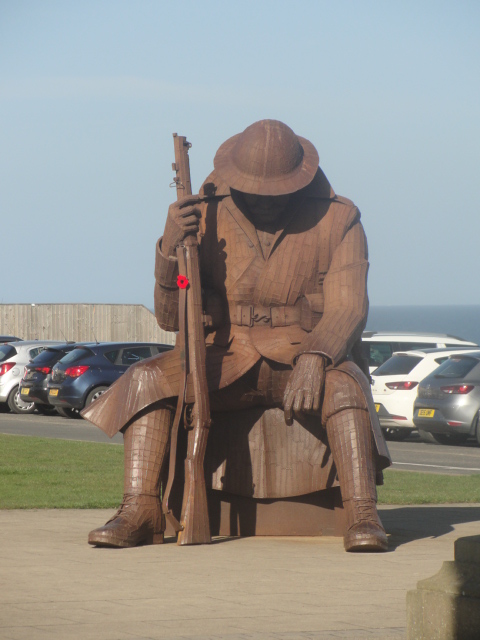
The Tommy statue on Seaham seafront, representing the reaction of English soldiers to the announcement of peace
We drove down from Melrose to Seaham on the back of a disagreement. I plan my journeys by Google maps (adding 15% to Google’s estimate of journey time because, well, Laws of Sod) while he relies on paper maps. Our paper maps of Melrose and Seaham are bang up to date, unlike our 1982 OS maps of East Anglia (still used, with caution), but Google warns of roadworks, road closures, alternative routes – and can be used to provide a driver’s eye view of a crucial junction. We were pulling over to, er, discuss the route all the way to Belsay, where we turned off and concentrated on getting it right.
Driving along the seafront at Seaham, we sat back and breathed again. Brilliant sunshine. We passed the Tommy Statue I’d seen on the internet and I knew to turn off there. Parked the car in a side-street, found the accommodation and headed for the beach. I love a beach. Take me there now.
What I was there for, of course, was the seaglass.
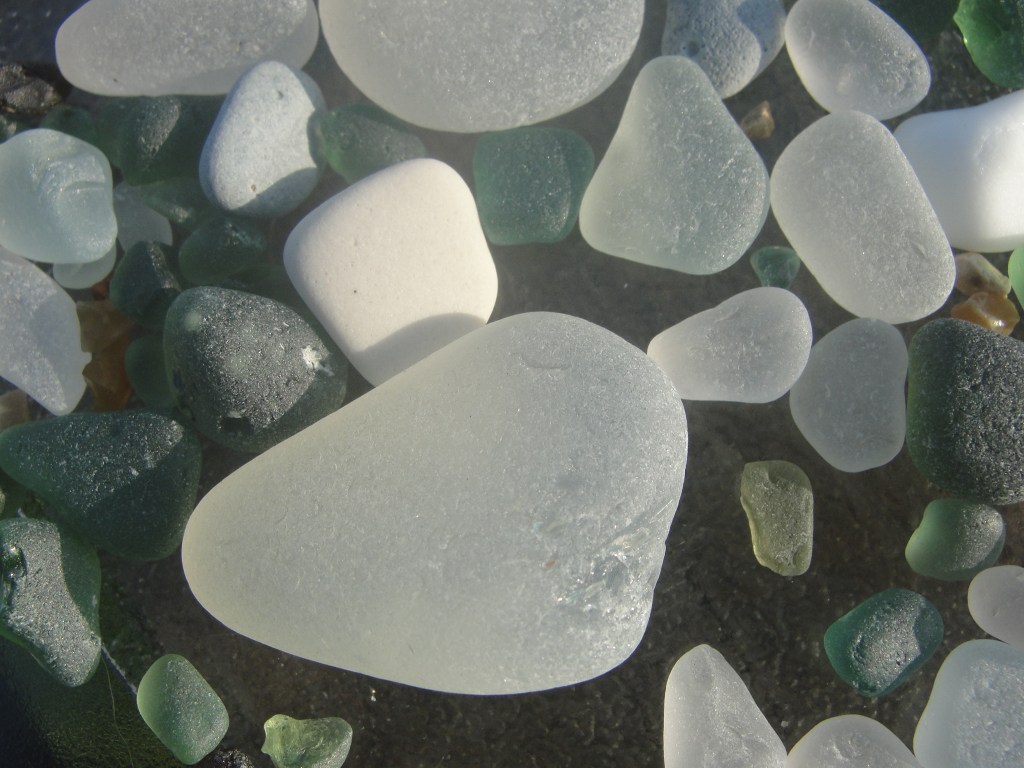
Seaham was home to several glass factories in the late Victorian age, with the largest (Londonderry Bottleworks) operating from 1853 to 1921. At the end of each day, the waste glass – the broken bottles, warped vases and cracked ornaments – were loaded into a cart and dumped over the cliffs to the north of Seaham. Perfectly acceptable Victorian practice. In the century and more since, those waste glass scraps have been tumbled in stones and salt-water to become sea-glass.
Sea-glass from Seaham
I’ve been picking up sea-glass for decades. As a child, I saw it as gems, not realising that the smooth specks were glass – the same substance that sliced open my instep during a trip to a north Welsh beach as a five year old. When I heard about Seaham’s beach and its glass, I had to visit. Work, illness and lock-down stopped me from going for years, and my planned 2021 trip failed when the car ate its brakes on the way there. I’m chuffed to have finally got there. Finding sea-glass would be a bonus.
We got onto the beach immediately on arrival, racing the tide. It was my wish to go there, so he tagged along – though by the time we reached halfway to the northern end of the beach, he was hunting just as enthusiastically. The commonest colour is clear glass, followed by mid-green and beer-bottle brown – the rarest colour is red, followed by purple, blue and black. Some collectors focus on particular colours or on shapes such as the codds that stopped up the bottles or the barley-twist glass walking canes that the apprentices were asked to make as their master-pieces. Plain clear or green glass is strictly for the novices like me. But they miss a trick.
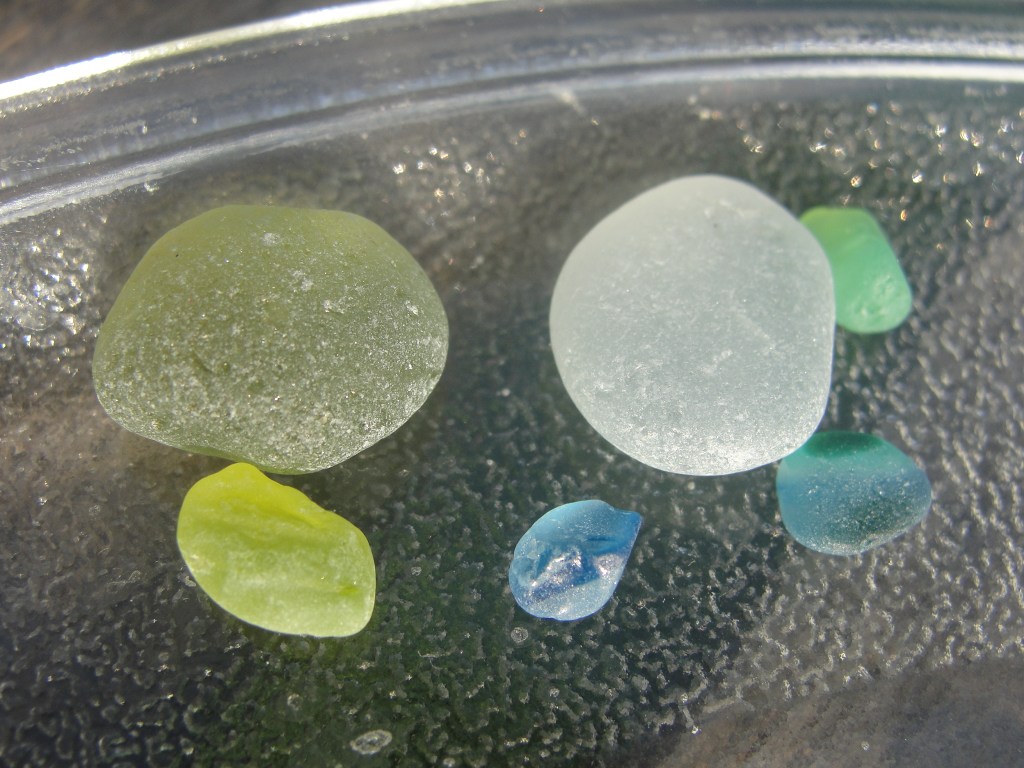
Some of the tiny specks of glass with a bit of zizz that we picked up
We reached the northern end of the beach and spent twenty minutes in the North Beach Coffee Bar, getting caffeined and getting cheered up by the happy waitress and the good service. And the excellent coffee. Before the long walk back to town.
The accommodation was superb, and we walked a hundred yards to a chippie with great reviews. True vegetarians beware – Downey’s fry the traditional way, with beef dripping. My objection to eating meat is the texture – chewing meat makes me feel sick, so meat-textured vegan burgers make me barf worse than flaky fish. Even so, beef dripping. It was fine, but I think I prefer the oil my local chippie fries with.
We were feet up and asleep by nine in the evening, and wide awake by six thirty. And out on the beach by eight. Breezy, sunny day, tide falling to a low, low tide just before ten and very few people out hunting. The most valuable thing we found was a serious collector who came over to advise us where to find the best glass. The biggest chunks hide among the biggest stones and the unusual colours and patterns are generally found at the northern end of the beach. He showed us his favourite pieces; a dark blue marble, some chunks with dark ‘eyes’ in them and a swirled dark purple and violet piece that looked like a black stone until he held it up to the sun. He gave us an enthusiasm for returning to hunt again, and for longer this time.
We found mainly tiny specks, but in such lovely colours that this was enough. A clear speck with a blue layer in it, a green striped piece and a dark blue iris in a clear and pale blue glass. Add to that the people – cheery and helpful – and we’ll definitely be back.
Even if we have another journey home like this one – two road closures and the chosen lunch stop closed just as we arrived. Sometimes, life’s like that.
I’ve been quiet. I’ve been busy. We’ve been travelling.
Roll back to November, and the post called ‘A Tale of Two Breakdowns’. We were both due to spend a night in Melrose before I stayed with friends and he went home to face the builders – but his Landrover broke down and I escorted him home before driving back up to Scotland alone. After my visit to Melrose, I was going to visit Seaham on the north-east coast to fossick on the famous sea-glass beach… except that my car broke down. I spent three hours on the A186 waiting for the best RAC rescue man in the North-East and three hours being cared for by Team Valley Services while they repaired my brakes and let me loose on the A1M after dark.
Unfinished business. Now finished.
We drove up to Melrose along the route I remembered from November. I didn’t warn him about the lovely approach to the border, where the A68 wound up and up and finally flew over the border like a bird and zig-zagged down into the Scottish borderlands. It was a land where raiders fought and either side was full of houses fortified against hostile visitors in the seventeenth century. Northumberland and the Scottish Border counties are equally scenic and quiet, but the three hills of Eildon are unmistakeable.
Not Carter’s Bar on the A68… but very similar.
In the 1970’s, I listened to Steeleye Span’s ‘Thomas the Rhymer’, telling the tale of True Thomas’ encounter with the Queen of Elfland and his seven years of servitude in her country. It’s the version of ‘Thomas the Rhymer’ set out by Sir Walter Scott, who lived within walking distance of the Eildon Hills, and it ends when True Thomas accepts the invitation of the Queen of Elfland to serve her in her country for seven years. The stories in Steeleye Span’s songs fascinated me for decades – it was the only introduction I had into the kind of folklore that others in Celtic, Gaelic or borderlands take for granted.
I drove myself to a summer residential school for the Open University in the 1990’s, on a GS motorcycle designed for fun offroad. I got a mild rebuke for exceeding 5mph on a mud road at the accommodation and protested that I couldn’t keep the bike stable on a rutted dirt track without standing up on the pegs and giving it enough welly to get it up to 15mph. Call it 20mph, but I got away with it. On the way home, I passed the sign to ‘The Rhymer Stone’ and could not resist. I turned off and parked up on a minor road under the Eildon Hills and looked up. I was expected home at a certain time and could not spend three or four hours climbing a hill. Especially not while wearing bike gear that wouldn’t fit into panniers already crammed full of dirty washing and academic texts – gear which cost a month’s salary if it was stolen while I was climbing and weighed roughly two stone (that’s just over 12 kilos for the younger readers). Try it, in leathers that don’t bend well and weigh a soddin’ ton. So I just stood and looked and sang the song quietly to myself. A father and daughter walking down the hill told me that there were great views from the top, but I had to drive home without seeing those views. Another day, I promised myself. It was several years before I admitted to the other half that I was off chasing fairytales when I should have been driving home.
2022, and I took the other half to Melrose to see the Eildon Hills for himself. The three hills stand 300 metres and more taller than the surrounding plains, in a bend of the River Tweed. The legend of Thomas the Rhymer says that he was offered the choice of ‘harp or carp’ on leaving Elfland; of being able to play any instrument he was given or to foretell the future, in one version (never to tell a lie, in another; a set of faerie clothes in yet another version). He chose the gift of prophesy, and foretold many events, such as the bridge across the Tweed that would be seen from the top of Eildon Hill. Depends on how bad the weather is, I suppose, but Leaderfoot Viaduct is just visible from the top of Eildon Hill.
Halfway up St Cuthbert’s Way, with Melrose at the foot of the hill
No, I didn’t get that far this year. We set out from our B&B to climb the Eildon Hills as far as we could with a forecast of sun till 3pm and rain thereafter, and felt rain on our faces before we’d climbed beyond the lowest foothills. It was steep, too. I’m really, really unfit. From the upper part of St Cuthbert’s Way, we felt the wind strengthen and the drizzle increase, and from the saddle between two of the hills we could see heavier rain falling to the west and blowing our way. Just before noon, we admitted defeat and started our way down. As soon as we settled in a tea-room in Melrose, the sun came out and the drizzle stopped. Laws of Sod will always apply.
Melrose Abbey, courtesy of Blue Budgie, Pixabay.
Melrose is a small town but a pretty one. The abbey is a ruin – no access to the interior while Historic Scotland is repairing the upper parts of the structure, gardens closed till April and the whole lot closed for lunch when we arrived, so we didn’t get to see it close to. Instead, we visited the Trimontium Museum, to see the very brief touch the Romans had on the borderlands of Scotland. The Emperor Septimus Severus made it his vanity project to push the borders of the Roman Empire as far north as Melrose in 210 AD, briefly, before he retreated to York to die. The Roman Empire shrank back to Hadrian’s Wall in Northumberland.
Dinner was mixed. Provender was the restaurant we were apprehensive about – with a Michelin star, we were ready to be turned away for not meeting their dress code, but it was the better of the two. The menu was varied and the staff were pleasant and relaxed. No-one was bothered whether he wore a tie or not, and they could see we were both too old and knackered to out-run the staff if we chose to dine and dash. The Italian restaurant Monte Cassino was less of a hit the following night. The starter was incredible, the pizza was good but thin and soggy in the middle and our polite ‘Not at the moment, thank you’ to the dessert menu immediately after the pizza plates were collected triggered a twenty minute wait, followed by a realisation that we’d out-stayed some unspoken time slot and were now invisible to the waiters. We paid up and left. Driving home, we saw two single headlamps descending the Eildon Hill saddle at some speed. Cyclists racing down the steep, muddy path by the light of a full moon.
The following morning, we left Melrose for Seaham, and part two of our short break.
The steps going down to Melrose on our descent on St Cuthbert’s Way