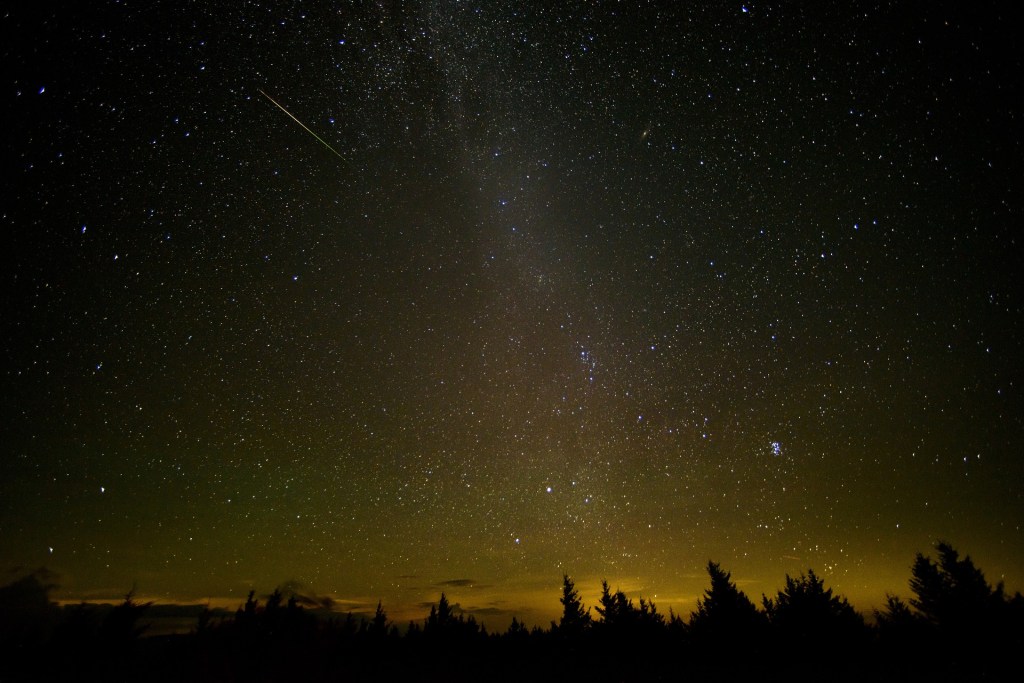
Perseid meteor captured by Dumitru Stoica, Pixabay
The Perseid meteor shower peaked right at the same time as the full moon. Law of Sod applies; meteor showers are best seen against dark skies. But we work with what we have.
It’s been so hot during the day that going out at night is a relief. We spent time resting indoors during the heat of the day and went out after 10pm to look up. The advice is to look north, towards the constellation of Perseus – the trails of the meteors radiate out from that area. We have a south facing garden (but a ruddy long south facing garden), so we’d have to walk right up the far end or across the road and down the hill to a spot where we can look north. What we did instead was to look straight up and to the west a little, away from the glare of the rising Moon and where the sky was darkest.
We spent three nights watching the sky. For all the fanfare, a meteor shower is not like a fireworks display – nothing like as spectacular and at one per ten minutes it is not for the easily bored. But when they zizz across the sky – this is something much further away than a firework exploding a hundred metres or so overhead. It looks tiny, but the thrill of seeing that brief fizz miles overhead – catching something that lasts just a second or two – it’s better than fireworks, where you bought it, placed it, timed it and lit the fuse that sent it on its way. This was a spark we saw by lucky chance.
We saw several on each night we went out to look. Looking up, looking north, looking south… in every direction, there were meteors. It was a good time to sit and talk between sightings, too. Sometimes, it isn’t just the light show in the sky above, it’s the chance to do nothing on purpose without feeling you’d better get up and get working.
There’s meteors and burning space junk at all times of the year, so if you have the chance, look up.
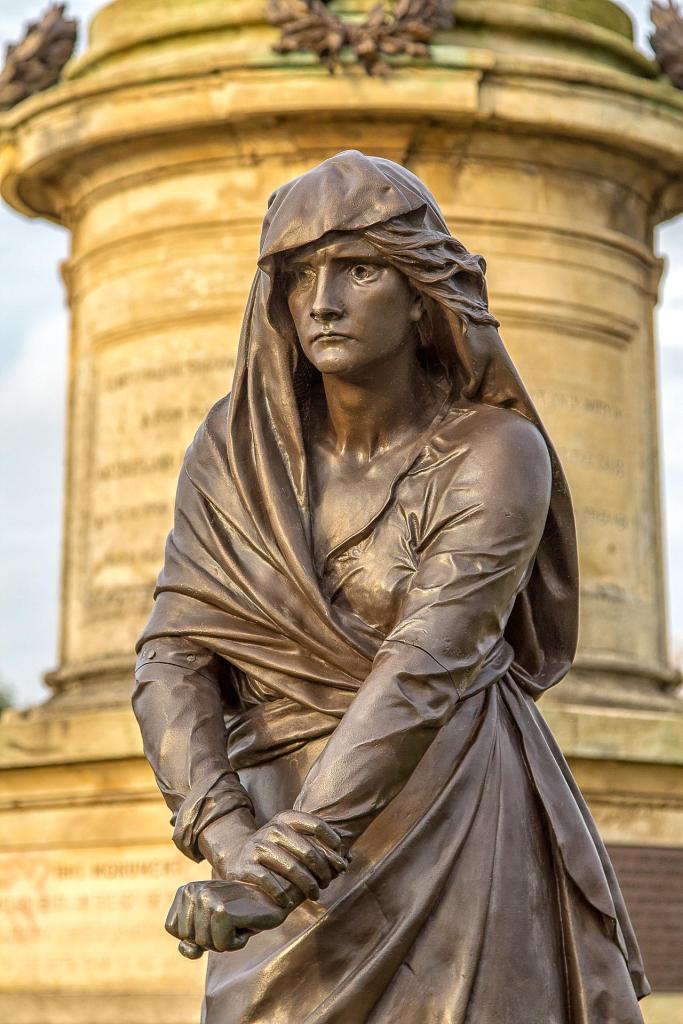
Lady Macbeth at Stratford on Avon, courtesy of Steve Oprey, Pixabay
The third visit to Sutton Hoo this year. This time to see the Red Rose Chain Theatre Company present Macbeth in the forest. I’m surprised there aren’t more plays performed in the open like this. We’ve seen a performance of Midsummer Night’s Dream in a park in midsummer, decades ago, and the memory stays with me – dusk coming down as the play gets more and more supernatural, the tidy little rockeries lit with lanterns and very different from their prim daytime selves.
This play was performed against a backdrop of tall trees, with the hill sloping down behind them. Red Rose Chain are lively, and all young – the oldest might have been close to thirty and there were a lot of talented child actors playing full roles in the play. The girl who played one of the hired murderers crept up beside our seats to screech her lines to the other murderer on stage and then quietly apologised for startling us. “I do hate murdering people,” she said, as she sneaked off.
The actors were never still, unless someone else was delivering a monologue that they were not meant to hear – they fought, danced, ran around the back of the set and leapt into and out of barrels. They played instruments – flute, trumpet, accordion, guitar, a lot of bashed tins and pots to act as makeshift drums and an upright piano. There was a lot of comedy chucked in at odd moments, too. The Witches were oversized puppets with the kind of faces you’d see at a continental Carnival, dancing and singing their first scene in huge macabre spite. The Porter put a lot of extras into his “Knock, knock, knock!” speech and one lucky little girl got the chance to throw a mug of water over one of the actors. Not yer usual Shakespeare tragedy, though I’m willing to bet his actors put a bit of extra clown into even the tragedies (“Let not your actors speak more than I have writ down for them…”)
But the play became darker as dusk fell. The spotlights came on, and some dimmed to leave the sides of the stage area in darkness where characters crept around. The Witches returned in a much more sinister mood, and when they threatened to have their master answer Macbeth directly, there was a sense that something more evil still might be summoned up to the stage.
I won’t post pictures of the cast and stage here, in case Red Rose get upset; in any case, going to their website will show you much better images than I was able to take. The only thing their photos missed was the full moon shining through the branches of the trees backing the stage as the battle for the crown of Scotland took place. There is nothing like being there for the whole spooky atmosphere.
During our first visit to Sutton Hoo we sat in the cafe and read the leaflets advertising the exhibition due to start three weeks later. ‘Swords of Kingdoms’. The curator at Sutton Hoo had arranged for part of the Staffordshire Hoard to be brought here to be displayed. There is a connection – the workmanship and designs in the Staffordshire Hoard were so similar to those of the artifacts recovered from the Sutton Hoo mounds that historians believe that both sets were made in the same workshop – probably in Rendlesham in Suffolk, which was known to have produced decorative items for King Raedwald.
Sutton Hoo is still sticking to the system of making everyone (even National Trust members) book a half hour slot in which they will arrive, and the same goes for entry to the Swords of Kingdoms exhibition. Knowing that the first time we visited, that there was a queue of cars waiting even by 9.50am and that the gates were opened on the dot of ten, that by the time we’d parked and walked to the entry gate it was almost ten past – we booked the second earliest slot, the 10.20 to 10.40 viewing for the exhibition, and the 10 till 10.30 entry for Sutton Hoo itself.
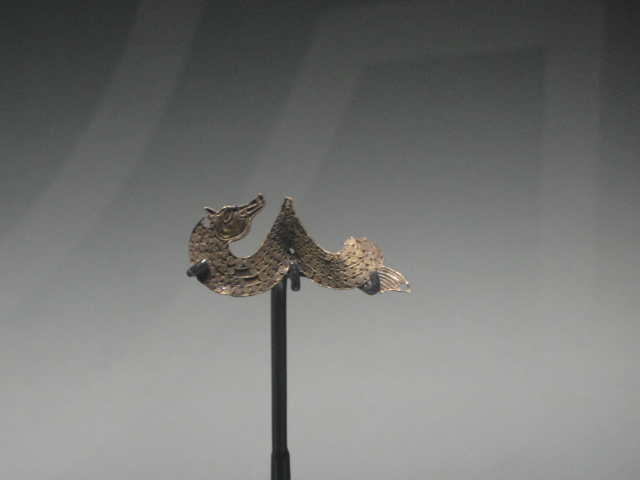
We got into Sutton Hoo by 10.15 and went to stand in the queue for entry to the exhibition hall. The staff kept us busy by telling us the story of the Staffordshire Hoard. If you’ve heard it, skip past the next photo – but basically, it was found by a metal detectorist called Terry Herbert in 2009. He found some of the items and reported them to the head of his club; the land owner gave permission for an excavation to find any further items. A geophysical survey revealed a broad patch of items buried within what seemed to be a ditch-like structure and two sets of digs brought the hoard to the surface. Most of the items were military – decorations to sword or dagger hilts, helmet cheekpieces and epaulettes. Most were beautifully crafted in gold, silver, garnet and inlays with a mix of pagan and Christian symbology. Many had been wrenched from their settings with no real care, and buried together. The theory was that these were spoils of war, ripped from the enemy’s weapons and armour after a great battle in Mercia and buried for later retrieval.
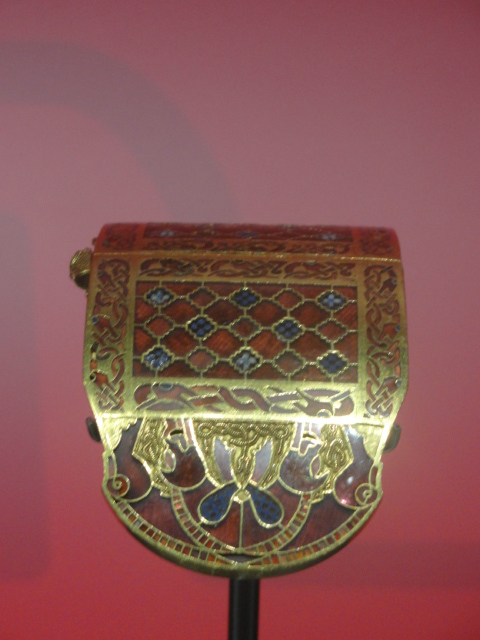
One of the pieces from the Hoard.
Twenty minutes wasn’t long enough to see it all and take it in. Luckily, this is being displayed an hour from our home until October. We have to come back and take it in when the crowds have dwindled.
This little ‘dragon’ is similar to the jewellery Ola Gorie designs, based on Viking and Saxon pieces
After our visit to the Hoard, we had a leisurely look around the main museum hall, followed by a visit to the house. We missed this on our first trip, as we’d been on our feet for hours and everything in our bodies was starting to feel elderly and unfit for purpose. The house was where the Pretty family lived, and it’s an odd mix today – preserved as a grand house of the 1930’s and 40’s with the addition of museum displays of books, photos, newspaper clippings and fragments of pottery found around the site. Interesting to visit, but too crowded. We’ve never been tolerant of large crowds, and we’re even less happy about getting close to strangers these days. We left the house for the cooler air outside before we’d seen it all. Meaning that we have to go back.
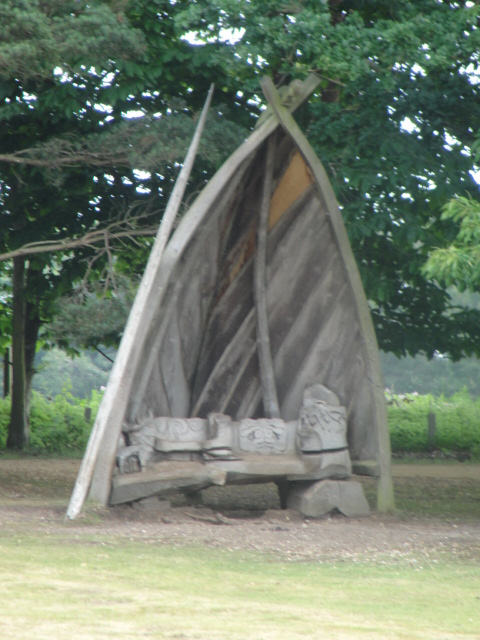
From the path, this looks like the underside of a boat prow. From the house, it’s a carved seat.
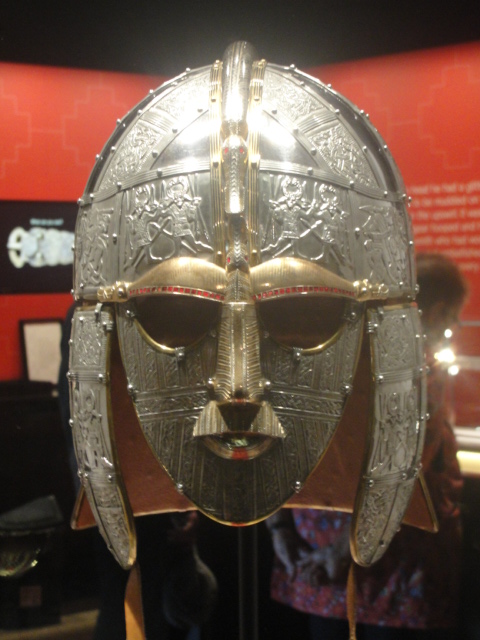
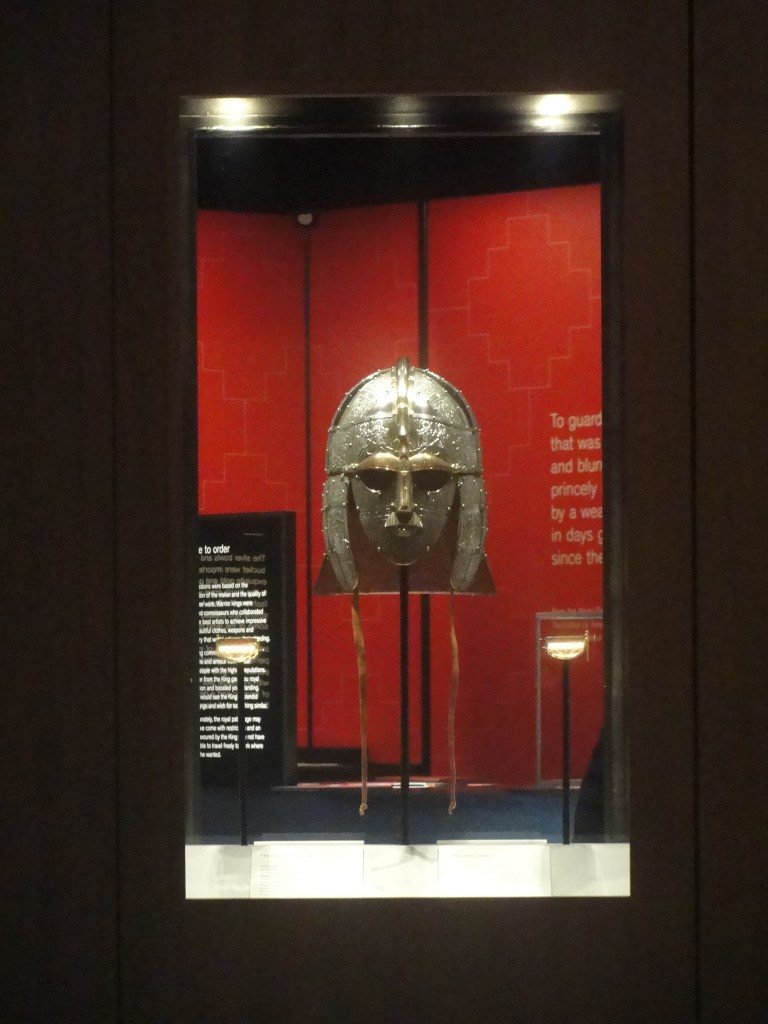
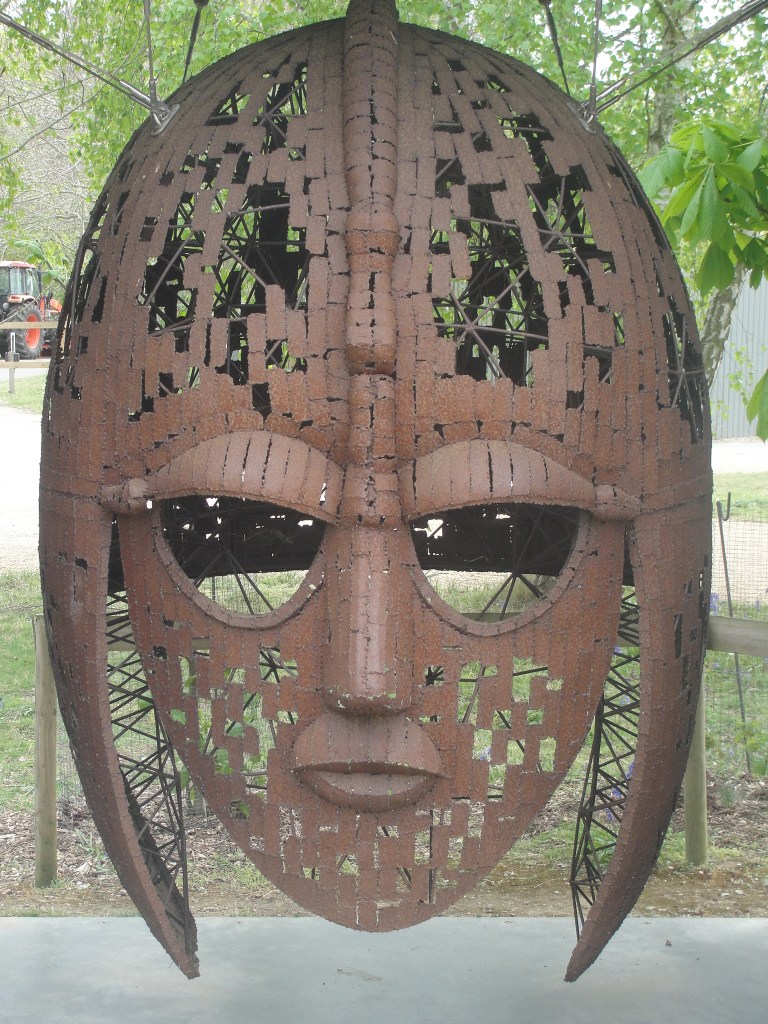
Facsimile of the Sutton Hoo helmet at the Sutton Hoo museum
Back in April, we stayed at home while the schools were out – everywhere is too crowded for a visit, and places tend to run events aimed at those with the reading ability and attention span of a five year old child. Our first day out in April was to Sutton Hoo. At the time, I was still stunned by the sudden death of our youngest cat and wasn’t in the mood to write about it.
Looking forward now to our third visit to Sutton Hoo, I’m ready to write about my first two visits. I passed the sign for Sutton Hoo at least fifty times in the last twenty years, and every time I thought; “Not now, I’m just keen to get home before the rush hour” or “They’ll be closed by now” or “One day.” The visit in April was after the long lockdown for Covid and the site’s shutdown for renovation, and was very much anticipated and dreaded. Renovated sites often focus on making the simplest possible display – aimed at children. Guys, we aren’t all three feet tall and obsessed with our own poo.
We turned up early. We had to book a half hour slot of arrival (stay as long as you like), and we chose ten to ten thirty. We were in a queue of maybe twenty cars by 10 am, so it was a great idea of theirs to restrict the numbers arriving in each half hour slot. One of the post-Covid queues apparently snaked out onto the main road outside, through the village and back onto the A12.
We had a dry, sunny day for that first visit. There were women set up outside the cafe and shop building who were demonstrating weaving and sewing skills and in the rush to see everything, I didn’t stop – and I should have done. We’d bought two tickets on the first tour around the mounds at 1 pm, so our first stop was to go up the new viewing tower.
The viewing tower at Sutton Hoo. Test your tolerance for heights…
The view from the next to last height looks back across the Deben, the river from which the boat was dragged for the king’s burial. The view from the top is across the field where the mounds are. I got to the edge only by hanging on to the rail hard and resolutely not looking down too often – the flooring is a steel mesh on each floor, which means that you can look down through all the mesh and see who’s walking in at ground level. Then you can hear them as they clang up the steel stairs, and feel the tower vibrate ever so slightly. I am really, really not good with heights. I survived Pulpit Rock in Norway by going no further than the mesh walkway with a 2,000 foot drop beneath it. Which meant I was spared the sight of the people sitting on the edge of the 2,000 foot sheer drop to the fjord, and the total prat who ran from the back right to the very edge to throw a banana off the edge and down into the fjord. Pity any boats sailing below.
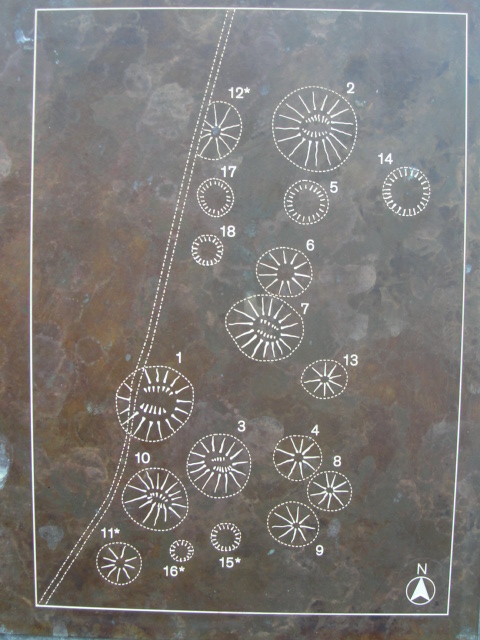
It did give us a great overview of the mounds, with a plate to explain which was which and which had been dug out, robbed, undisturbed. Getting up there early meant we were able to look in peace before the crowds arrived.
Simplified map of the mounds.
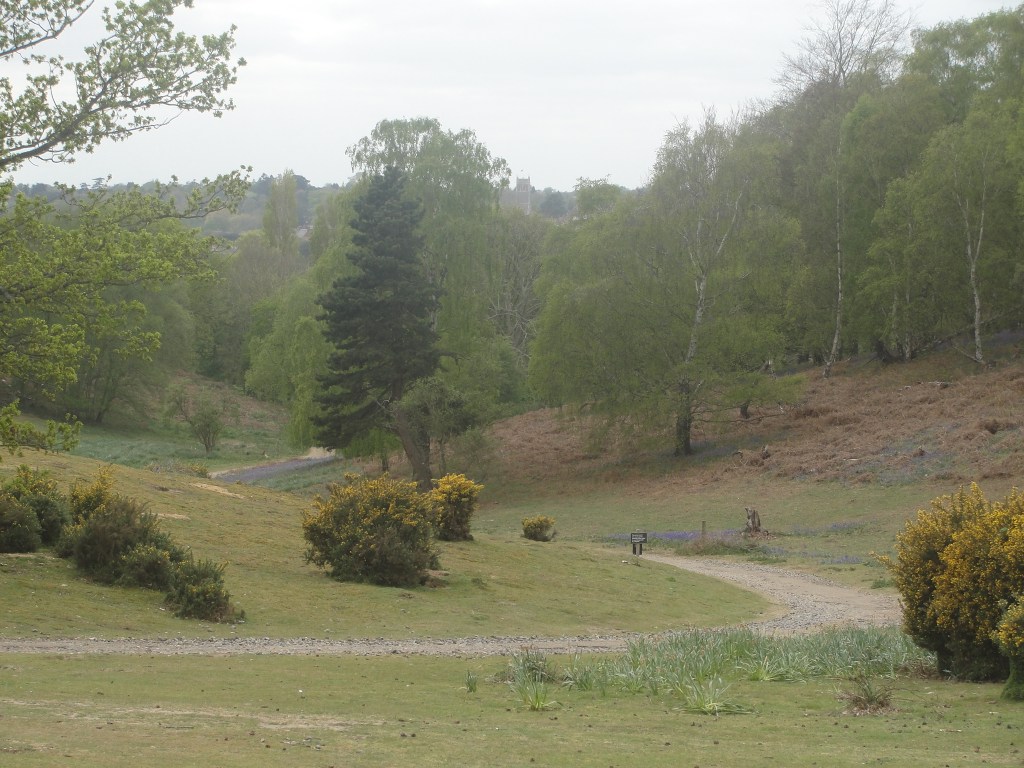
Back down. Around the path, away from the approaching crowds and down towards the river Deben. We moored our yacht on the Deben for years, and sailed up as far as Woodbridge (close to Sutton Hoo). There’s a walk that takes you down and along a quiet path and back up a long slope to the cafe. By the time we got there, we really needed a drink and a sit down.
The path up from the river. A long slow slope up to a very welcome pot of tea.
From here, we went back to the gate to the viewing tower where we were met by the guide to the tour of the mounds. Visitors are not allowed to walk across the field of mounds without supervision, and that’s a good thing, considering the thousands of visitors to the site every month. The ground would be worn to bare earth in a very short time.
The tour guide was one of the women from the Sutton Hoo Society, a group of – I think you’d call them re-enactors, though they don’t do battlefields. They weave their own cloth, make their own clothing in the pattern and style of the Saxon age and embroider the edges of their sleeves and hems. Beautifully. She was stately and graceful, reminding me of a senior nun or a lady of a great estate. She took us around the site, explaining the story of the family, the dig and the finds. The group of twenty Dutch teachers who had joined the tour were as fascinated as the rest of us.
She explained that the scattered finds over the years hadn’t gathered enough enthusiasm for a concerted dig until Edith Pretty threw a dinner party, and included a medium among the guests. Mrs Pretty told the guests that she thought the bumps in the field might be burial mounds, and the medium claimed to see a procession of ghostly figures walking slowly from the mounds towards the house. Drama, maybe, but Mrs Pretty took action on this and her own conviction that there was something to be found out there and hired Basil Brown to dig. And the rest is Netflix. Sorry, History.
When the guide reached the mound where the ship was found, she described the discovery of the imprints of ship’s nails before war was declared and the dig closed, resuming after the war finished. Nothing valuable was found – but then, King Henry VIII was known to have sold off the rights to dig out the treasures in sites such as Sutton Hoo, provided he got his commission. There’s no record of exactly what was robbed out.
The tour went to the site where a young warrior was buried with his horse nearby, and I was reminded of the site I’d heard of where a deceased Roman general was placed in his chariot, the horse harnessed to the chariot, driven into the burial pit and then shot and buried in its traces as if the Roman had been frozen at the height of battle.
Finally, the site where a woman of high status lay buried, her name (like the king’s) lost to history. We stayed to see the site where the bodies of criminals had been found, strangled and dumped, and then wandered off to the obligatory visit to the gift shop and the museum.
A fascinating place. I should not have waited so long to visit.
The main point of setting up this blog was to advertise the writing I was doing (and to prove to a writing friend of mine that I was listening to what she had said to me…). Sorry to report that the main part of what I’ve been doing over the last few months relates to going out, having fun and getting the garden in good order. Though to be fair – while I was working, I wasn’t able to take more than a few days’ leave between October and July of the following year without proving that the whole section wouldn’t collapse in my absence. Fridays were all but impossible as days off. So taking a long weekend off without a lot of forward planning and negotiating is still a treat.
When I decided to pack in the paid work and wind down to paid retirement, I promised myself a few treats. Getting on with my writing was the topmost of those. Alongside getting on with the patchwork, making a decent go of growing my own vegetables and not wearing shoes in summer. See my feet. Hobbits have more hair but less hard skin than I have right now. Barefoot everywhere – warm soil under the feet is one of life’s free pleasures.
And the writing? I get on with it, a bit. Not enough. I submitted a long short story to the Storgy Shallow Creek competition, but haven’t heard anything yet. I wasn’t shortlisted in the Globe Soup 7 Day competition in which I submitted a historical short about a man who sold his wife’s body to a medical student in exchange for treatment while she lived (the research for that one was pretty interesting). I was shortlisted for the Jane Austen Literacy Foundation’s short story competition, with a piece about how Mrs Bennet’s character was formed – that came from one person’s remark that everyone laughs at the silly Mrs Bennet and admires the sarcastic Mr Bennet, but it’s a fact that the Bennet girls had been left to an uncertain fate by Mr Bennet’s lack of foresight, and only Mrs Bennet’s determination to see her girls married well would secure their future. I’m still waiting for the verdict on Globe Soup’s 7 Day competition about an unlikely friendship – I chose science fiction, as it’s the main genre I’ve read since I was eight years old, and then had no damn idea what to write about for four of the seven days allowed.
Next up – a friend has pointed out two competitions for short stories, one in science fiction and one for a dark story. That’s you in a nutshell, she said – and she’s right, but the stories themselves are just no getting written. I’ve spent today rescuing my poor kale from some tiny black beetles that have eaten most of the green from their leaves, and not spent more than ten minutes thinking about what I could write. One week to the deadline for both, so tick-tock.
What I am really looking forward to is the return of The Literal Challenge’s Scriptly in October. That zing of getting a peculiar challenge and writing a screenplay for it within 24 hours is addictive – and relevant to writing short stories. Anyone who gets immersed in a book is running the scenes in their mind – it’s a film running in their brain. Being made to think of a story as if it were a film is good practice for writing a story that plays out in a highly visual way.
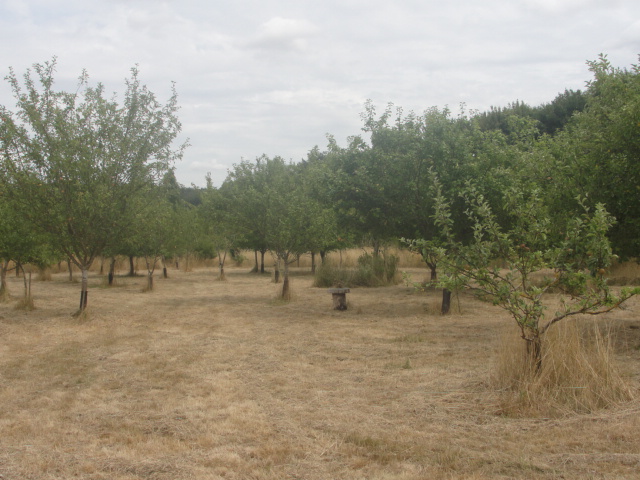
This is the orchard in August 2022. Dry, dry, dry.
Earlier this year, I reported on the odd project I got involved in. I’m a member of our local woodland trust, helping out as a volunteer. As part of that work, I volunteered to chart the orchard that had been planted in 2011 as a present for the founder’s 90th birthday. I thought it would be a simple job. Hah.
When I started pacing out the orchard, I admit I was annoyed at myself. I kept thinking of Terry Pratchett’s famous stone circle that had only one stone, but nobody had been able to count it. Every time I went down to the orchard in the first three or four days I came back with a different number of trees.
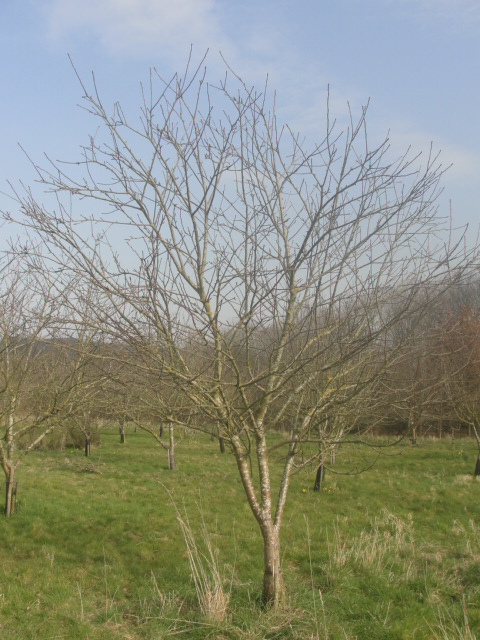
When I understood that the basic pattern was ten rows of trees in a square pattern, I counted 64 trees – though one that got included in that count turned out to be a blackthorn tree that was probably coincidentally in line with one of the rows, and another has proved to be completely dead. Back in March, there were no leaves and little blossom to serve as a guide to what each tree might be.
Tree A5 in March.
Now, though, the trees have come into their own and the guessing game can start.
Tree A5 is definitely an apple tree!
So – sixty-two living fruit trees and two bushes. Fourteen had legible labels; I found three more labels and deciphered two of those. About two-thirds of the trees have fruit on this year, so I can say that 22 are apple trees, five are pear trees, ten are plum, gage or damson trees, three are definitely cherry and two are quince. I can make a reasonable guess at eleven more trees, and have not enough idea of what the other nine might be to suggest it. With 23 varieties either known or probable, I’m making progress.
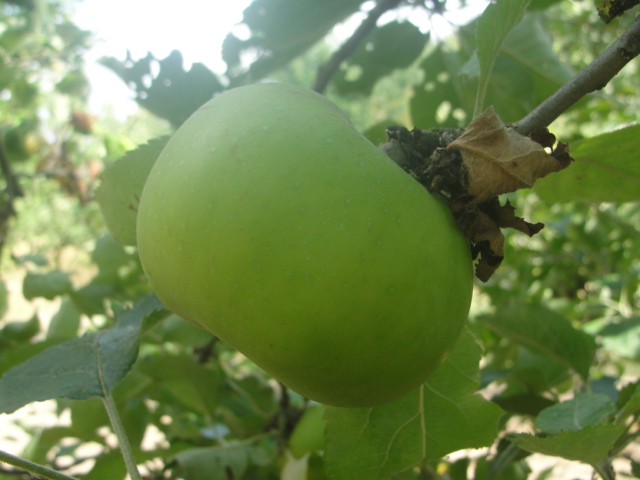
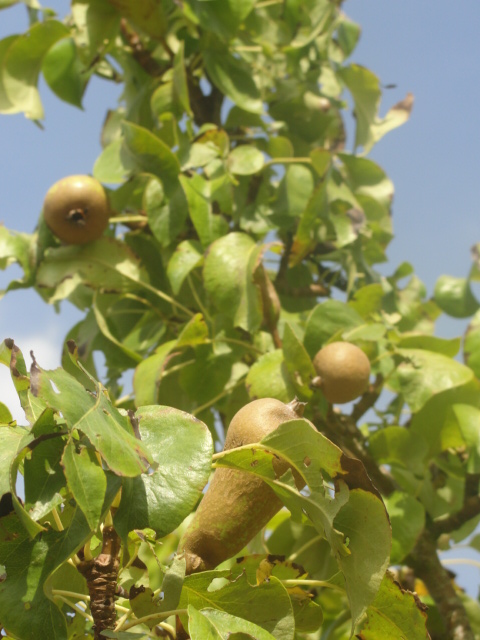
Be fair – huge, green, sour? Has to be a Bramley.
I’ve had help so far from the Orchards East project, which has found in their records that they sold eight fruit trees to the founder of the project in late 2010 – two St Edmund’s Russet apples and six varied plum trees, none of which featured in the fourteen legible labels. Having seen the yellow-brown russetting on the apples in two of the trees, it was a fair bet that both might be the St Edmunds, and finding a label saying “St Edmunds Russet” buried at the base of one of those just confirmed it. The almost purple blush on another apple suggests a Howgate Wonder, and the sweet red gooseberries are most likely to be Hinnonmaki Reds.
We have another visit planned in September from the orchard expert who set us running on identifying the trees, and I hope she’ll take the chance to look at the unidentified apples and suggest a variety. What I will do is to take sample fruit and leaves to the Orchard East people in Norfolk later this year and ask them to identify the mystery ones.
However it pans out – going from a group of fruit trees with no chart, no labels to most of them and no memory of what they were to sixty two trees and two bushes charted out and 44 of those identified is not bad going. Anybody could have done it, Nobody did it – I’m proud to be the Somebody who got stuck in. Watch this space.
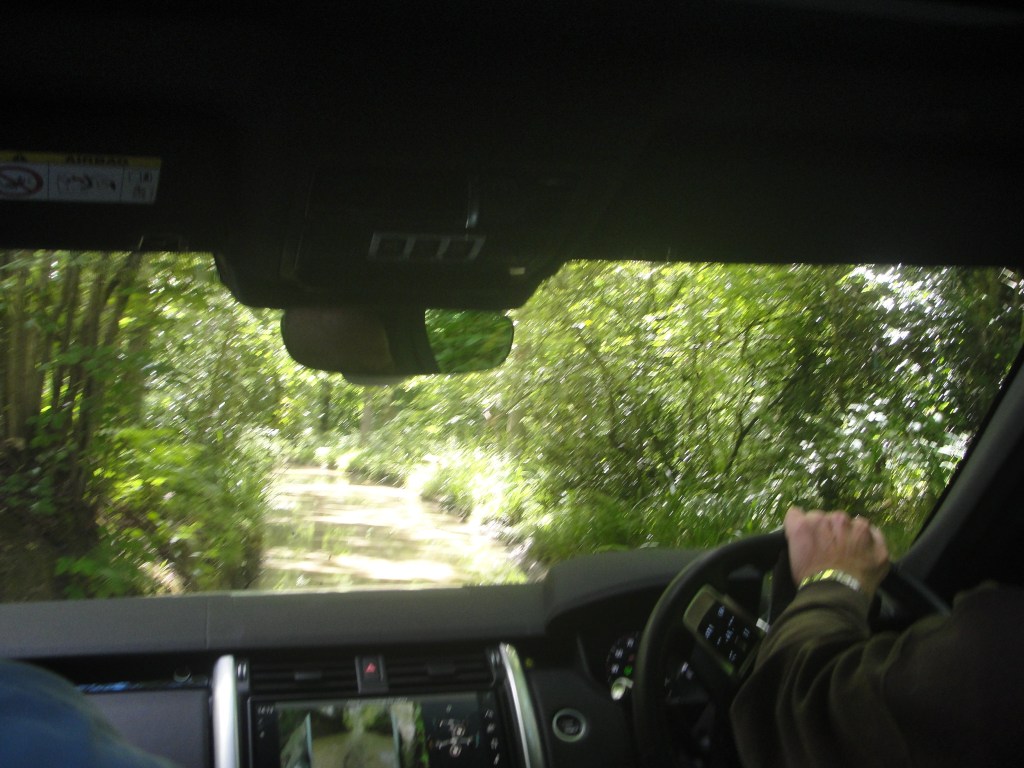
Well, the western half of England had enough rain to form puddles this summer…
Yes, that’s water you’re seeing through that windscreen. Himself was lucky enough to get a Landrover experience voucher for his birthday, and what you’re seeing in the photo is what he saw while driving. We booked it for early July, left the already parched grounds of our garden behind and went out to stay with friends in Gloucestershire for a long weekend.
The experience was based at Eastnor Castle. No, we didn’t get to see the castle – we were directed to a glass-walled showroom in the grounds, and taken out from there to where the Landrovers were parked. From there, he was settled into the driving seat of a new Discovery and away we went.
Just making this clear – I was in the back seat throughout. The driving experience was bought for him, with a follow-on session for the friend we were staying with. You get a different view from the back seat – the brake foot hasn’t got a pedal to land on, and you get the chance to take photos.
It was a good long ramble through the woods behind Eastnor Castle. We’ve both ridden off-road trials and trails on motorcycles many years ago, and we’re used to the principle of lining up on a muddy steep hill and giving the throttle some exercise to keep up the traction, standing up on the footpegs and letting the bike catch grip under you. If you’re sitting down, you can’t help but try to nudge the bike onto the line – if you’re standing up, the bike (usually) corrects itself and stays upright. That’s the theory. He was always better at it than I was.
Modern off-road super-cars are different. He was going to punch through the mud at about 15 miles an hour, until the instructor stopped him. Slow and gentle. Press the button on the dash for mud and snow… or press the button for downhill… you’ll excuse me, but press the right button doesn’t equal real off-road driving to me.
All the same, it was fun, sploshing through puddles up to a foot deep through a shaded forest. The instructor was great, always calm, and he encouraged both drivers to try The Peanut. This is a small concrete patch (accessed via a set of stairs) with a concrete hill in the centre and steep banking around it. Imagine sitting in a car with the right front and rear wheels jacked up by three or four feet, and you’ll get the idea of how steeply we were banked.
That was Friday’s treat. Saturday’s treat was a couple of seats in the audience at Ledbury’s Poetry Festival, listening to Brian Bilston read his poetry. If you don’t know Brian Bilston’s work, try it. He’s brilliant at the deadpan play on words and meanings with an occasional vicious kick at political stupidity. It was a good long hour of daft and smart poetry, and we went out cheered up.
Sometimes, a weekend away is as good as an expensive week’s holiday.
The ground under those trees is the colour of every lawn in East Anglia right now.
This dry spell has been going on for months, and now we are all used to it. It’s been over three months since we saw any reasonable amount of rain – even for a dry region like ours, this is definitely out of the ordinary. Local weather forecasters have said that we have had 1% of the expected rainfall for the area in the last six months, and are apologising for the lack of rain in the forecasts in the same way they were apologising for the constant rain we had over last winter.
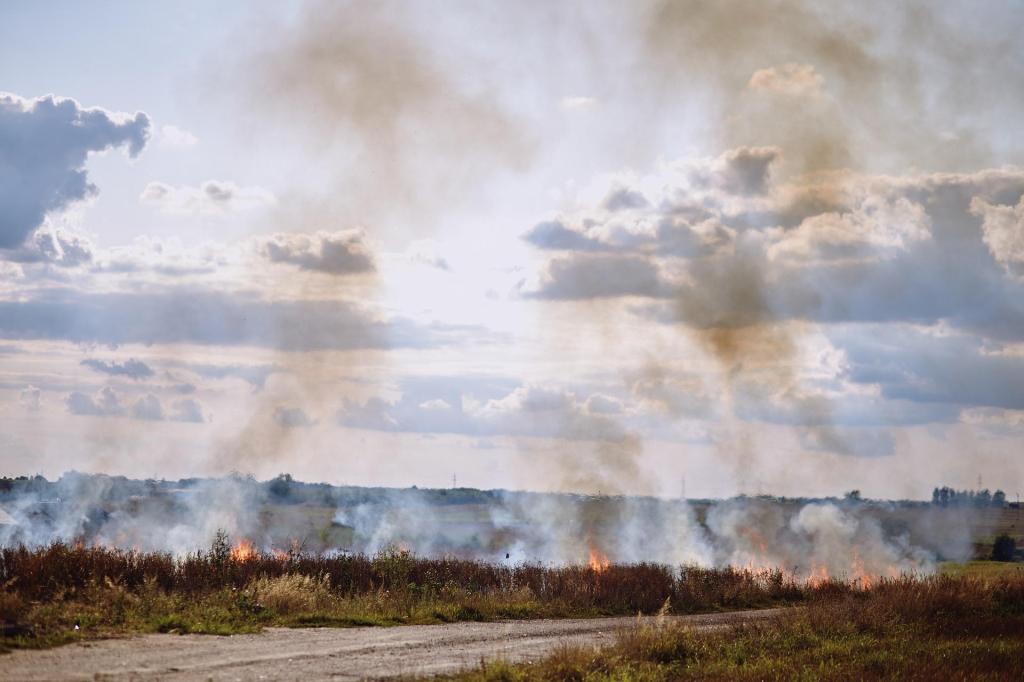
Photo by Bartek Zakzrewski, Pixabay – similar to photos of the fields that have burned locally.
One consequence is that the local fields are susceptible to dropped cigarettes, sunlight focussed through glass bottles and arson. One spark, one idiot with a disposable barbecue set, and the straw goes up. The breeze is enough to take out the rest of the grass, the dried out wheat crop, the haybales stacked in a corner, the combiner parked there – and the houses nearby. Most of a small village in Norfolk was destroyed by a fire that spread from the nearby fields within minutes, and three fields local to us have burned for a couple of hours, leaping the road and carrying on in the next field over.
Some of our trees have shed their leaves as if it were October. I think some of the rowans and the cherry tree we planted to mark our thirtieth anniversary have died, and a whole row of beech in a neighbour’s garden has gone brown. Beech are shallow rooted trees, so no wonder – over the last eight years we have been planting hornbeam to replace dead beech hedging, as it is more drought tolerant, but ‘tolerant’ is just delaying the day when the lack of water proves too much to survive.
We’ve all been asked to use less water, though our water authority has held back on imposing a hosepipe ban. ‘Using less water’ used to mean taking a shower instead of a bath, but now that most people only use the bath-tub for scrubbing down the family dog after a muddy winter walk, the advice has changed to ‘limit the time you spend in the shower’. Don’t use a hose to water the garden, fill paddling pools or ponds, wash the car. Fill dishwashers and washing machines to the top before setting them running.
I can see the time coming when we’ll be asked to stop using appliances like dishwashers and washing machines at all during times of drought, unless we’re caring for people who are ill, elderly or very young. It’s been suggested that eastern England might become virtually uninhabitable through almost permanent drought, though you can remind me of that when the rain starts this autumn and makes the ground squelch underfoot by Christmas.
Cucumber vines in the polytunnel five weeks ago
We’re still watering the polytunnel and the veg plot, but less than we were in spring. Enough has come out of the veg patch to make a ten minute plod around with watering cans enough to keep the plants thriving. Our shopping bill has gone up enough to make this food a real moneysaver, worth the water. Not successful across all plants – no surviving carrots or parsnips this year, though kale, courgettes and potatoes are doing better than last year and the bean plants are waiting their turn. Plenty of cucumbers, and the peppers and aubergines are threatening to give us a decent crop. If I have to give up a couple of showers a week to spare a can of water for these plants, I’ll do it. Thank Evans for Zoom meetings – on Zoom, no-one can smell your armpits, to paraphrase the Alien tagline.
We’re not filling the pond – most of the surface is covered by lily leaves and crispodea fronds, and that will hopefully slow the rate of evaporation. The birds are hopping straight into the shallowest part, rather than perching on the rocks, and one bird took a long splashy bath while balanced on a lily pad. It’s about a foot shallower than at the height of the rainy season. Tough to see it, but the fish are coping and it has another foot to go before they may be in any danger. I keep telling myself it takes two good thunderstorms to add a foot of water to the pond, but it is still hard to see the pond in this state. I’m moving the planted tubs down a level to give them the depth they need to survive, and hoping it will rain soon. If it doesn’t, the fish may find themselves rescued into the bath-tub. And then we really won’t be tempted to swap the shower for the bath ourselves.
No, I haven’t posted. Yes, my last posts were gloomy, featuring a dead cat and a stunned bluetit. No, that’s not really me. Let me catch up on what I’ve been doing since my last cheerful post.
The first genuine holiday I took this year was to Combe Martin on the edges of Exmoor. I’d booked it as a treat for us in the winter, when we were still almost thinking we might be back into lockdown for another long set of months. The cabin was booked through Canopy and Stars, a company that specialises in accommodation that is comfortable but not luxurious. This cabin was… made of lumber and recycled items. Which sounds like sleeping under a pallet, but it really, really isn’t.
The view from the deck of Skylark
Let me admit upfront; the original idea was stargazing. Exmoor is a dark sky reserve, and with all the building going on around our house, the sky is getting more and more polluted. The thought of a really dark sky… Try this one for yourself. Go outside any time after mid-September and find the constellation Orion (start by looking east). The distinctive three-star line of his belt and the smaller three-star line of his sword is easy to spot. Follow the line traced by that belt up and away from the east, until you find a tiny group of brilliant blue-white stars. That’s the Pleiades, the Seven Sisters, a group of relatively young stars still full of energy. Light from those stars has taken around 425 years to arrive on Earth’s surface. Queen Elizabeth the First was still alive when the light you see now was emitted from those stars. That’s truly alien.
If you can see the Pleiades as a set of distinct stars, congratulations, you have a pretty good dark sky. If you can see a murky bright glob, you’re probably near a city. When we first moved here, it was worth the mortgage to see all ten major Pleiades without binoculars. Now? It’s starting to turn into a bright blue white mass, most nights. If the Ministry of Justice go ahead with their threat to build Europe’s largest prison in a rural beauty spot ten miles away, the 24 hour lighting of that monster will turn our view of the Pleiades back into a murky blue blob.
So, Exmoor. Dark skies. Cabin set in a sheep field. Telescope weighing enough to tear the arms of two adults out of their sockets. English summer. What would you think might go wrong? We got the only full week of cloud and rain in June. I’m laughing more than grousing. Lugging the telescope around was good exercise, the cabin had the most comfortable bed I have ever slept in, no kidding, and the rain was warm. I could easily live in a cabin that size (maybe half again as big as my living room) if it had a bed and a silence and a view of Jacob sheep being total hooligans in the field below from eight till half nine every night.
We finished off the four night stay with a visit to friends of ours, on the run from the crowding and general unwillingness of officialdom to fight back against the nastier side of too many people per square metre, now living in Devon. The peace and quiet of their view reminded us of the quiet we enjoyed twenty years ago, when we first moved in and looked up at the Pleiades and said; “Oh my word.”
Orion, by sl1990 of Pixabay. Follow those three stars in the centre up…
Ruffled feathers – this one courtesy of Pixabay, 9436196, as I was too busy helping to take photos
I put our cats onto the “What The Cat Dragged In” project in March 2021. The project was set up by a PhD candidate for her dissertation, and it aimed to measure the prey taken by domestic cats. Our two were not hunters, and I hoped their records would help to clear the name of Felis silvestris catus as a species. The Telegraph ran a righteous story just a week ago about how many millions of birds and rodents ‘might be’ slaughtered by pet cats, conveniently forgetting that snakes, hawks, dogs and people also kill birds and rodents in their millions.
As soon as I signed her up, Genie began to fetch us presents. She didn’t have our old ginger cat’s three rabbits a day habit, but two or three times a month (including one memorable two night spree in her cattery pen) she fetched in mice, shrews, voles – and birds. I still laugh at the memory of the two kittens fleeing up the stairs, chased by an irate blackbird chick they’d dragged in through the catflap. The chick swore at me while I tried to shoo it back outside to its waiting parents, but it made it safely – and as I didn’t find any gory remains later, I think it may have survived.
Genie is gone, now, buried next to her brother. I have tried to make up for her reign of terror – we feed the birds and have an area in our pond where they can have a splash-bath and a drink. We have two magpies that visit often, one with feathers sticking up in all directions (Scruffy Herbert) and another that is sleek and precise and tolerant of Scruffy, so I suspect they are related. And a blackbird that is willing to let us get within a couple of metres of it. Possibly the defiant chick that got away, all grown up and scared of nobody.
I got a chance to do some more birdy good today. I was lying on the bed, lost in a good book, when I saw a swoop of movement outside and something hit the window hard. When I went to investigate, there was a bluetit lying on the tiles of the sloping roof below our window. Upside down, shuddering, twisted – one leg trapped under its body and tail feathers stuck to the wet tiles.
It was just out of reach from the window, and out of reach from the ground below. I got a feather duster – I know, tactless, but the only thing long enough to reach – and gently turned it right side up. It tipped upright, shook itself and kept shaking. Its legs were splayed out a little, but it seemed to be able to move its head and sit upright, so I could hope it hadn’t broken its neck.
I left it a small heap of sunflower seeds and watched it from a distance. It sat there dazed for about fifteen minutes. It did occur to me that I should put it in a box to give it some protection from wild predators (our elderly cats slept through the entire incident, disinclined to move at more than waddle-speed for their food, but the local hawks would be less gentle). As soon as I climbed up the stepladder and reached slowly for the blue-tit, it startled; it flew away from my hand and hopped into the corner of the upper walls, sheltered from the rain and wind.
I left it there. I did keep an eye on it, always from a distance, and it pulled its wits together gradually. I could see that it was looking less dazed, more alert; it had stopped shivering and was turning its head, looking around with some purpose. About thirty minutes after the original head-butt, the bird had gone. I didn’t see it fly off, and I can only tell myself the comforting story that it flew away with a great story for its fledgings, and that it survives everything nature can throw at it from now on. Including windows.
Pixabay, Gerhard_C… this is what our Head-Butt Hero looked like after fifteen minutes









 Julia Chalkley